
Russian Drone Strike Hits Civilian Infrastructure in Ukraine's Odesa Region
A confirmed drone strike on a supermarket in Ukraine's Odesa region underscores escalating risks to civilian infrastructure and Black Sea commercial transit corridors.
Geopolitical & Core Developments
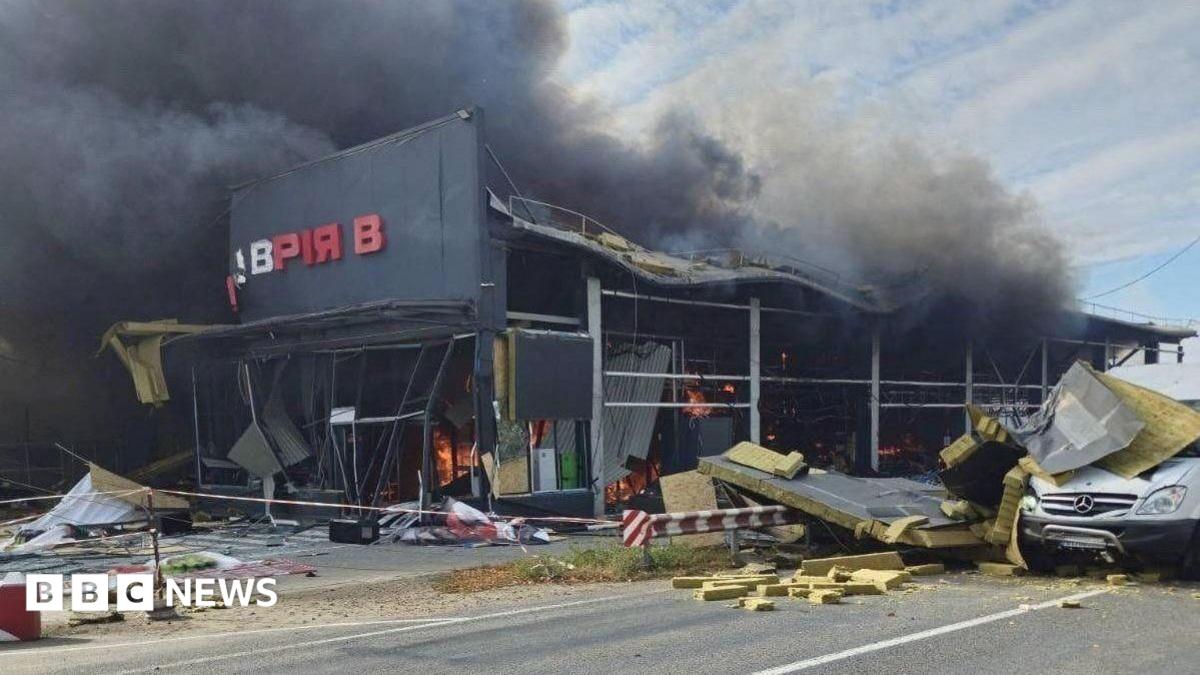
A verified aerial attack struck civilian commercial infrastructure in the town of Mayaky, located within Ukraine's southwestern Odesa region. Closed-circuit television footage authenticated by international monitors documented the direct impact of an unmanned aerial vehicle on a local supermarket, triggering significant structural damage and fires. The incident forms part of an intensified campaign of long-range aerial bombardments directed against logistics nodes and urban centers across southern Ukraine.
The Odesa administrative district serves as the linchpin for Ukraine's sovereign maritime access, bordering Moldova and anchoring the country's residual commercial shipping routes. Strategic analysis indicates that persistent strikes on secondary settlements such as Mayaky, situated proximate to key transit arteries and border crossings, aim to destabilize regional logistics, exhaust Ukrainian air defense systems, and undermine economic resilience outside primary metropolitan centers. Kyiv continues to solicit advanced counter-unmanned aerial system capabilities from Western partners as Russian forces maintain consistent saturation tactics deploying Shahed-type loitering munitions across critical southern sectors.
[Global Trade](/news/us-midterm-voter-discontent-signals-global-trade-shifts) & Economic Ripples
While this targeted strike hit retail commercial assets, the operational proximity to the broader Odesa port complex carries immediate repercussions for global commodity markets. Odesa remains the operational core of Ukraine's unilateral Black Sea humanitarian export corridor, which sustains critical grain, oilseed, and metallurgical shipments to developing economies across North Africa, the Middle East, and Asia.
Repeated aerial incursions across the Odesa perimeter directly influence commercial marine underwriting. Underwriters operating within Lloyd's of London and continental European syndicates continuously reassess war-risk insurance premiums for vessels entering Black Sea territorial waters. Any escalation in collateral operational risks elevates total freight rates, constraining profit margins for international grain houses and agricultural traders. Disruptions along overland corridors feeding into the Danube River ports of Reni and Izmail further threaten secondary supply chains that serve as backstops when deep-sea anchorages experience localized alerts.
Related Intelligence: US Midterm Voter Discontent Signals Major Shifts for Global Trade Policy
International Reactions & Diplomatic Stances
Multilateral bodies and international diplomatic delegations have repeatedly condemned the sustained targeting of non-military facilities across Ukrainian territory. Representatives at the United Nations have reiterated that systematic strikes on civilian retail locations and urban centers violate international humanitarian law, warning of the compounded socio-economic strain inflicted upon non-combatant populations.
Ukrainian officials utilized the incident to renew urgent appeals to European Union and NATO members for expanded air defense allocations, emphasizing that layered interception networks are required to protect not only heavy industrial assets but basic municipal life. Western defense ministries confirmed ongoing discussions regarding expedited deliveries of specialized electronic warfare systems, interceptor missiles, and radar platforms capable of tracking low-altitude, distributed drone swarms.
Strategic Outlook & Future Scenarios
The trajectory of military operations points toward an attritional aerial strategy targeting southern Ukraine's logistics depth throughout the coming quarter. Tactical reliance on relatively low-cost loitering munitions permits long-term campaign sustainability, designed to deplete finite stockpiles of surface-to-air defense missiles while keeping civilian populations under perpetual psychological and economic pressure.
Looking forward, diplomatic focus will center on multilateral security compacts and bilateral defense agreements aimed at standardizing anti-drone defenses. If aerial incursions continue to encroach upon logistical corridors near international borders, regional actors may face pressure to enhance joint airspace surveillance along the western Black Sea coastline. For commodity markets, the stability of Ukraine's export mechanism remains contingent on localized air defense efficacy, with price volatility expected to track the intensity of strikes across the Odesa maritime basin.
Join Our Official WhatsApp Channel
Receive live commodity alerts, policy changes, and commercial intelligence directly on WhatsApp.