
Peshawar Entry Marks Day Five of PTI March Under Afridi
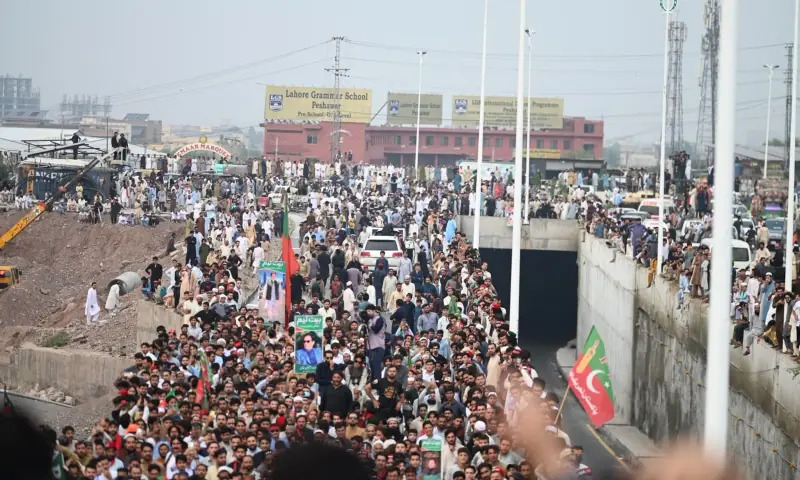
Khyber Pakhtunkhwa Chief Minister Sohail Afridi led a PTI convoy into Peshawar on Thursday evening as the party's high-stakes march entered its fifth day amid tentative final destinations.
The Core Development
The political landscape of Pakistan witnessed a significant escalation on Thursday evening as a high-profile Pakistan Tehreek-e-Insaf (PTI) convoy, spearheaded by Khyber Pakhtunkhwa Chief Minister Sohail Afridi, officially entered Peshawar. Marking the fifth consecutive day of sustained mobilization, the procession has drawn hundreds of supporters across strategic regional arteries. The march, initiated primarily to press for the immediate release of incarcerated PTI founder and former prime minister Imran Khan, has been characterized by frequent strategic pivots and fluid logistical planning. According to official communications released via digital platforms by the party at approximately 6:00 pm, the convoy successfully negotiated the Hayatabad Toll Plaza, where dense crowds gathered to welcome the provincial chief executive. Despite initial declarations pointing toward a definitive push onto Islamabad, the overarching itinerary has experienced multiple revisions. Analysts note that the ultimate terminus of the march remains ambiguous, with Chief Minister Afridi yet to formally unveil the operational roadmap governing the trek beyond October 8. This tactical ambiguity has kept security apparatuses and administrative machinery on high alert across the province.
Commercial & Economic Implications
Extended political agitations and large-scale street mobilizations of this magnitude invariably exert profound pressure on the commercial vitality and economic equilibrium of Pakistan, particularly within urban centers like Peshawar. Transport networks, wholesale distribution channels, and retail supply chains face immediate disruptions as arterial routes experience intermittent blockades and heightened security vetting. For local merchants and small-to-medium enterprise owners operating in key commercial hubs, the uncertainty translates into depressed consumer footfall, delayed freight transit times, and constrained inventory turnover. Furthermore, sustained political friction risks stoking inflationary expectations by impeding the frictionless movement of essential commodities from primary production zones to retail markets. Financial markets monitor such developments with acute caution, as prolonged political instability dampens investor confidence, complicates corporate planning, and exerts downward pressure on broader macroeconomic stability indicators at a time when the national economy is striving for delicate structural recovery.
Related Intelligence: Istanbul Building Collapse Exposes Urban Infrastructure and Economic Vulnerabilities
Stakeholder Perspectives & Market Reactions
Commercial bodies, trade associations, and regional business councils have expressed growing apprehension regarding the potential economic toll of protracted street agitation. Representatives from major chamber of commerce entities in Khyber Pakhtunkhwa have privately and publicly emphasized the imperative of maintaining uninterrupted trade corridors to safeguard industrial output and retail commerce. Conversely, PTI leadership maintains that the mobilization represents a legitimate democratic assertion of public will. Official statements from party spokespersons underscore that the citizenry has decisively broken through psychological barriers of fear, rallying strongly behind the leadership's core demands. Legal experts observing the unfolding scenario highlight the complex interplay between constitutional rights of assembly and public order maintenance, noting that administrative authorities are caught between facilitating political expression and preserving uninterrupted economic activity. Public response remains deeply polarized, reflecting broader societal divisions over governance, judicial independence, and political legitimacy.
Forward Outlook & Key Watchpoints
As the march navigates its critical juncture past October 8, observers and policymakers are closely monitoring several decisive indicators. The primary variable remains the formal announcement of the itinerary and ultimate destination by Chief Minister Sohail Afridi and the central PTI leadership. Should the march resume its trajectory toward the federal capital, inter-provincial friction and security mobilizations are expected to intensify markedly, with direct repercussions for federal-provincial relations. Conversely, any recalibration toward localized political engagement could de-escalate immediate logistical strains on national highways. Key watchpoints for the business community and financial analysts include potential government containment strategies, traffic management notifications, legislative responses, and any shifts in the stance of key institutional stakeholders. The coming days will test the resilience of regional supply chains and the capacity of administrative machinery to balance security imperatives with commercial continuity.
Join Our Official WhatsApp Channel
Receive live commodity alerts, policy changes, and commercial intelligence directly on WhatsApp.