
French Student Protests Expose Sovereign Debt Pressures and Public Sector Strain
French high-school students marched nationwide for a third week, protesting dilapidated schools and teacher shortages as the cash-strapped government balances public service demands against strict fiscal deficit reduction targets.
The Core Development
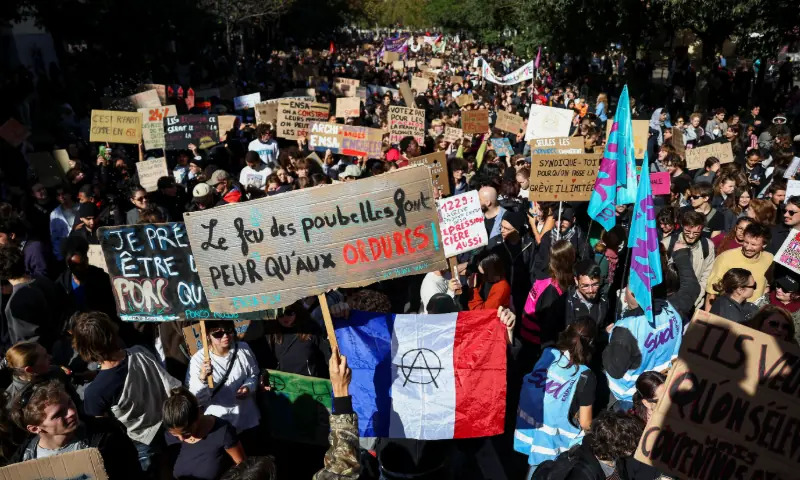
French high school students intensified nationwide demonstrations on Thursday, blockading academic institutions and staging large-scale marches across major urban centers, including Marseille and Paris. Now entering its third consecutive week, the protest movement has crystallized mounting public frustration over chronic systemic neglect within France's public education apparatus. Students and teachers are demanding immediate administrative action to rectify severe teacher shortages and alarming structural decay across numerous secondary school buildings.
Despite ongoing demonstrations, the French government has offered only broad assurances that grievances will be addressed, stopping short of delivering concrete fiscal commitments or specific timelines. This ambiguity has further inflamed tensions. High-school teacher Diane Di Sciullo, participating in a major demonstration in Marseille, highlighted the acute severity of classroom overcrowding, noting that her current roster stands at 37 students per room. The demonstrations reflect a broader systemic strain characterized by crumbling facilities, inadequate heating, and insufficient pedagogical resources, which educators argue directly undermines the constitutional right to equitable public education.
Commercial & Economic Implications
The unrest in France carries significant conceptual and practical implications for international trade partners, including emerging economies like Pakistan. At its core, the French standoff illustrates the classic macroeconomic dilemma between fiscal austerity and public investment. As a primary European Union economy, France is currently navigating intense scrutiny from bond markets and credit rating agencies to curb its expanding national debt and fiscal deficit.
For international observers and trading entities dealing with European markets, prolonged civil unrest and institutional paralysis can disrupt consumer confidence, retail trade velocity, and domestic commercial supply chains. Furthermore, the broader European struggle to balance sovereign debt obligations with essential public services sets a precedent for fiscal policymaking across OECD nations. When core economies face structural budgetary constraints, it often translates into shifting trade policies, altered foreign assistance frameworks, and fluctuating currency values that impact global commodity pricing and bilateral trade agreements with South Asian markets.
Related Intelligence: Bahrain Accelerates Push for Pakistan-GCC Free Trade Agreement
Stakeholder Perspectives & Market Reactions
Financial analysts and market participants are closely monitoring the political fallout in Paris, viewing the student-led mobilization as an early test of the government's resilience against labor and social unrest. Bond market investors have maintained pressure on French sovereign debt yields, demanding higher risk premiums amid uncertainty over whether Paris can successfully implement structural reforms without triggering widespread civil disruption.
Education sector unions and civil society organizations have expressed strong solidarity with the marching students, condemning what they describe as decades of systemic underfunding of public goods. Labor leaders argue that prioritizing fiscal deficit targets over human capital development is a shortsighted strategy that degrades long-term economic competitiveness. Conversely, fiscal conservatives and business associations emphasize the absolute necessity of fiscal discipline, warning that unchecked public spending would exacerbate inflation, elevate borrowing costs, and undermine macroeconomic stability across the eurozone.
Forward Outlook & Key Watchpoints
As the protest movement enters a critical phase, several key watchpoints will dictate the trajectory of the crisis. Foremost among these is the upcoming legislative debate regarding the national budget, where opposition parties are expected to challenge the administration's spending allocations. Markets will scrutinize whether the executive branch caves to public pressure by redirecting funds toward education, potentially risking a clash with European fiscal rules, or holds firm on austerity measures.
Additionally, the organizational capacity of student unions and allied teacher syndicates will be tested in the coming days. If demonstrations escalate into sustained general strikes affecting broader transportation and municipal services, the economic toll will rise exponentially. Policymakers in other debt-burdened economies will study the French response closely, as it offers a vital case study in managing domestic social unrest within the rigid confines of modern sovereign debt management.
Join Our Official WhatsApp Channel
Receive live commodity alerts, policy changes, and commercial intelligence directly on WhatsApp.