
Trump Honors Tech Titans with National Medals of Science Amid Shift
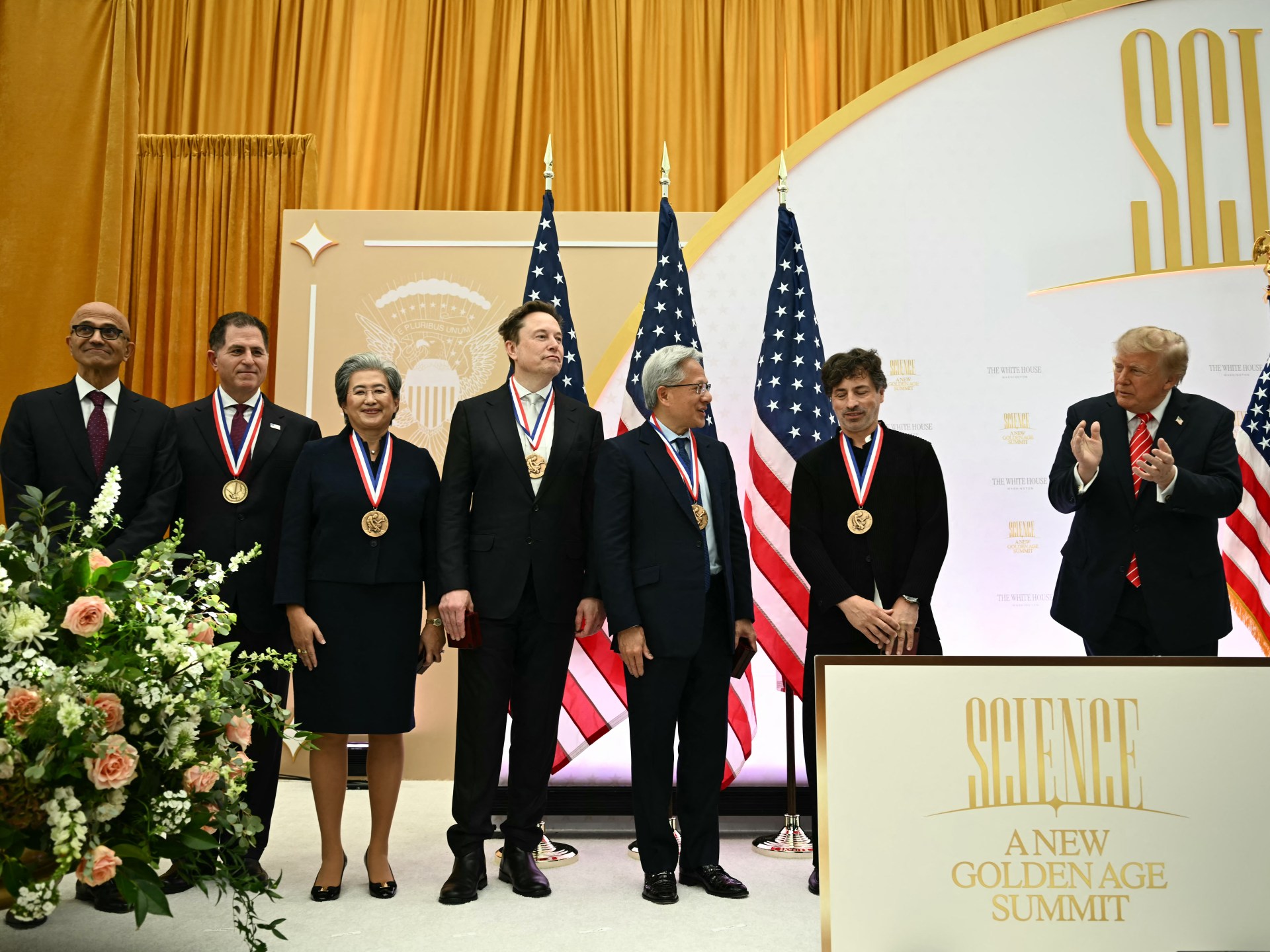
President Trump awards the National Medal of Science to Elon Musk and other tech leaders, marking a strategic alignment between state honors and private commercial innovation.
Geopolitical & Core Developments
In a departure from traditional academic and research-focused recognitions, the United States government has awarded the prestigious National Medal of Science to several prominent technology executives, most notably Tesla and SpaceX chief Elon Musk. Traditionally reserved for foundational academic researchers, theoretical physicists, and pioneering biologists whose decades-long laboratory work advanced human understanding, this year's conferment reflects an evolving perspective on statecraft and national capability. The decision underscores a broader geopolitical reality: the supremacy of a nation is increasingly defined not merely by traditional military might or academic publishing metrics, but by sovereign control over critical technologies, space infrastructure, artificial intelligence, and advanced manufacturing capabilities. State actors worldwide are recalibrating their diplomatic and industrial strategies to align more closely with private sector titans who wield transnational influence. This blending of state honors with corporate leadership highlights how modern superpower competition hinges on technological dominance, effectively rewriting the criteria for high-level national distinction.
[Global Trade](/news/wto-upgrades-global-trade-forecast-pakistan-gains-middle-east-disruptions) & Economic Ripples
While the award itself is a domestic United States decoration, its implications resonate deeply across global commodity markets, high-tech supply chains, and international trade corridors. Technology conglomerates led by figures like Musk sit at the epicenter of critical mineral consumption, including lithium, cobalt, rare earth elements, and advanced semiconductors. As governments explicitly tie national prestige to these commercial entities, market participants anticipate shifts in industrial policy, subsidies, and regulatory oversight. International trade partners, particularly in the European Union and Asia, are closely monitoring these developments to gauge whether U.S. industrial policy will tilt further toward protectionism or aggressive public-private alignment. Such shifts inevitably impact global supply chain dynamics, influencing pricing mechanisms for strategic commodities and altering the competitive landscape for international firms vying for dominance in green energy, aerospace, and digital infrastructure.
Related Intelligence: WTO Upgrades Global Trade Forecast as Pakistan Gains from Middle East Disruptions
International Reactions & Diplomatic Stances
Global diplomatic circles and economic analysts have offered mixed reactions to the high-profile recognition of commercial executives over traditional academic laureates. Representatives from international scientific bodies and multilateral institutions have expressed nuanced concerns regarding the potential politicization of foundational science awards, arguing that such honors should remain anchored to peer-reviewed breakthroughs in pure research. Conversely, market strategists and geopolitical risk analysts view the move as a pragmatic acknowledgment of 21st-century realities, where capital allocation, satellite deployment, and technological scaling dictate global power balances. Foreign ministries in major competitor nations, including China and European capitals, are assessing how this consolidation of state and corporate influence will impact international technological cooperation, standard-setting bodies, and cross-border regulatory frameworks.
Strategic Outlook & Future Scenarios
Looking ahead, the convergence of state recognition and corporate leadership is expected to accelerate upcoming strategic dialogues on technology governance, national security, and critical supply chain resilience. As nations prepare for upcoming international summits focusing on artificial intelligence safety and space exploration, the influence of private actors in diplomatic negotiations will only intensify. Future scenarios suggest that governments may increasingly rely on corporate executives as informal emissaries in international trade and technology pacts. However, this dynamic also introduces heightened volatility, as the commercial interests of individual conglomerates may occasionally diverge from long-term multilateral diplomatic objectives. Navigating this complex interplay between sovereign authority and private enterprise will remain a defining challenge for global leaders and market analysts alike.
Join Our Official WhatsApp Channel
Receive live commodity alerts, policy changes, and commercial intelligence directly on WhatsApp.