
Pakistan and Maldives Ink 20 Accords to Deepen Bilateral Trade Ties
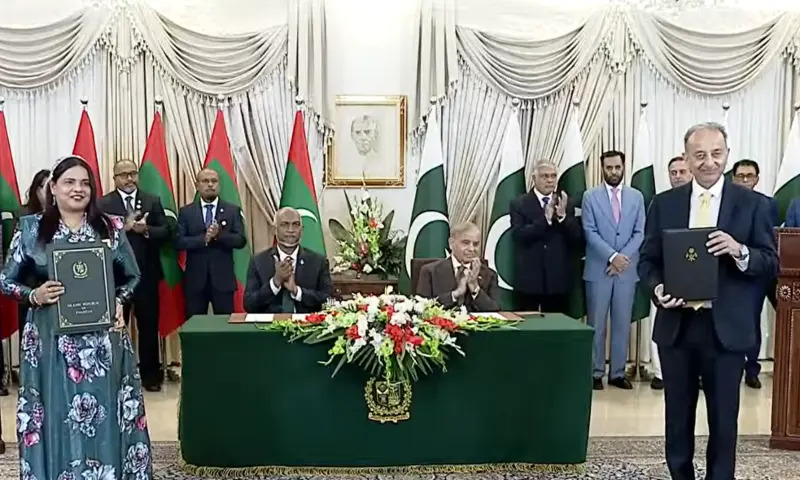
Pakistan and the Maldives signed 20 bilateral agreements during President Mohamed Muizzu's landmark visit to Islamabad, paving the way for expanded commercial ties and export diversification.
The Core Development
In a landmark diplomatic maneuver, Pakistan and the Maldives concluded the signing of 20 comprehensive Memorandums of Understanding (MoUs) in Islamabad on Wednesday, aimed at fundamentally expanding institutional, diplomatic, and commercial linkages between the two maritime nations. The high-level bilateral summit took place during the state visit of Maldivian President Dr. Mohamed Muizzu, who arrived in the federal capital on a three-day official tour following an invitation extended by Prime Minister Shehbaz Sharif.
This high-profile exchange represents the first visit by a Maldivian head of state to Pakistan in over 11 years, coinciding with the 60th anniversary of formal diplomatic relations established in 1966. Addressing a joint press stakeout, Prime Minister Shehbaz affirmed that the agreements underscore an enduring commitment to elevate engagement across diverse economic sectors, stating that both countries remain resolute in deepening structural ties. The signed accords span multiple domains, including commerce, bilateral investment, technical capacity building, agro-allied industries, tourism development, and public health cooperation.
Commercial & Economic Implications
From a macroeconomic perspective, the operationalization of these bilateral agreements presents significant opportunities for Pakistan's export-oriented manufacturing sectors. The Maldives remains heavily reliant on merchandise imports, particularly finished consumer items, staple foods, construction inputs, and healthcare products. For Pakistani wholesale distributors and manufacturers, formalizing market access opens lucrative distribution channels into the Maldivian retail and hospitality ecosystem.
Pakistani agro-exporters stand to gain immediate dividends by securing consistent market share for basmati rice, seasonal fruits, and value-added livestock goods. Concurrently, Pakistan's domestic pharmaceutical industry, which operates with competitive pricing structures and robust formulation capacity, can address structural import demands across Maldivian medical facilities. Establishing direct logistical connections and clearing non-tariff regulatory barriers will substantially reduce transit costs, providing relief to supply chain operators and mitigating pricing volatility for regional commodity trade.
Related Intelligence: King Charles Hails Oman Peace Diplomacy During London State Visit
Stakeholder Perspectives & Market Reactions
Financial analysts and commercial bodies in Pakistan have welcomed the development, noting that bilateral trade volumes have historically operated well below economic capacity. Leaders within the Federation of Pakistan Chambers of Commerce and Industry (FPCCI) emphasized that regular business-to-business interaction must follow these state-level frameworks to convert institutional memorandums into viable transactional agreements.
Market observers also highlighted that the diplomatic pivot under President Muizzu's administration provides an optimal window for Pakistani enterprises to establish direct agency contracts in Male. By bypassing third-party regional transshipment hubs, domestic exporters can lower freight markups, offering competitive quotes against regional counterparts. Industrialists, however, maintain that bureaucratic inertia and banking clearance procedures must be addressed quickly by the State Bank of Pakistan and Maldivian monetary regulators to sustain commercial continuity.
Forward Outlook & Key Watchpoints
The trajectory of this renewed partnership will hinge on how rapidly inter-ministerial committees convert the 20 MoUs into binding trade protocols. A pivotal watchpoint over the coming quarters will be the establishment of preferential tariff schedules and streamlined customs certifications, specifically targeting agricultural and medical shipments departing from Karachi and Port Qasim.
Furthermore, direct air and maritime shipping connectivity remains critical to overcoming traditional geographic hurdles. Bilateral technical groups are slated to convene over the next six months to review execution milestones. Should regulatory approvals and merchant banking integrations advance uninterrupted, Pakistan's trading community will benefit from direct access to a stable, dollar-denominated consumer market across the Indian Ocean.
Join Our Official WhatsApp Channel
Receive live commodity alerts, policy changes, and commercial intelligence directly on WhatsApp.