
Pakistan Accelerates Trilateral Defence Pact With Saudi Arabia and Turkiye
Prime Minister Shehbaz Sharif received a comprehensive operational briefing from Makkah Defence Alliance Secretary General Nauman Mahmood, advancing strategic and economic cooperation between Pakistan, Saudi Arabia, and Turkiye.
The Core Development
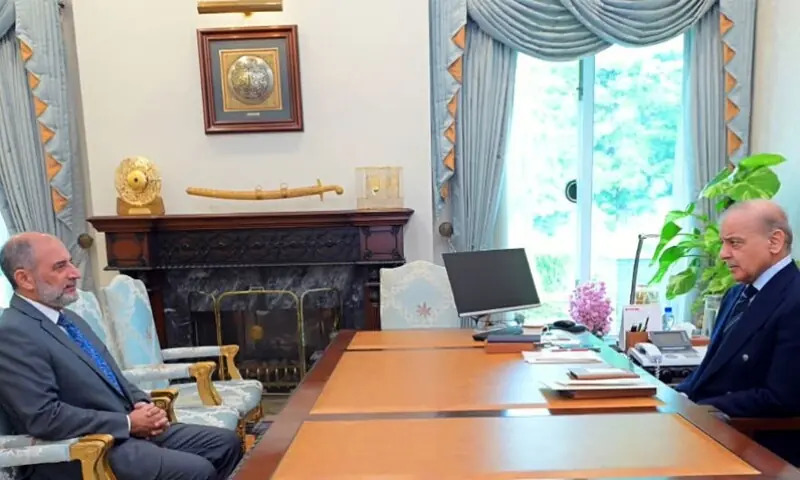
Prime Minister Shehbaz Sharif convened a high-level briefing in Islamabad on Wednesday with retired Lieutenant General Nauman Mahmood, the inaugural Secretary General of the newly constituted Makkah Defence Alliance. The discussions centered on institutionalizing the operational framework and strategic cooperation mechanisms established under the landmark trilateral agreement between Pakistan, Saudi Arabia, and Turkiye.
Formally executed on August 7, the multilateral treaty represents a structural recalibration of regional security architecture. Central to the pact is a mutual defense clause stipulating that any armed aggression against a member state will be construed as an attack against all signatories. General Mahmood, who assumed his leadership role last month following extensive intergovernmental consultations, presented a phased roadmap designed to synchronize command structures, joint industrial initiatives, and intelligence coordination. Prime Minister Sharif reaffirmed Islamabad's commitment to the alliance, designating the treaty as an essential benchmark for multilateral security, diplomatic cohesion, and cross-border deterrence.
Commercial & Economic Implications
While predominantly framed as a military alliance, the trilateral framework carries substantial commercial and macroeconomic ramifications for Pakistan's fiscal profile and local enterprise ecosystem. In the immediate term, institutionalized security alignment with Riyadh and Ankara significantly reinforces investor confidence, offering a stabilizing backstop against external geopolitical volatility. Enhanced sovereign alignment with Gulf financial centers bolsters foreign exchange reserve stability, sovereign debt rollover assurances, and balance-of-payments resilience.
For domestic industrial markets, the alliance establishes a formal gateway for joint defense production, aeronautical engineering ventures, and precision component manufacturing. Pakistani engineering firms and state-affiliated manufacturing facilities stand to integrate into international supply chains through technological transfers from Turkiye's advanced aerospace industry and Saudi sovereign capital deployment. Moreover, maritime and trade lane security across the Arabian Sea, Red Sea, and Persian Gulf corridor directly shields commercial shipping lanes from regional disruption. For Pakistani wholesale distributors, importers, and retail merchants, secured logistics channels directly suppress shipping risk premiums, mitigate marine freight insurance spikes, and protect landed import costs across petroleum products, industrial raw materials, and machinery.
Related Intelligence: Bihar Ganges Boat Disaster Sparks River Transport Scrutiny Across South Asia
Stakeholder Perspectives & Market Reactions
Financial analysts and industrial trade associations have welcomed the advancement of institutional talks, pointing to bilateral investment pledges that typically accompany such high-tier defense frameworks. Leaders within Pakistan's heavy manufacturing and engineering sectors have noted that defense co-production pacts could inject vital liquidity into downstream domestic suppliers, precision tool fabricators, and metal casting operators.
Strategic and legal analysts emphasize that the collective security umbrella fundamentally alters risk pricing for foreign direct investment within Pakistan. Sovereign credit observers noted that heightened coordination with Riyadh provides implicit support for bilateral fiscal facilities, which serves to reassure commercial banking syndicates and institutional investors. Simultaneously, diplomatic stakeholders highlight that institutionalizing the alliance's secretariat under Pakistani leadership cements Islamabad's pivotal geopolitical standing across the Middle East and South Asia.
Forward Outlook & Key Watchpoints
The implementation phase will now advance toward regular trilateral ministerial summits and technical committee assemblies to establish standard operating procedures for joint deterrence and technology sharing. Over the next two quarters, market participants must monitor the formalization of dedicated working groups focused on industrial defense collaboration and bilateral technology offset agreements.
Key watchpoints include the announcement of joint defense manufacturing facilities within Pakistan's designated Special Economic Zones, budgetary allocations for joint military exercises, and potential reciprocal trade concessions embedded in ancillary economic pacts. The trajectory of this alliance will serve as a foundational barometer for Pakistan's broader fiscal stabilization, regional trade safety, and cross-border commercial liquidity in the fiscal year ahead.
Join Our Official WhatsApp Channel
Receive live commodity alerts, policy changes, and commercial intelligence directly on WhatsApp.