
New Delhi Clamps Down on Protests Over Disenfranchisement Allegations
Authorities in New Delhi locked down a major public park to suppress demonstrations challenging alleged voter disenfranchisement, highlighting broader regional political and economic vulnerabilities.
The Core Development
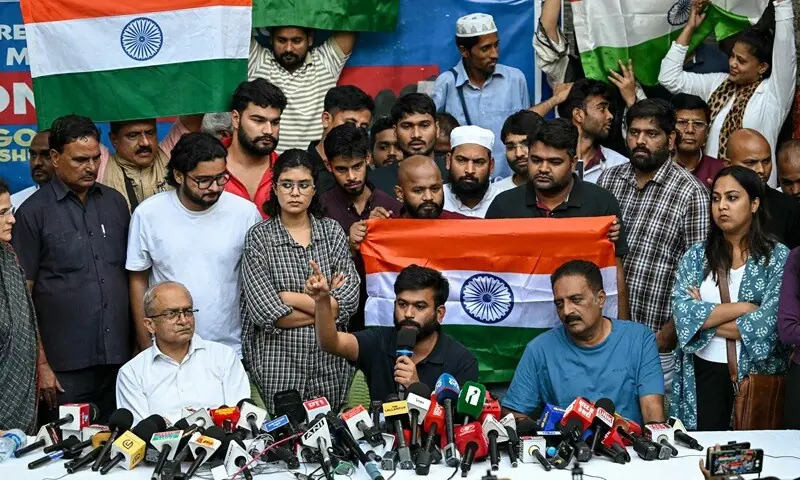
Security agencies in New Delhi preemptively sealed off Central Park on Friday morning, moving to thwart an unauthorized demonstration organized by the Cockroach Janta Party (CJP). The gathering was coordinated to demand the immediate resignation of India's Chief Election Commissioner over contentious nationwide voter-roll revisions. Opposition groups, legal researchers, and civic watchdogs assert that the restructuring of electoral records resulted in the systemic disenfranchisement of millions of vulnerable eligible voters, disproportionately impacting working-class and minority demographics in major urban centers.
The clampdown escalated rapidly after CJP founder Abhijeet Dipke issued a public call for an assembly at Central Park, located in the commercial heart of Connaught Place. This mobilization followed the police detention of two senior party organizers who reportedly breached perimeter barricades near the Jantar Mantar observatory, an official demonstration site. While the Election Commission of India (ECI) categorically rejected claims of partisan interference—maintaining that roll rationalization is a routine constitutional exercise aimed at removing duplicate records—critics argue the procedural changes systematically tilt the institutional framework in favor of Prime Minister Narendra Modi’s ruling Bharatiya Janata Party (BJP).
Commercial & Economic Implications
Although the political epicenter remains within India's domestic institutional machinery, macroeconomic observers and trading enterprises in Pakistan note direct ramifications for broader regional stability. Political unrest in South Asia historically dampens international investor sentiment across border corridors. For commercial houses like Kalyar Traders, heightened friction in neighboring capital markets correlates with increased volatility in regional commodity futures, transit security concerns, and fluctuations in indirect overland supply channels through third-party hubs such as Dubai.
Disruptions in primary metropolitan retail centers like Connaught Place reverberate through broader South Asian wholesale trade networks. Prolonged institutional friction in the region often exacerbates currency volatility, raising import parity pricing for key agricultural inputs, industrial polymers, and textiles. When major regional administrative hubs face frequent civic blockades, regional logistics providers face compounded delays, directly influencing spot freight rates and cross-border mercantile clearing efficiency throughout South Asia.
Related Intelligence: Peshawar High Court Sets Hearing on Khyber Pakhtunkhwa Governance Petitions
Stakeholder Perspectives & Market Reactions
Civic activists and legal experts have raised urgent alarms over the ECI's administrative overreach, arguing that preemptive citywide lockdowns erode institutional credibility. Human rights advocacy coalitions characterized the shutdown of public recreational spaces as an unconstitutional suppression of peaceful assembly. Conversely, municipal security authorities defended the park closure as a necessary public order intervention designed to prevent severe economic disruption and transport gridlocks across New Delhi's commercial core.
Financial sector analysts and institutional market makers have expressed unease regarding institutional polarization. Cross-border mercantile analysts in Pakistan observe that institutional erosion across the subcontinent typically feeds risk premiums assigned by international credit rating agencies. In the short term, trade bodies emphasize that maintaining transparent governance standards is a prerequisite for sustaining commercial liquidity and regional economic resilience.
Forward Outlook & Key Watchpoints
Moving forward, the primary focus rests on whether opposition factions can build sustained momentum beyond sporadic urban assemblies. Petitions challenging the methodology of the voter-roll revision are expected to reach the Supreme Court of India, a legal development that could force judicial scrutiny onto the Election Commission's computational algorithms and administrative verification procedures.
Regional supply chain operators and mercantile entities must monitor potential spillover effects, including expanded curfew zones, localized transportation stoppages, and shifting diplomatic rhetoric. As institutional tensions intensify ahead of key provincial elections, corporate risk desks across South Asia will closely evaluate whether domestic instability compromises broader trade predictability and regional macro stability.
Join Our Official WhatsApp Channel
Receive live commodity alerts, policy changes, and commercial intelligence directly on WhatsApp.