
Maldives President Mohamed Muizzu Arrives in Pakistan for Bilateral Talks
Maldives President Mohamed Muizzu has arrived in Pakistan on an official state visit, focusing on expanding commercial ties, maritime cooperation, and bilateral trade infrastructure between Islamabad and Male.
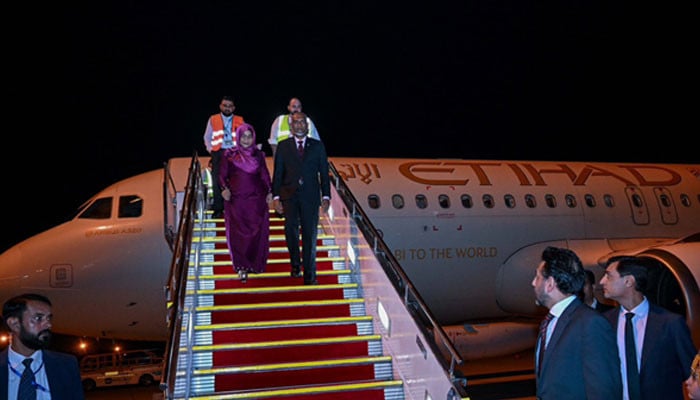
The Core Development Maldivian President Mohamed Muizzu has arrived in Pakistan on a high-stakes official state visit, marking a critical juncture in diplomatic and economic engagement between the two South Asian nations. Arriving in Islamabad alongside a delegation of senior cabinet ministers, foreign policy advisors, and trade representatives, President Muizzu was received by senior Pakistani officials with formal state honors.
The diplomatic itinerary includes formal delegations meeting Prime Minister Shehbaz Sharif, President Asif Ali Zardari, and institutional heads across commerce, maritime logistics, and defense. The discussions center on expanding bilateral cooperation under South Asian regional frameworks, reviewing trade agreements, and strengthening institutional ties. Key agendas prioritize the revitalization of long-delayed trade protocols, defense collaboration, tourism exchanges, and technical assistance programs. With Male actively diversifying its foreign and economic partnerships, Islamabad presents a strategically vital partner for supply chain cooperation and diplomatic alignment in the Indian Ocean region.
Commercial & Economic Implications From an [economic and](/news/uk-leadership-andy-burnham-fiscal-trade-headwinds) supply chain perspective, the engagement between Pakistan and the Maldives provides critical avenues for expanding merchandise exports and securing institutional procurement contracts. Bilateral trade between both nations has historically remained well below potential, hovering under the $20 million threshold annually. High freight costs, indirect shipping routes, and financial transaction barriers have consistently impeded direct market penetration for Pakistani businesses.
For Pakistani traders, wholesale distributors, and agro-exporters, the Maldives represents an import-dependent market heavily reliant on basic commodities, fresh produce, processed foods, pharmaceuticals, and construction inputs. The luxury hospitality sector in the Maldives imports upwards of 90 percent of its food, beverage, and supply requirements. Establishing direct cargo routes, standardizing phytosanitary compliance, and instituting preferential trade tariffs could substantially reduce intermediate handling fees. This development directly impacts Pakistan's cement, rice, textile, and pharmaceutical manufacturers, enabling them to bypass re-export hubs in Colombo or Dubai, thereby improving operational margins and bolstering foreign exchange earnings.
Related Intelligence: UK Leadership Under Andy Burnham Faces Early Economic and Fiscal Tests
Stakeholder Perspectives & Market Reactions Market participants and business bodies across Pakistan have welcomed the visit as an essential step toward formalizing trade linkages in the maritime corridor. The Federation of Pakistan Chambers of Commerce and Industry (FPCCI) and regional trade associations emphasized the urgency of finalizing a structured Bilateral Free or Preferential Trade Agreement (BTA/PTA). Exporters noted that without direct shipping lines, Pakistani goods face uncompetitive logistics timelines relative to regional peers.
Financial analysts and diplomatic observers note that President Muizzu's visit reflects Male's calibrated foreign policy aimed at balancing regional engagements and diversifying import baskets. Institutional stakeholders in Islamabad view the state visit as an opportunity to project Pakistan's logistics and manufacturing capabilities into Indian Ocean markets. Meanwhile, legal and trade advisory councils highlighted the need for bilateral banking arrangements to facilitate smooth trade settlements, eliminating currency conversion frictions that currently weigh down private enterprise.
Forward Outlook & Key Watchpoints In the coming months, focus will shift toward translating state-level communiques into actionable commercial mechanisms. Key watchpoints include the formation of a Joint Business Council (JBC), technical working sessions between civil aviation authorities to explore direct commercial flights, and the framework for regular commercial container transshipments.
Policy implementation will depend on how rapidly both ministries of commerce formulate tariff rationalization schedules. Observers will also track potential agreements in higher education, institutional training, and defense diplomacy. For wholesale and commercial operators in Pakistan, swift progress on maritime clearing agreements and customs harmonizations will determine whether bilateral trade can realistically scale past historic bottlenecks over the next fiscal cycle.
Join Our Official WhatsApp Channel
Receive live commodity alerts, policy changes, and commercial intelligence directly on WhatsApp.