
Indian Election Protests Escalate Amid Crackdown and Trade Disruption Fears
Young Indian demonstrators adopt decentralized tactics to bypass severe security crackdowns in New Delhi, demanding electoral integrity and heightening regional economic uncertainty.
The Core Development
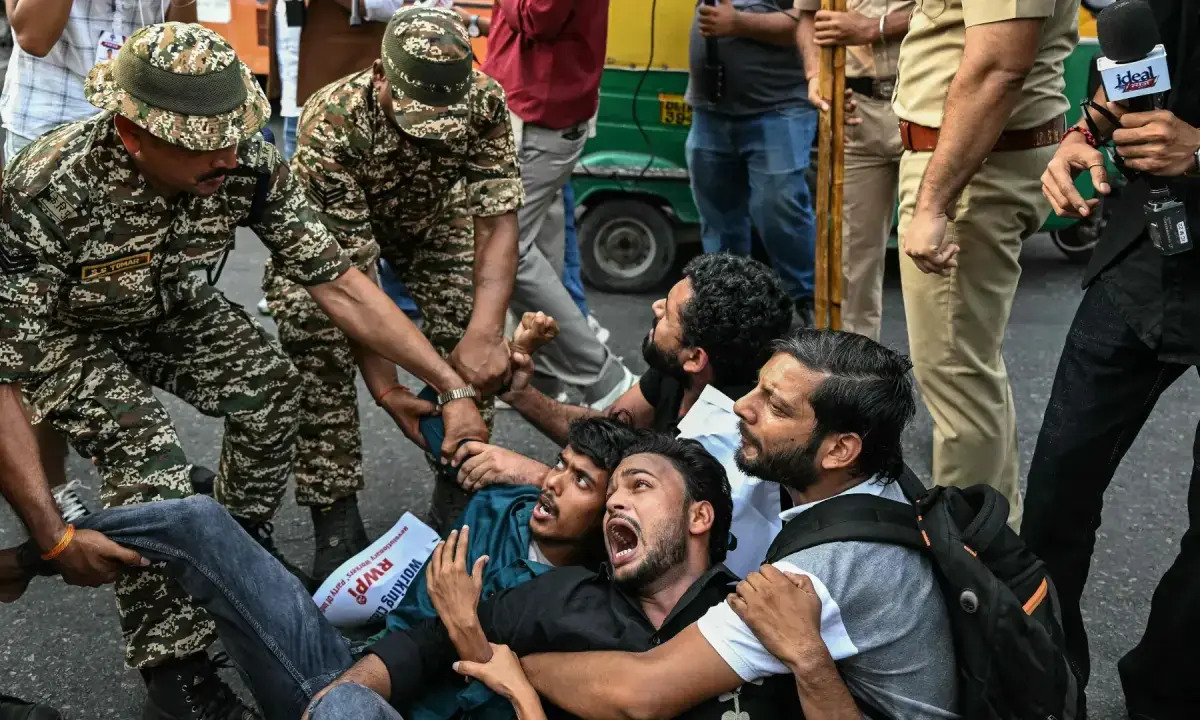
New Delhi has become the epicenter of an intensifying confrontation between state security apparatuses and student-led demonstrators following widespread allegations of voter roll manipulation during recent electoral processes. In response to the deployment of tens of thousands of police and paramilitary personnel aimed at sealing off Jantar Mantar, the historic core of civil assembly in the capital, youth groups have adapted their operational mechanics. Protesters have instituted decentralized, rapid-assembly flash demonstrations across peripheral districts, utilizing counter-surveillance measures including peer-to-peer offline communication networks, open-source mapping applications, and facial occlusion techniques to evade facial recognition tracking.
The demonstrations erupted following coordinated demands seeking the immediate resignation of the head of the Election Commission of India. Civil rights groups and student syndicates accuse the electoral body of systemic irregularities and partisan gerrymandering of electoral registers. Despite mass detentions numbering in the thousands over the preceding weekend, the operational resilience of the movement has persisted. Municipal authorities have instituted rolling transit closures, arbitrary checkpoints, and localized telecommunications throttles across central corridors, transforming major metropolitan commercial thoroughfares into heavily militarized containment zones.
Commercial & Economic Implications
While rooted in institutional and constitutional contention within India, the compounding instability in the region's largest economy generates notable secondary risks for South Asian trade logistics, financial market flows, and cross-border commercial channels. For market operators and trading enterprises in Pakistan, political turbulence across the border compounds macroeconomic headwinds. Regional risk premiums frequently dictate foreign institutional investment trajectories across broader South Asian capital markets, directly impacting currency valuations, sovereign yields, and debt instruments.
Furthermore, civil disruptions in major metropolitan centers within India inevitably impede overland freight movement, coastal port turnaround intervals, and bilateral informal trade corridors operating via third-party transit hubs such as Dubai and Singapore. Prolonged transport standstills and supply disruptions within Indian wholesale textile, chemical, and pharmaceutical raw material sectors induce upward pricing pressure on critical inputs across secondary markets. Pakistani commercial importers relying on global distribution networks for synthetic yarns, industrial compounds, and bulk commodities face elongated transit periods and higher transshipment freight insurance rates, worsening domestic cost-push inflation.
Related Intelligence: India Protest Traditions Resurface Amid Emerging Disputes Over Electoral Integrity
Stakeholder Perspectives & Market Reactions
Market analysis desks and regional commercial federations have expressed growing concern regarding institutional unpredictability within the subcontinent. In New Delhi, retail merchant guilds and wholesale commercial cartels operating in adjacent trading enclaves have reported significant turnover contractions due to transport restrictions and recurring flash shutdowns. Legal analysts argue that the aggressive deployment of public order legislation to suppress political grievances jeopardizes institutional credibility and investor sentiment.
Concurrently, cross-border trade analysts and manufacturing trade bodies in Pakistan are closely monitoring the escalation. The Federation of Pakistan Chambers of Commerce and Industry and regional commodity import syndicates note that heightened domestic friction inside India typically translates into more defensive, protectionist trade postures by New Delhi, diminishing prospects for regional normalization. Financial analysts emphasize that institutional degradation and recurrent civic shutdowns erode global corporate confidence in South Asia as an integrated industrial manufacturing alternative.
Forward Outlook & Key Watchpoints
The trajectory of the standoff hinges on the state's capacity to contain decentralized demonstrations without inflicting broader economic paralysis. Watchpoints over the coming fortnight include scheduled supreme judicial hearings regarding petitions on electoral integrity, potential administrative responses from the Election Commission, and the scope of further union-backed strikes. Should unrest spill into broader industrial belts, critical infrastructure chokepoints could face prolonged supply halts. Regional commercial stakeholders, particularly wholesale importers and logistics providers across Pakistan, must maintain defensive inventory buffers against rising regional freight costs and volatile intermediate commodity pricing.
Join Our Official WhatsApp Channel
Receive live commodity alerts, policy changes, and commercial intelligence directly on WhatsApp.