
UK Court Acquits Woman in Landmark Speech Case on Palestinian Resistance
A UK court has acquitted an activist accused of backing Hamas, establishing that her speech defended the legal principle of Palestinian resistance rather than endorsing a proscribed terrorist group.
Geopolitical & Core Developments
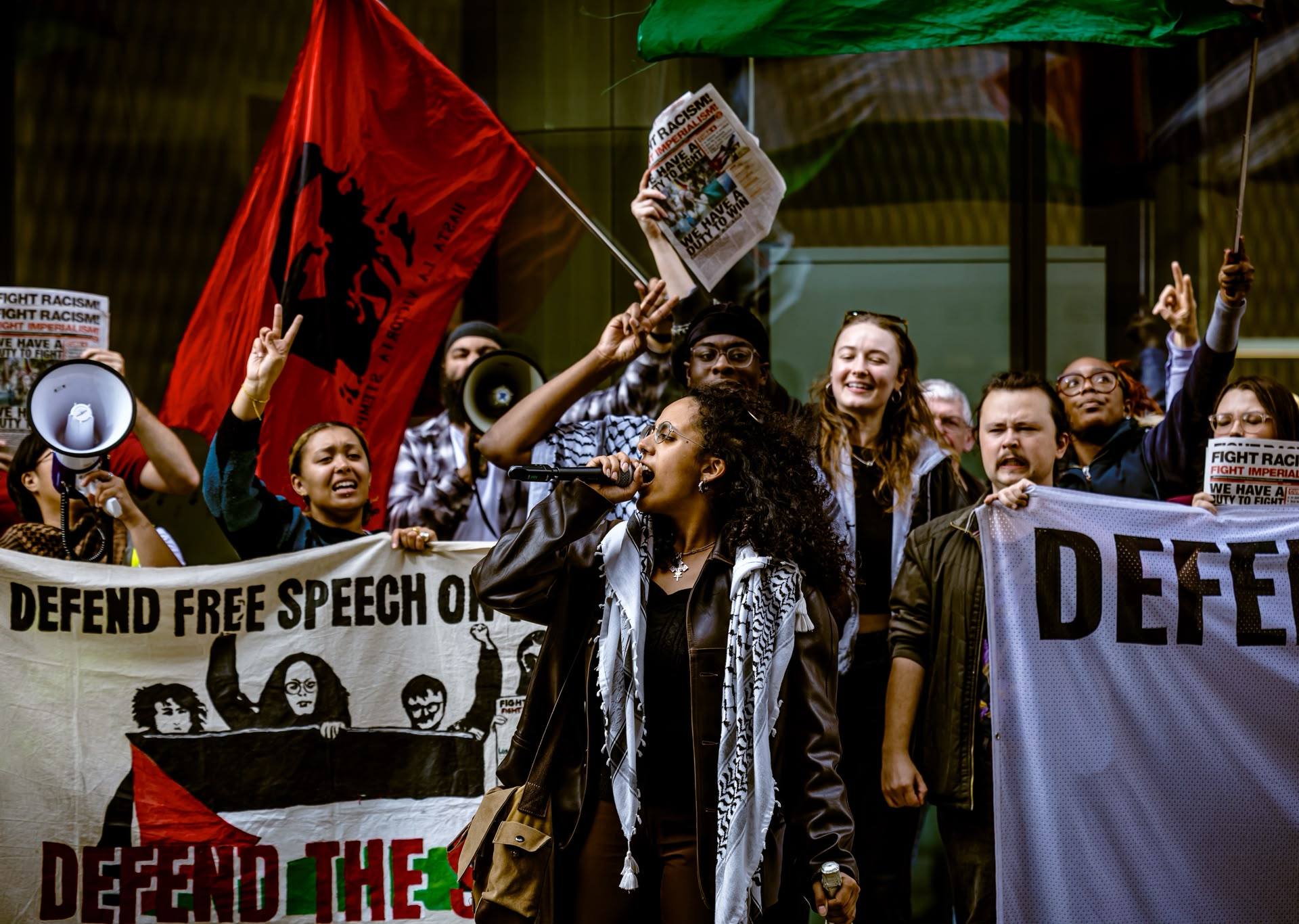
A British court has acquitted Sarah Cotte of charges alleging expression of support for a proscribed terrorist organization, concluding a high-profile legal dispute stemming from an address delivered at a university event regarding the war in Gaza. Cotte had been prosecuted under the United Kingdom's Terrorism Act 2000 after Crown prosecutors asserted that her spoken remarks amounted to an endorsement of Hamas, which was designated in its entirety as a foreign terrorist organization by the British government in late 2021. The defense successfully argued that her statements differentiated between an organizational endorsement of Hamas and broader political advocacy for the internationally recognized right of Palestinians to resist military occupation under international law.
The acquittal exposes deepening domestic and geopolitical fissures within Western democracies as governments attempt to police political speech surrounding the Middle East crisis. In capitals across Europe and North America, legal frameworks established primarily for counter-terrorism enforcement are increasingly coming into conflict with mass civil demonstrations, academic symposiums, and political mobilization. The legal boundary separating legitimate advocacy for sovereign self-determination from unlawful statutory support for proscribed militant factions has become a central point of contestation between state security apparatuses and human rights litigators.
Global Trade & Economic Ripples
While the legal decision represents a domestic judicial finding, its underlying geopolitical drivers continue to exert measurable pressure on international commerce and capital allocation. The unresolved conflict in Gaza remains tightly coupled with asymmetric disruptions across vital international transit corridors. Commercial shipping lanes through the Red Sea and the Bab al-Mandeb strait continue to operate under severe constraints due to maritime interdiction campaigns conducted by Houthi forces in Yemen, who justify their actions as solidarity with Palestinian resistance. This sustained maritime insecurity has institutionalized elevated container freight rates, redirected significant merchant tonnage around the Cape of Good Hope, and preserved an enduring risk premium on global crude benchmarks, including Brent.
Simultaneously, heightened domestic polarization across Western economies has expanded into corporate and institutional environments. Sovereign wealth funds, university endowment boards, and multinational corporations face sustained divestment campaigns targeting companies associated with Israeli defense procurement, surveillance technology, and settlement infrastructure. Concurrently, institutional capital must navigate intensifying compliance requirements tied to counter-terrorism financing statutes and anti-boycott legislation, introducing non-trivial legal friction into cross-border investment strategies.
Related Intelligence: Kennedy Center Financial Solvency Clarified Amid Scrutiny Over Federal Cultural Funding
International Reactions & Diplomatic Stances
Human rights organizations, legal watchdogs, and civil liberties coalitions welcomed the verdict as a crucial affirmation of judicial independence and free expression. Observers emphasized that an overbroad application of counter-terrorism legislation threatens to criminalize legitimate political discourse and chill academic inquiry into international humanitarian law. Conversely, pro-Israel advocacy organizations and several national security analysts expressed concern that acquittals in public address cases risk weakening deterrence against extremist rhetoric within educational and civic institutions.
The case also touches on broader international norms. The United Nations Special Rapporteur on the promotion and protection of human rights and fundamental freedoms while countering terrorism has repeatedly warned member states against adopting expansive statutory interpretations of terrorism that encroach upon fundamental speech protections. Domestically, the UK Crown Prosecution Service and law enforcement agencies face heightened scrutiny over evidentiary thresholds, highlighting an emergent divergence between ministerial policy directives on public order and the standards applied by the judiciary.
Strategic Outlook & Future Scenarios
The Cotte acquittal creates a notable precedent for dozens of active and pending cases involving public demonstrations, campus walkouts, and political speeches across the United Kingdom. However, the outcome is likely to spur legislative pushback. Policy analysts anticipate that security-focused parliamentarians may advocate for statutory amendments to existing public order and counter-terrorism legislation to eliminate perceived legal ambiguities regarding implied or indirect support for proscribed entities.
On the international stage, persistent domestic polarization in Western democracies will continue to constrain diplomatic room for maneuver in the Middle East. Without a durable diplomatic settlement addressing the humanitarian catastrophe in Gaza, regional escalation risks, and the future governance of the Palestinian territories, domestic unrest across European and American cities will remain persistent. The legal, institutional, and economic domains will consequently remain primary arenas where the geopolitical tensions of the Middle East conflict are actively litigated and contested.
Join Our Official WhatsApp Channel
Receive live commodity alerts, policy changes, and commercial intelligence directly on WhatsApp.