
Smoke Plume Near Riyadh Airport Signals Deepening Gulf Regional Security Risks
A major security alert near Riyadh's King Khalid International Airport caused grounded flights and massive smoke plumes on Saturday. The escalation threatens Gulf air transit, crude benchmarks, and Pakistan's import-dependent macroeconomic stability.
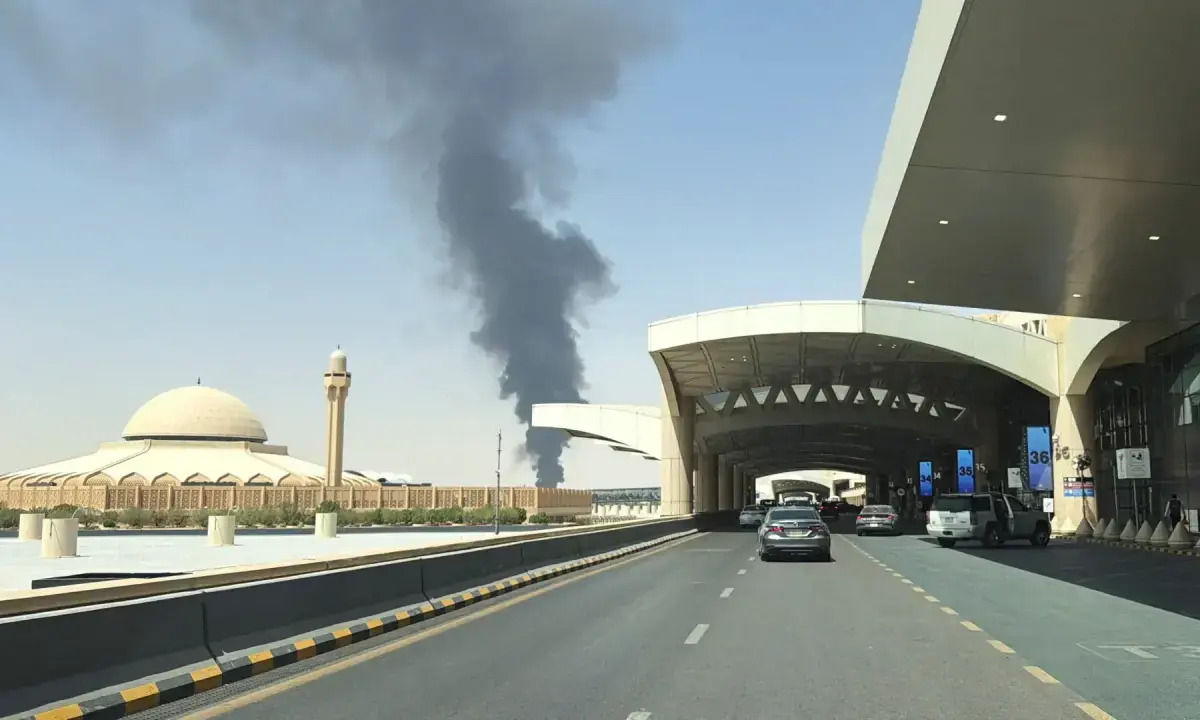
The Core Development
A massive column of black smoke rose into the sky adjacent to Riyadh's King Khalid International Airport on Saturday, following overnight emergency alerts and audible explosions across the Saudi capital. The incident unfolded against the backdrop of renewed aerial offensives launched by Yemen's Houthi movement, marking the first time since the resumption of hostilities that strikes have penetrated the sovereign perimeter of Riyadh. Visual verification confirmed thick smoke billowing along the airport highway corridor, directly visible from the passenger terminals and support infrastructure.
Civil aviation operations faced immediate operational paralysis. Real-time aviation tracking intelligence from FlightRadar24 indicated that King Khalid International Airport registered a disruption index of 5.0—the highest possible score on the platform's volatility scale. This rating reflects systemic flight cancellations, extensive holding patterns, and diversions across Gulf airspace. While civil defence authorities issued regional all-clear notices following initial interceptions, the proximity of visible impacts to vital transit nodes underscores a significant compromise of Saudi metropolitan airspace safety.
Commercial & Economic Implications
The vulnerability of Saudi aviation and transport hubs carries acute macroeconomic consequences for South Asian economies, most notably Pakistan. Any structural threat to Saudi Arabian infrastructure immediately recalibrates the geopolitical risk premium on global energy markets. For Pakistan, where crude oil, refined petroleum, and liquefied petroleum gas imports account for the single largest share of foreign exchange outflows, sustained crude price inflation above baseline projections directly threatens the country's fragile balance of payments.
Beyond direct energy costs, commercial air freight and cargo routing between Riyadh and Pakistani logistics centers face immediate disruption. Aviation carriers operating through central Arabian corridors are anticipated to incur heightened war-risk insurance premiums, driving up landed airfreight tariffs. For wholesale importers and industrial fabricators in Pakistan relying on GCC-routed parts, specialized machinery, and express cargo, freight surcharges will inevitably cascade into wholesale prices, further squeezing retail distribution margins and elevating domestic consumer price index (CPI) readings.
Related Intelligence: Pakistan Urges Iran to Protect Energy Supplies and Maritime Trade Lanes
Stakeholder Perspectives & Market Reactions
Global aviation bodies and regional cargo syndicates have expressed immediate apprehension regarding corridor viability. Air cargo handlers have begun reassessing scheduled routes linking the Gulf with Asian manufacturing hubs, citing both airspace risk advisories and potential insurance tariff hikes on airframes transiting peninsular routes. Energy market traders in London and Singapore have already priced in precautionary volatility, closely monitoring state refinery output and transport conduits for potential systemic vulnerability.
Within Pakistan, commercial trading associations and financial market analysts view the event as an alarming external headwind. The Federation of Pakistan Chambers of Commerce and Industry (FPCCI) and wholesale trade representatives have repeatedly cautioned that unpredictable geopolitical disruptions in the Gulf swiftly translate into domestic logistics shocks. Additionally, the broader Pakistani business community remains highly attuned to Gulf stability due to the presence of over 2.5 million overseas Pakistani workers in the Kingdom, whose inward remittances form the cornerstone of Pakistan's secondary income account.
Forward Outlook & Key Watchpoints
Moving forward, commercial stakeholders must monitor several critical indicators over the coming days. The immediate watchpoint remains the restoration timeline of commercial aviation schedules at King Khalid International Airport, accompanied by official damage assessments and statements from the Saudi Ministry of Defense regarding the interception rate of incoming projectiles.
Secondary surveillance must focus on the crude oil benchmark response. If Brent crude experiences structural escalation toward higher operational brackets, Pakistan's energy regulators will face renewed pressure to adjust fortnightly petroleum pricing mechanisms, directly impacting national distribution logistics and industrial power tariffs. Regional security doctrines, maritime escort protocols, and retaliatory diplomatic moves in the Gulf will dictate whether this incident represents an isolated disruption or the precursor to sustained commercial friction across key Middle Eastern trade lanes.
Join Our Official WhatsApp Channel
Receive live commodity alerts, policy changes, and commercial intelligence directly on WhatsApp.