
Sindh Defends Nehr-i-Khayyam Rehabilitation Amid Clifton Environmental and Commercial Concerns
Sindh Local Government Minister Nasir Shah defended the concrete covering and rehabilitation of Clifton's Nehr-i-Khayyam, asserting the engineering intervention will curtail public health risks and enhance surrounding commercial real estate value.
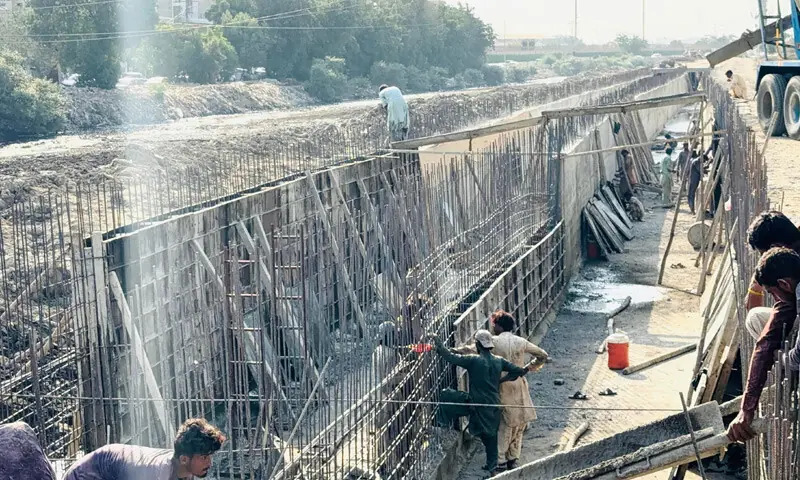
The Core Development
In response to escalating public backlash regarding urban interventions in Karachi's prime commercial and residential sectors, Sindh Local Government Minister Syed Nasir Hussain Shah formally intervened to defend the ongoing Nehr-i-Khayyam Rehabilitation Project. Undertaken directly by the Sindh Local Government Department, the project centers on covering substantial sections of the open storm-water and sewage channel with reinforced concrete structures while systematically re-engineering the local drainage network.
During an on-site operational inspection in Clifton, Minister Shah confirmed that Sindh Chief Minister Syed Murad Ali Shah had taken formal cognizance of grievances lodged by local residents, conservation groups, and civil society advocates. The official architectural layout entails covering the contaminated drain, diverting raw sewage flows into designated treatment corridors, and constructing a segregated clean-water canal. The civil works framework also encompasses extensive linear tree plantations and green corridors designed to arrest environmental degradation along one of Karachi's vital arterial routes.
Commercial & Economic Implications
Nehr-i-Khayyam cuts through an economically pivotal sector of Karachi, directly bordering high-density retail districts, corporate headquarters, and upscale hospitality establishments in Clifton and Old Clifton. For decades, the open conveyance of untreated industrial and domestic effluent generated persistent atmospheric pollution, corrosive off-gassing, and localized urban flooding during monsoon events. These factors depressed commercial property values, discouraged outdoor retail foot traffic, and accelerated structural deterioration in surrounding real estate.
From a macroeconomic perspective, upgrading this drainage asset directly influences consumer activity and retail revenues. Open sewer canals suppress pedestrian retail density and raise maintenance costs for corporate offices dealing with hydrogen-sulfide-induced corrosion of electronics and HVAC systems. By mitigating toxic emissions and reducing disease vectors, municipal upgrades are expected to stabilize commercial asset valuations and stimulate investment in mixed-use real estate, retail showrooms, and corporate offices across the Clifton coastal belt.
Stakeholder Perspectives & Market Reactions
Civil society groups and urban planning coalitions, including heritage and environmental watchdogs, previously expressed deep reservations about capping the natural waterway with concrete slabs. Critics argued that covering major drainage conduits complicates desilting operations, increases structural risk during flash floods, and reduces accessible open urban spaces. Community groups raised concerns that the concrete surface might eventually yield to commercial encroachments rather than public green spaces.
Conversely, regional trade bodies, office building owners, and business associations have broadly supported the elimination of the open cesspool. Business operators around Boat Basin, Kehkashan, and Block 5 Clifton noted that foul odours and stagnant water historically depressed trade turnover during peak hours. In response to transparency demands, the Local Government Department assured stakeholders that storm-water discharge capacity will remain unhindered and that the project emphasizes recreational parkland rather than commercial leasing.
Forward Outlook & Key Watchpoints
The Sindh provincial administration faces the critical task of executing the civil engineering works within scheduled municipal budget allocations and operational deadlines. Observers will track whether the sewage diversion mechanisms operate without backing up into adjacent secondary drainage arteries during the upcoming monsoon season.
Key watchpoints for institutional investors and commercial stakeholders include the structural integrity of the clean-water canal segregation, continuous municipal enforcement preventing commercial squandering of newly reclaimed concrete decks, and subsequent phases connecting Clifton's outfalls to broader water treatment infrastructure. If executed successfully, the corridor could serve as an infrastructure precedent for upgrading other deteriorated storm channels across metropolitan Karachi.
Join Our Official WhatsApp Channel
Receive live commodity alerts, policy changes, and commercial intelligence directly on WhatsApp.