
Middle Powers Forge Strategic Defense Axis Across Middle East and Asia
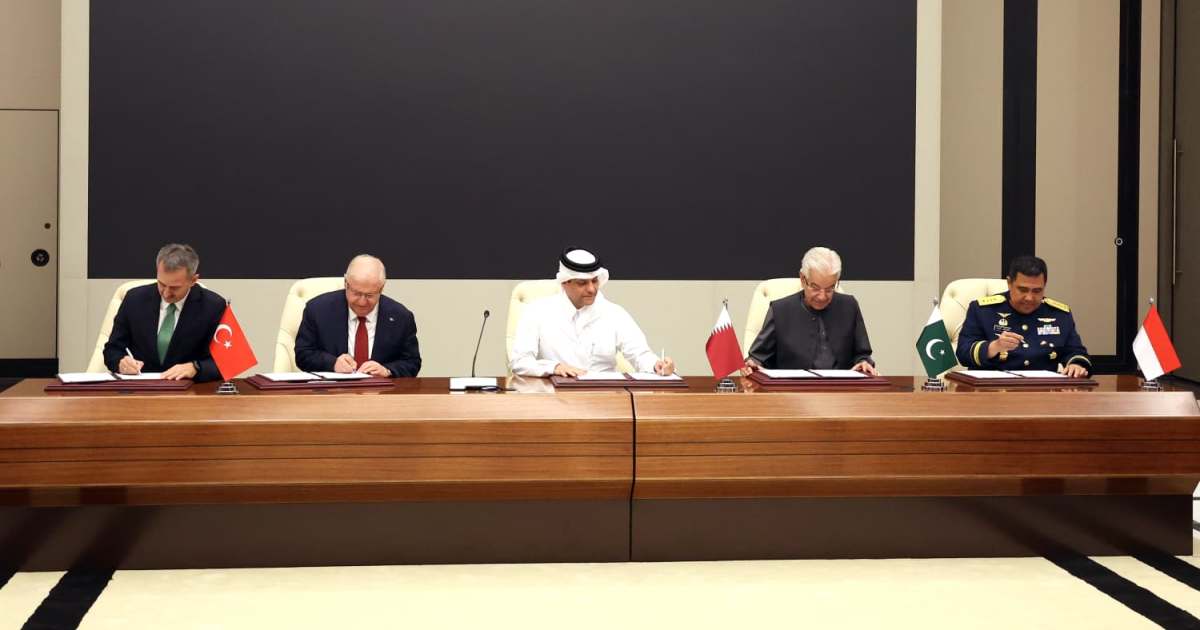
Qatar, Turkey, Pakistan, and Indonesia are deepening defense and industrial cooperation to bolster strategic autonomy and navigate escalating global geopolitical volatility.
Geopolitical & Core Developments
A transformative realignment is unfolding across the Middle East, South Asia, and Southeast Asia as Qatar, Turkey, Pakistan, and Indonesia systematically consolidate their defense and security architectures. Spurred by compounding regional conflicts, shifting alliance commitments, and strategic friction between Washington and Beijing, these four middle powers are actively cultivating alternative security partnerships. Ankara's rapidly maturing defense-industrial complex sits at the epicenter of this matrix, offering combat-proven aerospace systems, naval platforms, and precision-guided munitions unencumbered by the restrictive political conditionalities often attached to Western arms transfers.
The strategic rationale differs yet converges across all four capitals. For Qatar, expanding defense cooperation beyond its conventional reliance on Western security umbrellas ensures broader operational deterrence and fortifies its sovereign defense posture in the Gulf. Pakistan seeks sophisticated technological inputs and capital investment to modernize its armed forces while managing chronic fiscal constraints and regional balance-of-power considerations. Indonesia, pursuing a sprawling military modernization agenda under President Prabowo Subianto, requires advanced maritime and aerospace capabilities to defend its vast archipelagic territory in the increasingly contested Indo-Pacific. Turkey, meanwhile, benefits from substantial capital infusions, access to high-growth defense export markets, and expanded geopolitical influence spanning from the Mediterranean to the Malacca Strait.
Recent high-level defense dialogues, reciprocal military exercises, and bilateral industrial agreements underscore the institutional momentum behind this quadrangle. Joint initiatives are moving beyond standard procurement toward co-production frameworks, technology transfers, and shared intelligence-sharing protocols.
Global Trade & Economic Ripples
The deepening military-industrial integration among these states carries tangible ramifications for international commerce, high-technology trade flows, and critical maritime corridors. Commercial defense trade represents a multi-billion-dollar market where Turkey's export revenues have surged past historic thresholds, fueled significantly by acquisitions from Gulf and Asian partners. Joint investments between Qatar and Turkish defense conglomerates like Baykar, Aselsan, and STM have accelerated indigenous production lines, directly challenging the market share of European and North American defense contractors.
Moreover, the geopolitical geography encompassed by Qatar, Pakistan, and Indonesia straddles several of the world's most critical energy and maritime trade choke points, including the Strait of Hormuz, the Arabian Sea, and the Malacca Strait. Enhanced naval interoperability and shared maritime domain awareness among these states contribute to securing sovereign maritime supply lanes against piracy, asymmetrical threats, and disruption to global liquefied natural gas (LNG) and crude oil shipments. The establishment of localized defense manufacturing supply chains also mitigates vulnerability to secondary sanctions and global semiconductor or avionics bottlenecks, creating more resilient regional industrial ecosystems.
Related Intelligence: Russia Dispatches First Diesel Tanker to United States Under Bilateral Arrangement
International Reactions & Diplomatic Stances
Western capitals have observed the deepening alignment with measured caution. Washington and NATO allies continue to monitor Ankara's export of high-end aerospace technology and its defense pacts with non-NATO states, balancing the desire to maintain Turkey within the alliance's orbit against concerns over technological proliferation. United States defense officials have quietly expressed apprehension that third-party defense ecosystems could eventually bypass Western export control regimes.
Conversely, regional stakeholders in the Indo-Pacific and South Asia view the network through distinct lenses. Beijing views the bilateral defense cooperation between Pakistan and Turkey pragmatically, maintaining its position as Islamabad's primary strategic partner while observing Indonesia's non-aligned balance between external defense suppliers. India continues to monitor Pakistan-Turkey defense cooperation with concern, particularly regarding unmanned aerial vehicles and electronic warfare transfers. Independent defense analysts note that these partnerships reflect a structural shift toward strategic autonomy, wherein emerging powers construct cross-regional hedging coalitions rather than committing to binary superpower blocs.
Strategic Outlook & Future Scenarios
The trajectory of this four-nation alignment points toward formalized multilateral defense production and expanded trilateral or quadrilateral operational exercises over the medium term. Upcoming bilateral defense summits scheduled throughout 2025 and 2026 are expected to yield concrete co-development programs in next-generation aerospace systems, including contributions to Turkey's KAAN fifth-generation fighter jet program.
Potential flashpoints and constraints remain. Fiscal volatility in Islamabad, shifting procurement priorities in Jakarta, and the imperative for Qatar to balance relations with Washington could impose operational caps on integration. Nevertheless, as geopolitical polarization deepens and access to Western military hardware faces growing political scrutiny, the institutionalized defense corridor connecting Doha, Ankara, Islamabad, and Jakarta is poised to become a permanent feature of the multipolar global security landscape.
Join Our Official WhatsApp Channel
Receive live commodity alerts, policy changes, and commercial intelligence directly on WhatsApp.