
Pakistan Joins Qatar, Turkiye, and Indonesia in Landmark Badr Defence Agreement
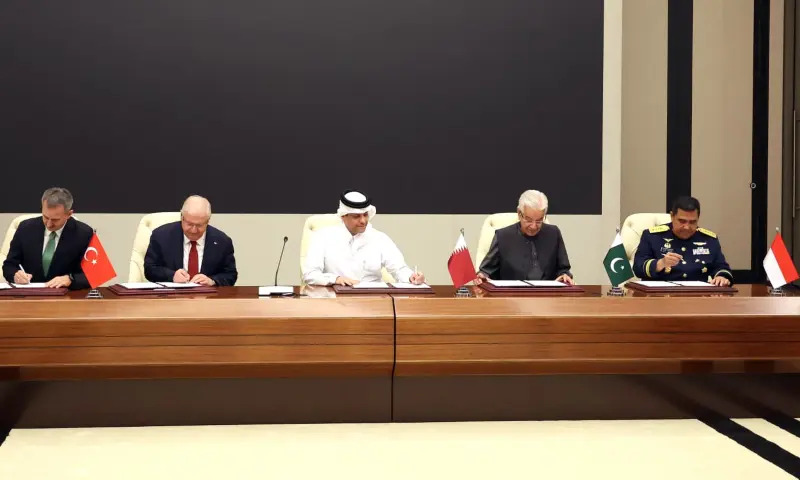
Pakistan has signed the multilateral Badr defence cooperation agreement with Qatar, Turkiye, and Indonesia in Doha, establishing a collaborative framework for joint defence production, industrial integration, and strategic capabilities.
The Core Development
In a strategic realignment of regional security cooperation, Pakistan, Qatar, Turkiye, and Indonesia have formally signed a multilateral defence accord dubbed the 'Badr' pact. The signing ceremony took place in Doha, Qatar, drawing high-level ministerial delegations from all four partner nations. Pakistan was represented by Defence Minister Khawaja Asif, who joined his counterparts to ink the multilateral framework aimed at accelerating joint industrial production, military research and development, and sovereign capability enhancement.
According to an official communique issued by the Turkish Ministry of National Defence, the agreement establishes structured institutional mechanisms to co-develop, manufacture, and market defence systems among the signatory states. While Pakistan's Ministry of Foreign Affairs has maintained operational discretion regarding granular project parameters, the initiative marks a significant pivot toward plurilateral technological integration. The Badr pact formalises ongoing bilateral military arrangements into a cohesive four-nation bloc, leveraging Turkiye's expanding aerospace and naval manufacturing base, Qatar's capital financing, Pakistan's extensive ordinance and aerospace infrastructure, and Indonesia's regional production footprint.
Commercial & Economic Implications
Beyond traditional military strategy, the Badr accord holds profound structural implications for Pakistan's macro-fiscal health, industrial manufacturing ecosystem, and wholesale supply chains. Historically, foreign military acquisitions have placed heavy demands on Pakistan's foreign exchange reserves. By institutionalising joint ventures and co-production frameworks, the agreement provides a platform to substitute capital-intensive imports with domestically assembled and engineered components, mitigating pressures on the current account.
For Pakistan's industrial downstream sectors—particularly precision metallurgy, specialized chemicals, avionics, and engineering fabrication—the accord opens cross-border procurement pipelines. Commercial vendors and sub-contractors tied to the domestic engineering base, notably in the industrial corridors of Punjab and Karachi, could witness heightened demand for dual-use inputs, raw material sourcing, and specialized tooling. Furthermore, integrated production contracts with well-capitalized partners like Qatar and technologically advanced partners like Turkiye could stimulate direct capital inflows, spurring technical employment and technology transfer that indirectly bolster domestic industrial productivity.
Related Intelligence: UK Clears Jackdaw North Sea Gasfield to Bolster Domestic Supply
Stakeholder Perspectives & Market Reactions
Market observers, financial analysts, and corporate chambers have expressed measured optimism regarding the commercial spin-offs of the agreement. Trade and engineering associations note that multi-nation military partnerships often produce civilian technological transfers, modernizing local manufacturing benchmarks. Economists in Islamabad highlighted that direct cooperation with Doha and Ankara provides crucial balance-of-payments relief for sustained defence procurement programs, shielding the broader economy from disruptive sudden-stop capital drains.
Strategic analysts point out that the inclusion of Indonesia extends Pakistan's export horizon into the wider ASEAN region, creating export avenues for joint-venture products manufactured at facilities like the Pakistan Aeronautical Complex (PAC) and Pakistan Ordnance Factories (POF). However, legal and trade compliance experts urge government institutions to formulate clear regulatory frameworks ensuring transparency in domestic sub-contractor allocations and compliance with international export-control regimes.
Forward Outlook & Key Watchpoints
The implementation of the Badr pact will hinge on technical follow-up meetings slated across the four capital cities over the coming quarters. Key watchpoints include the formation of joint steering committees, the establishment of dedicated financing vehicles facilitated by Qatari financial institutions, and the finalization of initial coproduction priority projects—anticipated to centre on unmanned aerial vehicles, naval technologies, and advanced communications.
Investors and market participants should closely observe whether the government will initiate localized public-private partnerships, allowing private manufacturing enterprises in Pakistan to participate in supply-chain tiers. If effectively operationalized, the accord could establish a resilient industrial corridor across South Asia, the Middle East, and Southeast Asia, decoupling vital security manufacturing from volatile currency swings and unilateral supply restrictions.
Join Our Official WhatsApp Channel
Receive live commodity alerts, policy changes, and commercial intelligence directly on WhatsApp.