
Pakistan and Russia Explore Expanded Bilateral Trade and Economic Ties
Russian Interior Minister Vladimir Kolokoltsev met Prime Minister Shehbaz Sharif in Islamabad, underscoring significant potential for expanding bilateral trade, economic cooperation, and security coordination between the two nations.
The Core Development
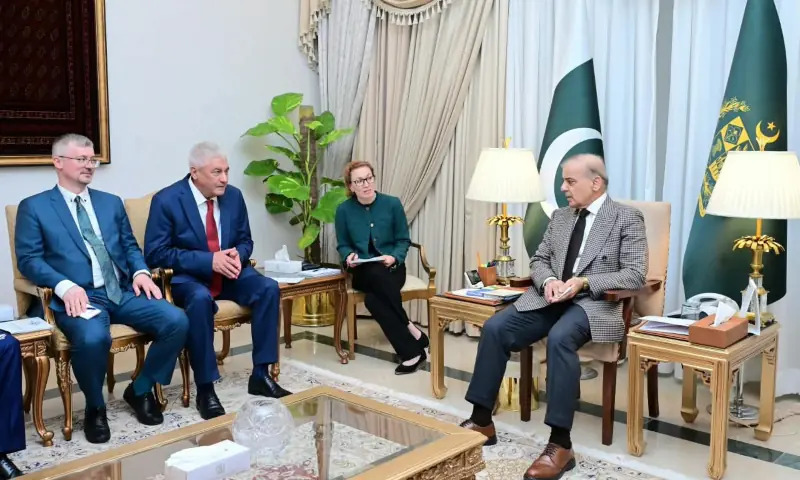
In a landmark diplomatic engagement, Russian Interior Minister Vladimir Kolokoltsev met with Prime Minister Shehbaz Sharif in Islamabad to discuss the broadening of bilateral trade, commercial linkages, and institutional security cooperation. Minister Kolokoltsev arrived in the federal capital on Monday for an official four-day visit at the formal invitation of Pakistan's Interior Minister Mohsin Naqvi. The visit represents the first time a sitting Russian interior minister has visited Pakistan, marking a strategic milestone in Islamabad-Moscow relations.
According to an official communique released by the Prime Minister’s Office (PMO), discussions centered on tapping the unrealized potential of bilateral commerce. Minister Kolokoltsev emphasized Moscow's readiness to deepen cooperation across various sectors, pointing to substantial scope for mutual exchange. Prime Minister Sharif reaffirmed Pakistan's commitment to strengthening ties with the Russian Federation across energy, commerce, investment, and regional security frameworks. Both sides underscored the importance of frequent high-level interactions to transform political goodwill into tangible economic partnerships.
Commercial & Economic Implications
For Pakistan's commercial landscape, closer economic ties with the Russian Federation carry critical macroeconomic and supply-chain significance. Historically constrained by financial clearance mechanisms and Western sanctions compliance, direct commercial exchanges between Pakistani and Russian enterprises have hovered below their true potential. Expanded trade cooperation offers vital alternatives for Pakistan's commodity import basket, particularly in key agricultural inputs like wheat, fertilizer, and energy products including crude oil and petrochemical derivatives.
Wholesale distributors and domestic manufacturers stand to benefit from more diversified import channels. A stable inflow of industrial raw materials and competitively priced fertilizers directly reduces production overheads for Pakistan's agrarian base and manufacturing sector. Lower landed costs for critical inputs play a consequential role in curbing domestic wholesale price inflation, stabilizing consumer price indices, and shielding local supply chains from volatile international spot markets. Furthermore, formalizing trade frameworks creates avenues for Pakistani exporters, particularly in textiles, sports equipment, surgical instruments, and perishable agro-commodities such as citrus and rice, to secure a larger footprint in the Russian retail market.
Related Intelligence: Pakistan and Russia Explore Trade Expansion During Historic Ministerial Visit
Stakeholder Perspectives & Market Reactions
Industrial and trading bodies in Pakistan have reacted positively to the diplomatic engagement, emphasizing the necessity of resolving logistical and transactional hurdles. The Federation of Pakistan Chambers of Commerce and Industry (FPCCI) and regional trade bodies have frequently highlighted that banking channels and freight connectivity remain primary obstacles to scaling bilateral commerce. Market stakeholders have urged both governments to operationalize currency swap agreements, explore barter mechanisms, and establish dedicated maritime transport routes via the International North-South Transport Corridor (INSTC).
Financial sector analysts note that while political intent is evident, commercial realization hinges on establishing secure payment settlement architectures that shield local commercial banks from secondary sanctions risks. Legal experts in international trade point out that bilateral trade protocols must provide clear statutory protections for private enterprises engaging in cross-border settlements. Government officials have reiterated that enhanced engagement with Russia complements Pakistan's geoeconomic strategy of regional integration, positioning the country as a transit hub connecting Central Asia and Russia to warm-water ports.
Forward Outlook & Key Watchpoints
Moving forward, the focus shifts toward institutionalizing the outcomes of these high-level deliberations into enforceable commercial agreements. Key near-term watchpoints include the upcoming sessions of the Pakistan-Russia Intergovernmental Commission (IGC) on Trade, Economic, Scientific, and Technical Cooperation, where bilateral trade targets and technical clearing mechanisms will be deliberated.
Market observers will closely monitor whether bilateral discussions lead to formal agreements on energy imports, rail-sea connectivity routes, and customs facilitation. Over the next two quarters, the pace at which both capitals address currency settlement systems and streamline trade documentation will determine whether this historic diplomatic visit translates into expanded balance sheets for Pakistani importers, wholesale distributors, and exporters alike.
Join Our Official WhatsApp Channel
Receive live commodity alerts, policy changes, and commercial intelligence directly on WhatsApp.