
Maldives President Arrives in Pakistan to Deepen Bilateral and Trade Ties
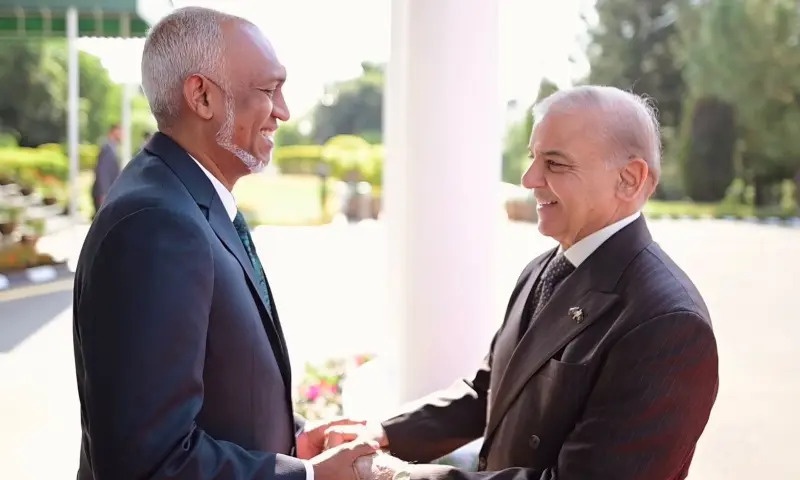
Maldives President Dr. Mohamed Muizzu received a formal guard of honour at Prime Minister House in Islamabad, initiating landmark talks on bilateral commerce, maritime connectivity, and institutional cooperation.
The Core Development
In a diplomatic milestone reflecting shifting regional realignments, the President of the Maldives, Dr. Mohamed Muizzu, was accorded a formal guard of honour at the Prime Minister House in Islamabad on Wednesday morning. Arriving on a three-day official visit at the formal invitation of Prime Minister Shehbaz Sharif, Muizzu's presence represents the first state visit by a Maldivian head of state to Pakistan in eleven years.
The high-level visit directly coincides with the 60th anniversary of diplomatic ties established between Islamabad and Male in 1966. During the welcoming protocol, Prime Minister Sharif presented key members of the federal cabinet, including ministers overseeing foreign affairs, maritime operations, commerce, and national defense, to the Maldivian delegation. Following the ceremony, both leaders engaged in restricted one-on-one consultations before leading extensive delegation-level talks. The diplomatic agenda prioritized institutional engagement across healthcare, higher education, maritime trade routes, climate adaptation, and the expansion of preferential trading frameworks.
Commercial & Economic Implications
For Pakistan's commercial landscape, institutional re-engagement with the Maldives opens lucrative avenues for export diversification and specialized logistics. Bilateral trade between the two South Asian nations has historically hovered below potential, largely constrained by shipping transit costs, direct sea lane connectivity gaps, and inconsistent trade facilitation protocols. Strengthening these linkages directly benefits domestic wholesale exporters operating in agricultural and industrial hubs across Punjab and Sindh.
The Maldives represents an import-dependent economy with sustained demand for high-grade agricultural commodities, pharmaceutical goods, textiles, surgical equipment, and construction materials. Pakistan's agricultural sector stands to secure institutional supply channels for staples such as basmati rice, seasonal fruits, onions, and processed dairy, mitigating domestic oversupply pressures during harvest peaks. Furthermore, Pakistani light engineering, cement manufacturers, and specialized leather distributors can exploit infrastructural development initiatives across the Maldivian atolls. Establishing scheduled air freight and consolidated maritime transit hubs will play a pivotal role in compressing freight costs and elevating profit margins for retail supply chain intermediaries.
Related Intelligence: King Charles Hails Oman Peace Diplomacy During London State Visit
Stakeholder Perspectives & Market Reactions
Commercial stakeholders and trade bodies across Pakistan have welcomed the visit as a timely catalyst for South Asian diversification. Representatives from the Federation of Pakistan Chambers of Commerce and Industry (FPCCI) and major wholesale merchants highlighted the urgent need to formalize a Free Trade Agreement (FTA) or a tailored Preferential Trade Agreement (PTA) to eliminate tariff barriers on core Pakistani consumer goods.
Financial analysts observe that Dr. Muizzu's foreign policy orientation, which seeks diversified international economic partnerships beyond traditional regional alliances, offers Pakistan a strategic opening. Maritime analysts emphasize that closer cooperation between the Port of Karachi and Male could establish viable transshipment synergies. Legal and commercial experts also point out that bilateral mechanisms must encompass streamlined business visa processing and cross-border currency settlement arrangements to alleviate foreign exchange friction for small and medium-sized trading houses.
Forward Outlook & Key Watchpoints
The trajectory of Pakistan-Maldives relations following this state visit will depend heavily on the concrete operationalization of bilateral agreements. Over the coming quarters, watchpoints include the signing of targeted Memoranda of Understanding (MoUs) in tourism logistics, agricultural quarantine harmonization, and maritime security.
Traders and policy observers will closely monitor whether both governments establish a joint business council to formalize private-sector interactions. If direct commercial flights and maritime shipping arrangements materialize, bilateral merchandise trade could see an immediate double-digit expansion, reinforcing foreign exchange earnings and integrating Pakistani enterprise deeper into Indian Ocean littoral trade circuits.
Join Our Official WhatsApp Channel
Receive live commodity alerts, policy changes, and commercial intelligence directly on WhatsApp.