
Pakistan and Maldives Deepen Bilateral Defence and Economic Ties in Islamabad
Maldivian President Dr Mohamed Muizzu and Pakistan's military leadership have reaffirmed commitments to enhance defence collaboration and regional trade security during a landmark state visit.
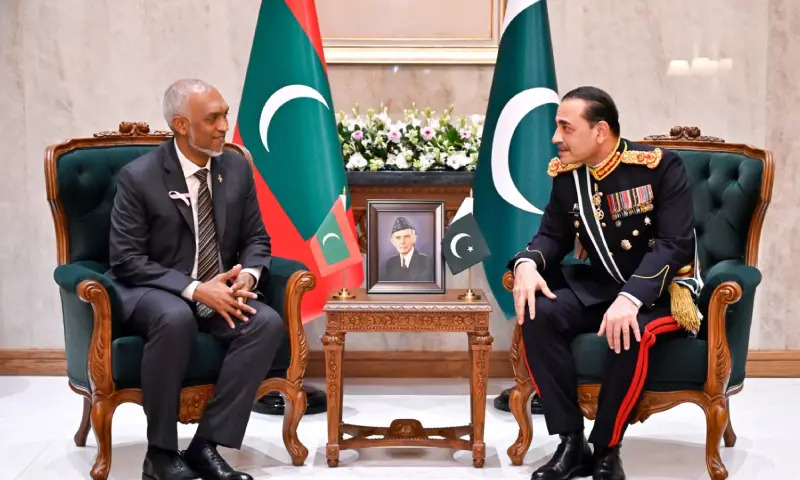
The Core Development
In a landmark diplomatic engagement marking the first visit by a Maldivian head of state to Pakistan in eleven years, President Dr Mohamed Muizzu met with Chief of Army Staff General Asim Munir in Islamabad on Wednesday. The high-level conference, convened during President Muizzu's three-day official visit upon the invitation of Prime Minister Shehbaz Sharif, centered on reinforcing bilateral defence cooperation, counter-terrorism frameworks, and maritime security within the Indian Ocean region.
The engagement arrives as both nations commemorate the 60th anniversary of their formal diplomatic relations, originally established in 1966. According to official briefings, both leaders engaged in exhaustive discussions addressing shared regional stability concerns, capacity-building initiatives for defence personnel, and collaborative intelligence mechanisms. The military leadership reaffirmed Pakistan's commitment to supporting the Maldives through technical assistance, institutional training programmes, and enhanced surveillance coordination across critical sea lines of communication.
Commercial & Economic Implications
Beyond military diplomacy, the strategic overtures hold substantial economic consequence for Pakistan's trade corridors and regional shipping routes. The Maldives occupies a critical geographic position along vital commercial transit lanes in the northern Indian Ocean, through which a significant portion of Pakistan's sea-bound exports and hydrocarbon imports flow. Strengthening bilateral security frameworks reduces vulnerability to maritime piracy, narcotics trafficking, and irregular disruptions, stabilizing logistics pricing and cargo insurance premiums for Pakistani freight operators.
Furthermore, the normalization of high-level state exchanges creates clear avenues for trade diversification. Pakistan's wholesale sectors, particularly pharmaceutical manufacturing, agricultural commodities including rice and fresh produce, and construction materials, stand to gain market access in the import-reliant Maldivian economy. For domestic retail distribution and wholesale supply chains, expanded commercial agreements could open streamlined export channels, providing foreign exchange inflows and offsetting local trade deficits.
Related Intelligence: Pakistan, Turkiye, Qatar, Indonesia Sign Landmark Defence Cooperation Accord
Stakeholder Perspectives & Market Reactions
Domestic trade bodies and foreign policy analysts have viewed the diplomatic resumption with measured optimism. The Federation of Pakistan Chambers of Commerce and Industry noted that institutionalizing bilateral links could revive neglected preferential trade discussions, urging policymakers to prioritize direct shipping connectivity and business visa facilitation to accelerate private-sector engagement.
Regional security experts emphasized the strategic dimension of the meeting, observing that Male's re-engagement with Islamabad signals a recalibration of island diplomacy and multi-vector foreign policy in South Asia. Legal and policy observers noted that formal institutional cooperation between the two armed forces provides a foundational framework under which future commercial, port management, and investment treaties can be secured safely without regulatory friction.
Forward Outlook & Key Watchpoints
The immediate horizon will test how effectively both capitals translate high-level security dialogues into tangible bilateral agreements. Over the coming quarters, key indicators will include the formalization of joint military exercises, the scheduling of bilateral joint commission meetings on commerce, and discussions surrounding direct commercial aviation links connecting Karachi or Lahore to Male.
Market observers will closely monitor follow-up trade delegations, tariff reduction dialogues, and potential maritime security memorandums of understanding. For Pakistani traders and corporate stakeholders, the durability of this diplomatic revitalization will depend on whether both administrations establish clear legal mechanisms to facilitate cross-border banking transactions, cargo handling, and mutual investment protection.
Join Our Official WhatsApp Channel
Receive live commodity alerts, policy changes, and commercial intelligence directly on WhatsApp.