
North Korea Ballistic Missile Test Escalates Regional Tensions and Supply Risks
North Korea launched a ballistic missile off its east coast following its rejection of an International Atomic Energy Agency resolution, heightening geopolitical instability across East Asian maritime routes and global energy markets.
The Core Development
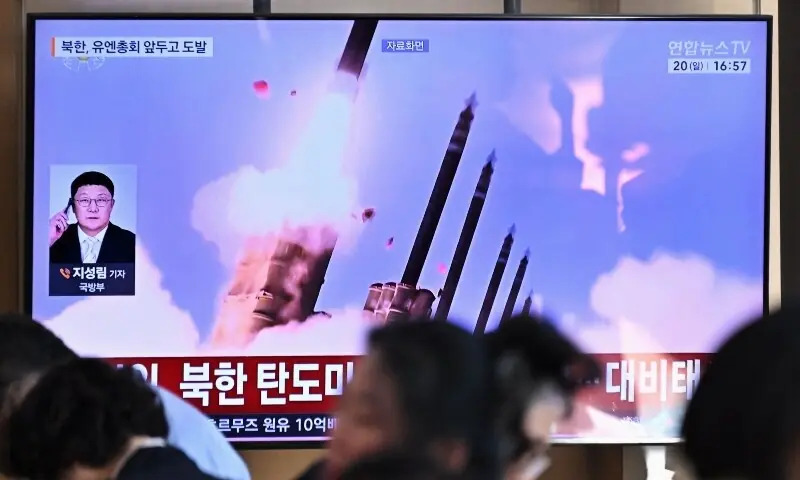
North Korea launched a ballistic missile into the East Sea on Sunday afternoon, intensifying military friction on the Korean Peninsula just days after Pyongyang formally reiterated its posture as an irreversible nuclear-armed power. According to South Korea's Joint Chiefs of Staff (JCS), the projectile was fired from the vicinity of Wonsan on North Korea's eastern coast at approximately 3:00 pm local time (0600 GMT). South Korean radar systems and allied surveillance assets tracked the missile's trajectory as it plunged into maritime waters between the Korean Peninsula and Japan, prompting heightened border readiness across Seoul and emergency intelligence coordination with Tokyo and Washington.
The military operation followed eight days after the Democratic People's Republic of Korea (DPRK) conducted a coordinated salvo of short-range ballistic missiles, an exercise later characterized by state media as a simulated joint tactical firepower drill. Crucially, this latest escalation arrives immediately after Pyongyang's categorical rejection of a binding resolution passed by the International Atomic Energy Agency (IAEA) general conference in Vienna, which demanded an immediate halt to North Korea's uranium enrichment programs and unlawful ballistic missile development. By accelerating its testing timeline, the regime has signaled total defiance of United Nations Security Council mandates, forcing trilateral defense alliances in Northeast Asia into acute alert postures.
Commercial & Economic Implications
Although centered in East Asia, persistent military escalations along strategic littoral borders generate direct transmission channels to global shipping networks and developing economies, including Pakistan. The East Sea and adjacent Western Pacific transit corridors represent high-density maritime arteries carrying finished goods, raw materials, and precision components between East Asian manufacturing hubs and South Asia, the Middle East, and Europe. Any sustained escalation or sudden airspace closure triggers immediate re-routing of commercial carriers, elevating bunker fuel consumption and inflating international marine hull insurance surcharges.
For Pakistan's import-dependent trade architecture, such developments compound ongoing macroeconomic challenges. South Korea and Japan remain pivotal suppliers of high-precision industrial tooling, completely knocked down (CKD) automotive assemblies, synthetic polymers, and specialized flat-rolled steel utilized across Pakistan's manufacturing sectors. Escalating risk premiums along Far Eastern shipping lanes directly increase landed costs at Karachi ports, eroding operating margins for commercial wholesalers and industrial assemblers. Furthermore, geopolitical tremors in East Asia invariably introduce speculative risk premiums into international energy markets, exposing Pakistan's delicate foreign exchange reserves to heightened volatility in global crude oil and liquefied natural gas (LNG) contracts.
Related Intelligence: Tour Fallout Highlights Cultural Sector Exposure to Middle East Geopolitical Rifts
Stakeholder Perspectives & Market Reactions
South Korean military leadership condemned the missile launch as a provocative breach of multiple international non-proliferation treaties, confirming that defense forces have instituted intensified intelligence monitoring alongside US operational commands. Japan's Ministry of Defense similarly lodged formal diplomatic protests through embassy channels in Beijing, warning that unannounced missile tests pose immediate, unacceptable risks to commercial civilian aviation and international maritime navigation in the Sea of Japan.
Global financial markets exhibited immediate risk-averse positioning, with benchmark crude oil futures stabilizing higher and capital shifting marginally toward safe-haven assets, including gold and the US dollar. In Pakistan, wholesale trade associations and manufacturing cartels expressed cautious concern over the accumulating external friction. Domestic business leaders observed that with local enterprises already contending with domestic credit constraints and thin import cover, any secondary geopolitical shock that disrupts Far Eastern supply deliveries or increases international shipping charges will rapidly flow downstream into domestic wholesale and retail consumer price indices.
Forward Outlook & Key Watchpoints
Diplomatic deliberations will now center on the United Nations Security Council, where Western partners will pursue formal condemnation, though historical voting patterns suggest structural resistance from Beijing and Moscow will prevent expansive multilateral sanctions. Intelligence analysts are monitoring whether Pyongyang will leverage this momentum toward a long-anticipated seventh underground nuclear detonation or the deployment of an upgraded military reconnaissance satellite before the conclusion of the fourth quarter.
For enterprise operators and commercial traders, vital watchpoints include prospective unilateral trade restrictions enacted by the Group of Seven, retaliatory joint deterrence maneuvers across the Yellow Sea and Sea of Japan, and adjustments by global maritime underwriters to Asian container freight corridors. For commercial houses in Pakistan, tracking currency fluctuations against regional trade partner currencies and locking in shipping contracts against Far Eastern routes will remain essential protective measures in navigating systemic geopolitical volatility.
Join Our Official WhatsApp Channel
Receive live commodity alerts, policy changes, and commercial intelligence directly on WhatsApp.