
Multan Train Derailment Leaves Five Dead, Disrupting Key Transit Route
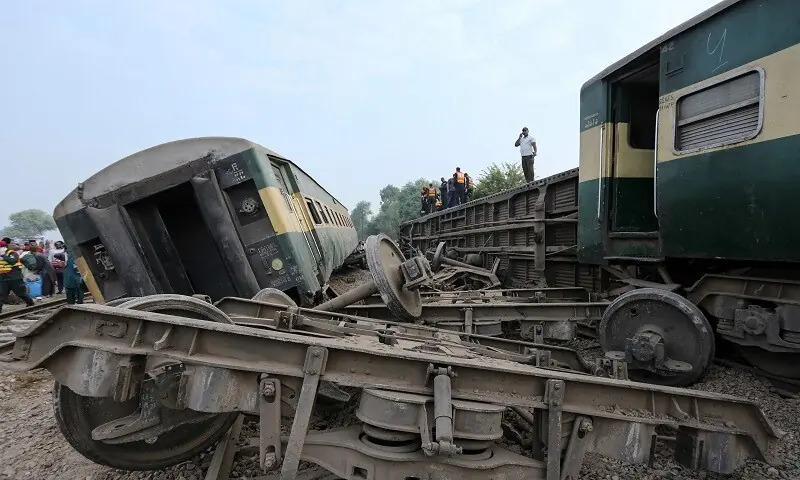
At least five passengers died and over forty sustained injuries when the Peshawar-bound Rehman Baba Express derailed near Sher Shah in Multan, disrupting national rail corridors and prompting high-level safety inquiries.
The Core Development
A critical rail accident in southern Punjab has resulted in significant loss of life and raised renewed concerns over Pakistan's transport infrastructure. On Tuesday, the Peshawar-bound Rehman Baba Express derailed near the Sher Shah Railway Station in Multan district, leaving at least five passengers dead and more than 40 others injured, several of them critically.
Pakistan Railways Chief Executive Officer Muhammad Hafeezullah confirmed the casualty figures, noting that local rescue operations mobilized immediately to extricate passengers trapped in mangled carriages. Medical emergency protocols were enacted across tertiary hospitals in Multan to handle the influx of wounded. Preliminary assessments conducted by technical teams indicate that the accident likely stemmed from a mechanical defect in one of the passenger coaches rather than track sabotaging or signal failure. Following the incident, Minister for Railways Hanif Abbasi confirmed that the Federal Government Inspector of Railways has been designated as the primary inquiry officer tasked with determining operational culpability and submitting a formal investigative dossier.
Commercial & Economic Implications
The derailment along the central artery connecting Punjab, Sindh, and Khyber Pakhtunkhwa immediately reverberated through the domestic transport and logistics networks. Multan serves as a vital junction on the Main Line-1 (ML-1) corridor, which handles both heavy passenger volume and essential freight logistics across the country. Service interruptions on this trunk route invariably lead to cascading delays across the entire rail network, compelling intermediate transit halts for both domestic passenger services and cargo freighters.
For wholesale traders and distribution networks, prolonged line closures force cargo diversion to costlier road freight options, driving up logistical expenses for bulk commodities, agricultural inputs, and manufactured goods. The rail system remains a cost-effective mode of moving freight between the ports in Karachi and industrial centers in upper Punjab and Khyber Pakhtunkhwa. Persistent infrastructure failures create delivery bottlenecks, add storage overheads, and contribute to short-term inflationary pressure on consumer staples reliant on punctual inter-provincial distribution.
Stakeholder Perspectives & Market Reactions
The tragedy has reignited intense scrutiny from commuter advocacy groups, labor unions, and transport operators regarding chronic underfunding and deferred maintenance across Pakistan Railways. Industry observers have pointed out that rolling stock inspections have suffered due to resource constraints and procurement delays for critical spare parts.
Business chambers in central Punjab expressed concerns regarding the broader reliability of state-managed transit corridors. Representatives noted that while passenger safety is the paramount issue, structural instability in railway operations diminishes commercial confidence in domestic rail freight. Meanwhile, officials within Pakistan Railways emphasized that emergency clearing operations were prioritized to restore regular line velocity, assuring that any discovered technical negligence would face punitive institutional action under statutory transport protocols.
Forward Outlook & Key Watchpoints
The immediate priority remains the conclusion of the formal inquiry by the Federal Government Inspector of Railways, with findings expected to guide departmental disciplinary measures and technical protocols. Regulatory bodies will be closely monitoring whether the inquiry results in systemic mechanical revisions for the Rehman Baba Express fleet and comparable long-haul services.
Over the medium term, the incident will intensify pressure on the Ministry of Railways and federal fiscal authorities to accelerate capital expenditure allocated toward track modernization and rolling stock refurbishment. Market participants and logistics operators will closely watch the resumption timeline for full-capacity freight and passenger transits through the Multan junction, alongside government commitments to modernizing the critical ML-1 network.
Join Our Official WhatsApp Channel
Receive live commodity alerts, policy changes, and commercial intelligence directly on WhatsApp.