
Maulana Fazlur Rehman Accuses Government of Betrayal Amid KP Crisis
JUI-F chief Maulana Fazlur Rehman has accused the federal government of breaking commitments made during mediation efforts, culminating in the imposition of emergency rule in Khyber Pakhtunkhwa.
The Core Development
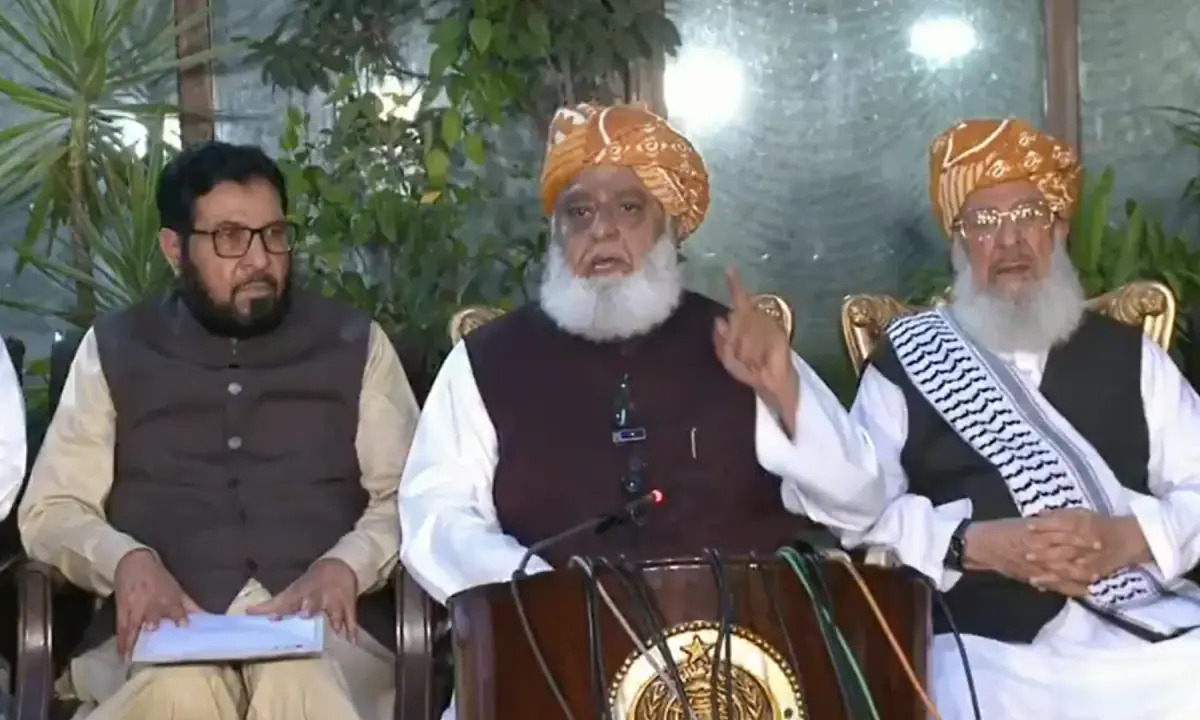
In a dramatic escalation of Pakistan's protracted political crisis, Jamiat Ulema-i-Islam-Fazl (JUI-F) chief Maulana Fazlur Rehman has accused the federal coalition government of reneging on fundamental commitments. Speaking at an emergency press conference held at his Islamabad residence following a consultative meeting of the party's Central Core Committee, Maulana Fazl detailed how his intensive backchannel mediation between the ruling establishment and the Pakistan Tehreek-e-Insaf (PTI) was abruptly undermined.
Until Sunday, the veteran politician had been positioned as the pivotal mediator capable of bridging the profound chasm between the Centre and the opposition party. Both political factions had engaged in separate, high-stakes consultations with the JUI-F leadership to diffuse mounting tensions. However, these delicate negotiations collapsed precipitously, culminating in the federal cabinet's decision to invoke emergency measures and impose governor's rule in Khyber Pakhtunkhwa, where the PTI held provincial power. Maulana Fazl expressed deep dismay, asserting that the government's unilateral actions rendered political dialogue a charade and violated the spirit of mutual accommodation necessary for national stability.
Commercial & Economic Implications
The breakdown of political dialogue and the subsequent imposition of administrative emergency in Khyber Pakhtunkhwa carry severe ramifications for Pakistan's fragile economic recovery. Commercial activity across the northwestern province faces immediate disruption, threatening vital wholesale distribution networks and retail trade corridors that connect domestic markets with Central Asian trade routes.
Financial analysts at major brokerage houses in Karachi note that prolonged political instability directly undermines market sentiment, triggering capital flight and depressing equity valuations. Supply chains originating from or passing through Khyber Pakhtunkhwa are increasingly vulnerable to roadblocks, strikes, and logistical bottlenecks. For ordinary consumers, heightened uncertainty translates directly into inflationary pressures, as commercial transporters factor security risks into freight rates, driving up the cost of essential food commodities and manufactured goods nationwide.
Related Intelligence: Riyadh Airport Strike Escalates Gulf Crisis and Threatens Trade Routes
Stakeholder Perspectives & Market Reactions
Business councils and trade associations have voiced grave concern over the deterioration of the political landscape. Representatives from the Federation of Pakistan Chambers of Commerce and Industry (FPCCI) emphasized that sustained civil unrest and constitutional crises paralyze industrial planning and deter foreign direct investment at a juncture when the country is desperately attempting to stabilize its macroeconomic indicators under an International Monetary Fund (IMF) program.
Legal experts have similarly questioned the constitutional propriety of bypassing provincial mandates through emergency declarations, warning that protracted judicial and political litigation will further bog down state apparatuses. Meanwhile, public response remains polarized, with business districts in major urban centers exhibiting cautious trading behavior as merchants brace for potential nationwide protests called by opposition groups.
Forward Outlook & Key Watchpoints
As Pakistan navigates this dangerous political precipice, key stakeholders are closely monitoring several critical watchpoints over the coming weeks. The primary variable remains the legal and legislative challenges mounted against the governor's rule in Khyber Pakhtunkhwa, which could either exacerbate tensions or force a judicial compromise.
Market participants will closely scrutinize upcoming legislative sessions, institutional responses to public mobilization, and potential signals from international lenders regarding the durability of economic reforms. Unless the ruling coalition and opposition forces establish a credible framework for political reconciliation, the compounding governance crisis threatens to derail hard-won fiscal stabilization efforts, leaving commercial markets highly volatile and vulnerable to external shocks.
Join Our Official WhatsApp Channel
Receive live commodity alerts, policy changes, and commercial intelligence directly on WhatsApp.