
Karachi Canal Encroachment Sparks Urban Flood Fears and Trade Risks
Civil society and environmental experts have raised alarms over construction and capping of Karachi's Nehr-i-Khayyam stormwater drain, warning the project invites catastrophic urban flooding and deep commercial disruption.
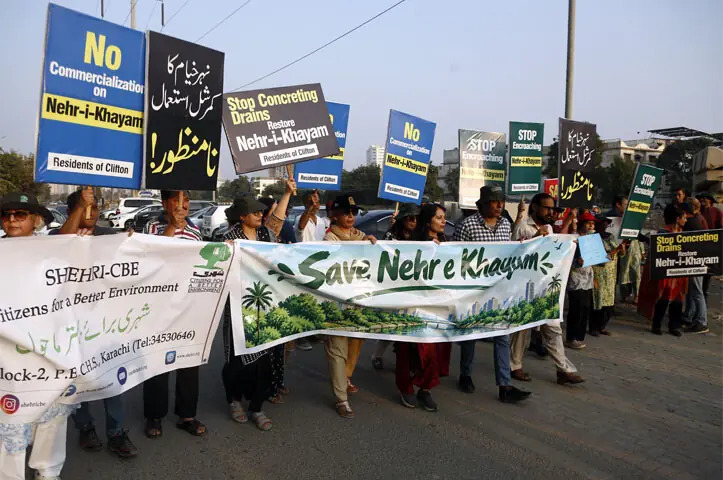
The Core Development
A contentious infrastructure move in Karachi’s prime Clifton area has sparked intense public backlash, as environmental advocates, civil society groups, and local residents rallied against ongoing construction over Nehr-i-Khayyam, a crucial natural drainage corridor in Clifton Block 5. The demonstration brought together urban planners and community leaders demanding an immediate suspension of civil works until a comprehensive Environmental Impact Assessment (EIA) is conducted and made accessible for public review.
Demonstrators expressed grave concern that the provincial and municipal drive to culvert and slab over the open drain will significantly constrict its effective hydrological width, setting the stage for unauthorized commercialization and real estate monetization. Historical satellite imagery and ground inspections reveal that dense native tree canopies once flanked both sides of the canal. Recent site assessments demonstrate severe deforestation along the active construction stretch, where natural embankments have been cleared to make way for reinforced concrete framing.
Urban hydrology experts emphasize that covering natural open-air storm channels impedes silt removal, obstructs emergency machinery access during monsoon flash floods, and creates severe subsurface blockages. Given Karachi’s vulnerability to intense meteorological events, unengineered tampering with prime drainage channels represents an immediate environmental hazard to the southern metropolitan district.
Commercial & Economic Implications
While municipal authorities frequently view the capping of urban drains as an avenue to unlock high-value land for real estate, recreational boardwalks, or commercial retail strip developments, the collateral macro-financial liabilities are substantial. Southern Karachi, housing Clifton and adjacent districts, serves as the operational epicenter for top corporate headquarters, retail centers, high-end hospitality, and regional distribution networks. Any failure in stormwater discharge mechanisms threatens localized supply chain corridors and distribution channels.
Urban flooding historically brings Pakistan's commercial capital to a standstill. Inundated thoroughfares halt wholesale freight movement from Karachi Port and Port Qasim, leaving imported inventory stranded and manufacturing inputs delayed. For regional trading houses and wholesale networks, prolonged waterlogging translates to degraded road infrastructure, supply shortages, rising logistical detention charges, and direct physical loss of dry-port warehouse consignments. When major arteries flood, commercial trade losses mount into billions of rupees within days, driving up local retail inflation on consumer goods due to artificial transport bottlenecks.
Related Intelligence: Security Escalation in Balochistan Threatens Supply Corridors and CPEC Investment
Stakeholder Perspectives & Market Reactions
Public sentiment remains uniformly critical of the opaque execution surrounding the Nehr-i-Khayyam development. Protest participants carrying placards warned that turning public ecological buffers into commercial venues violates basic civic safety. Legal advocates point out that initiating major urban interventions without mandatory public hearings under the Sindh Environmental Protection Act (SEPA) 2014 renders the ongoing construction legally vulnerable to judicial intervention.
Commercial traders and regional merchant bodies have voiced shared apprehensions over drainage obstruction. Past monsoon cycles have repeatedly demonstrated that water overflows from choked drains quickly flood arterial roads such as Khayaban-e-Iqbal and Gizri, cutting off key wholesale nodes from downtown commercial districts. Financial stakeholders argue that municipal authorities must prioritize resilient, nature-based drainage solutions rather than pouring concrete over critical flood-relief arteries.
Forward Outlook & Key Watchpoints
The trajectory of the Nehr-i-Khayyam development now hinges on regulatory compliance and potential public-interest litigation. Legal petitions are anticipated in the Sindh High Court to secure a stay order against further civil works pending an independent environmental evaluation. Watchpoints include whether the Sindh Environmental Protection Agency will issue a formal stop-work notice and demand an authentic hydrological audit.
Moving toward the upcoming monsoon seasons, trade bodies and risk analysts will closely monitor municipal response mechanisms. If the drainage capacity of Nehr-i-Khayyam remains impaired by culverting structures, municipal planners risk orchestrating a preventable civic and economic disaster. The outcome of this dispute will set a vital governance precedent for the preservation of urban drainage infrastructure across Pakistan.
Join Our Official WhatsApp Channel
Receive live commodity alerts, policy changes, and commercial intelligence directly on WhatsApp.