
Government and Opposition Open High-Stakes Talks Ahead of PTI Islamabad March
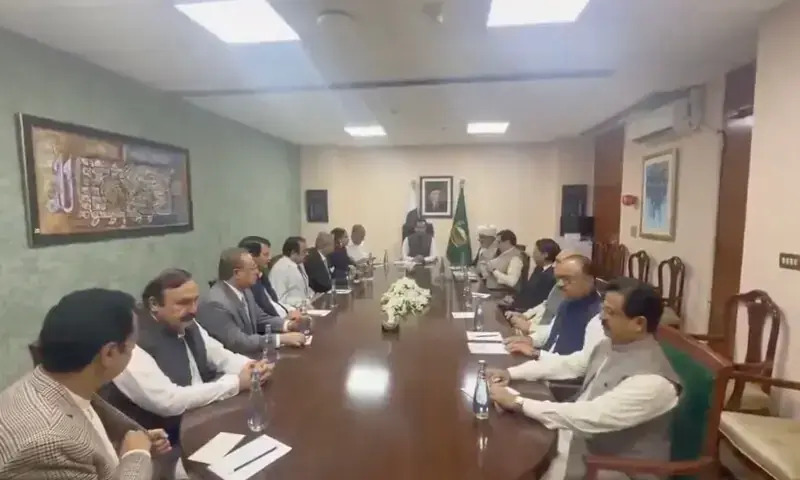
Government and opposition delegations initiated a second round of high-stakes negotiations in Islamabad to defuse political tensions surrounding the PTI's planned October 4 protest march.
The Core Development
Political tensions in Islamabad escalated significantly on Saturday afternoon as delegations from the federal government and opposition parties commenced their second round of crucial negotiations. Chaired by National Assembly Speaker Ayaz Sadiq, the high-level meeting is designed to defuse an intensifying political crisis gripping the country. The dialogue comes directly ahead of the Pakistan Tehreek-e-Insaf (PTI) planned October 4 protest march toward the federal capital, an action organized to demand the release of jailed party founder Imran Khan.
The standoff has dominated national headlines and created an atmosphere of acute uncertainty across major urban centers. Earlier in the day, Khyber Pakhtunkhwa Chief Minister Sohail Afridi adopted a defiant stance, voicing unwavering determination to execute the long march on October 4. Mr Afridi publicly vowed to prevent any repetition of the violent events witnessed on May 9, 2023, setting up a potential collision course with federal security apparatuses.
In immediate response, Parliamentary Affairs Minister Dr Tariq Fazal Chaudhry cautioned that inflammatory rhetoric and uncompromising statements from provincial leadership could severely undermine and derail the delicate negotiation process currently underway.
Commercial & Economic Implications
For Kalyar Traders and the broader business community across Pakistan, prolonged political instability and looming street agitations pose severe economic hazards. Financial markets, retail trade, and wholesale distribution networks are acutely sensitive to civil unrest in the federal capital. Containerized roadblocks, suspension of public transport, and commercial shutdowns traditionally accompany major political marches in Islamabad, strangling supply chains and disrupting the smooth transit of goods between Punjab, Khyber Pakhtunkhwa, and major port facilities in Karachi.
Inflationary pressures remain a persistent concern for retail markets. Supply chain bottlenecks caused by sudden security lockdowns invariably drive up transportation costs, which are subsequently passed down to ordinary consumers already burdened by high utility tariffs and compressed purchasing power. Wholesale markets in Rawalpindi and Islamabad report immediate dampening of commercial activity as merchants adopt conservative inventory strategies ahead of the October 4 deadline, fearing property damage and prolonged market closures.
Related Intelligence: Government and PTI Hold High-Stakes Talks Amid Islamabad March Deadlock
Stakeholder Perspectives & Market Reactions
Business councils, trader associations, and industrial bodies have expressed deep dismay over the escalating rhetoric between the ruling coalition and the political opposition. Representatives from prominent chamber of commerce entities have issued urgent appeals for restraint, emphasizing that macroeconomic recovery remains extremely fragile and vulnerable to political shocks.
Legal experts and constitutional analysts monitoring the talks suggest that while parliamentary dialogue mediated by Speaker Ayaz Sadiq represents a positive institutional mechanism, deeply entrenched positions on both sides leave little room for compromise. Official statements from federal ministers stress the primacy of the writ of the state, whereas opposition leaders maintain that peaceful assembly is a fundamental democratic right that cannot be arbitrarily suppressed.
Forward Outlook & Key Watchpoints
As the October 4 march approaches, domestic financial markets and commercial stakeholders are closely monitoring key operational indicators. Critical watchpoints include the progress and outcome of ongoing parliamentary negotiations, the potential deployment of civil armed forces in Islamabad, and statements from provincial executives regarding route planning.
Policy enforcement measures, traffic diversion plans, and potential administrative clampdowns will dictate the immediate trajectory of business confidence. A breakdown in talks could trigger severe market volatility, currency pressure, and a sharp contraction in retail turnover during the first week of October.
Join Our Official WhatsApp Channel
Receive live commodity alerts, policy changes, and commercial intelligence directly on WhatsApp.