
Federal Constitutional Court Bars Risk Allowance for KP Police Administrative Staff
The Federal Constitutional Court has ruled that administrative staff within the Khyber Pakhtunkhwa Police are ineligible for risk allowance, setting aside a previous Peshawar High Court judgment.
The Core Development
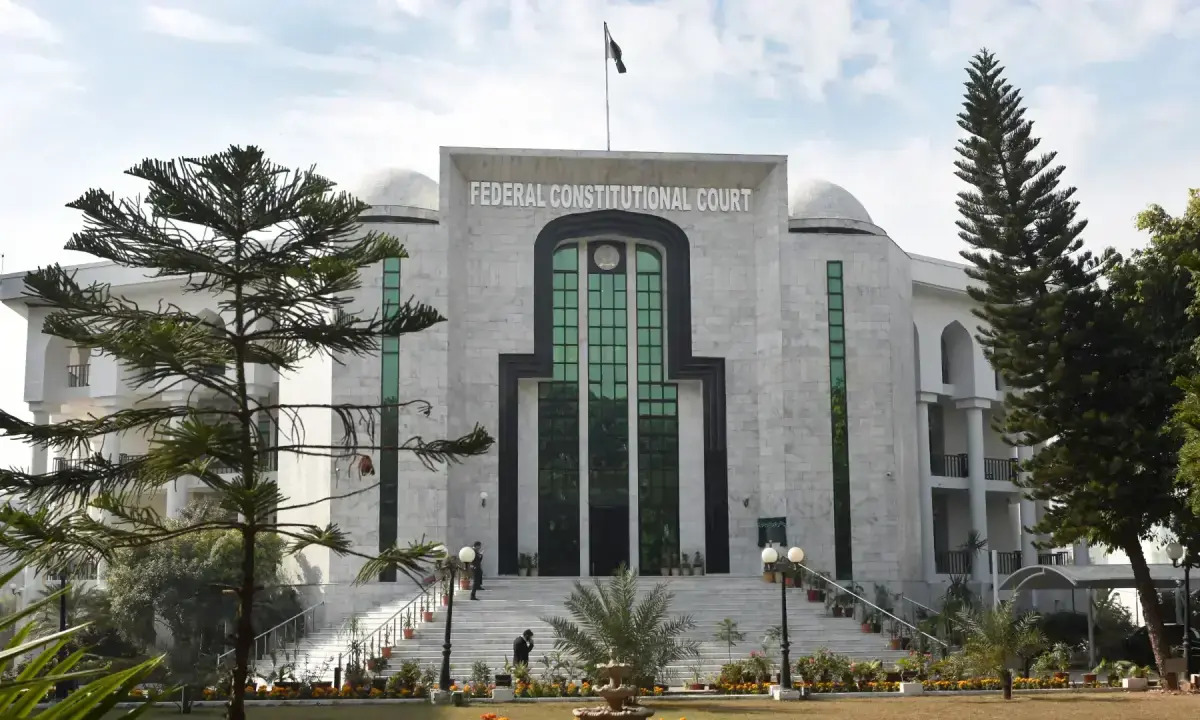
The Federal Constitutional Court (FCC) has formally determined that administrative and ministerial staff of the Khyber Pakhtunkhwa (KP) Police are not legally entitled to draw risk allowances reserved for active-duty personnel. The authoritative verdict was handed down in Islamabad by a two-member bench comprising Justice Aamer Farooq and Justice Syed Arshad Hussain Shah, resolving a long-disputed payroll classification controversy within the provincial security apparatus.
In its comprehensive ruling, the bench overturned an April 10, 2025 decision issued by the Peshawar High Court’s Mingora Bench (Dar-ul-Qaza), Swat, which had previously extended hazardous duty stipends to non-operational departmental employees. The judgment, authored by Justice Aamer Farooq, articulated a stringent legal demarcation between uniformed police personnel deployed in field operations fraught with physical hazards and the administrative secretariat working behind desks. The bench observed that statutory provisions under the Khyber Pakhtunkhwa Police Act, 2017 delineate distinct functional mandates, confirming that compensatory hazard packages cannot be extended indiscriminately across state institutions without operational exposure.
Commercial & Economic Implications
While ostensibly a public-sector employment dispute, the ruling carries direct fiscal ramifications for provincial balance sheets and regional economic stability. Khyber Pakhtunkhwa continues to face acute revenue imbalances, exacerbated by heightened security expenditures and mounting wage burdens. The inclusion of non-combatant, ministerial workers in risk-adjusted compensation tiers had threatened to create unsustainable recurrent budgetary liabilities, compounding the province's reliance on federal fiscal transfers and deficit financing.
By capping the expansion of non-essential wage top-ups, the judiciary has effectively shielded provincial resources from unchecked operational inflation. Unrestrained public payroll expansion often diverts scarce budgetary headroom away from productive capital investments, road transport infrastructure, and commercial facilitation corridors across major commercial hubs like Peshawar, Swat, and Mardan. For retail distribution networks and wholesale merchants operating within the province, public spending discipline remains vital to stabilizing municipal taxation rates and maintaining public credit without resorting to arbitrary municipal levies on commercial businesses.
Related Intelligence: Israeli Plan to Reopen Route 463 Threatens Ramallah Isolation and Regional Stability
Stakeholder Perspectives & Market Reactions
Fiscal policy analysts and corporate legal practitioners have endorsed the determination, emphasizing that civil-service wage parity must be anchored in objective operational risk metrics. Legal representatives for the provincial exchequer argued throughout the proceedings that applying combatant-level benefits to clerical personnel blurred regulatory classifications and diluted the incentives intended for frontline counter-insurgency officers.
Conversely, associations representing public-sector clerical bodies voiced frustration over the ruling, contending that ministerial employees in volatile districts operate under baseline security pressures despite performing sedentary duties. However, broad financial observers note that allowing the precedent to stand would have triggered domino litigation across other provincial departments, including municipal revenue teams and disaster response bodies, which could have triggered massive retrospective claims against an already strained treasury.
Forward Outlook & Key Watchpoints
The implementation of the Federal Constitutional Court’s ruling is anticipated to prompt an immediate audit of provincial police disbursement mechanisms to halt redundant allowance distributions. The KP Finance Department, in tandem with the Central Police Office, will oversee the alignment of payroll records with the bench’s strict legal taxonomy.
In the coming quarters, watchpoints will center on whether public-sector clerk syndicates pursue procedural review petitions or lobby provincial legislators for alternative executive compensatory stipends. Market observers will track how the provincial administration allocates preserved operational funds, specifically evaluating whether retained fiscal capacity translates into improved commercial safety protocols, trade transit protection along border corridors, and sustained regional market stability.
Join Our Official WhatsApp Channel
Receive live commodity alerts, policy changes, and commercial intelligence directly on WhatsApp.