
Rare Van Gogh Unveiling In Hong Kong Signals Asian Capital Resilience
The public preview and impending auction of Vincent van Gogh's 'Chestnut Trees in Blossom' in Hong Kong underscores Asian capital dominance and alternative asset liquidity amidst global market turbulence.
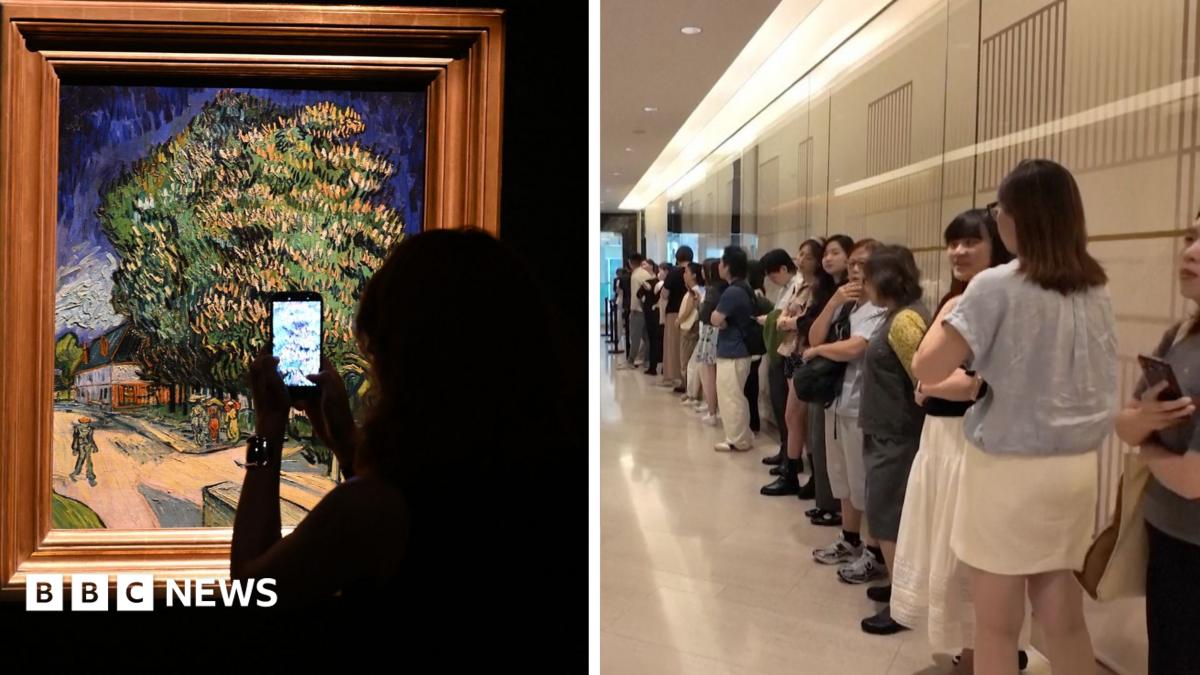
Geopolitical & Core Developments
The public re-emergence of Vincent van Gogh's seminal 1890 masterpiece, Châtaigniers en fleurs (Chestnut Trees in Blossom), in Hong Kong marks a significant confluence of international cultural heritage and global high-finance capital flows. Unseen by the public for six decades, the masterwork's arrival at an Asian financial hub—rather than traditional auction centers in London or New York—underscores an accelerating pivot in the global concentration of private wealth. Crowds converging on the exhibition center highlight both cultural reverence and the strategic positioning of Hong Kong as an indispensable gateway for institutional and ultra-high-net-worth liquidity.
The painting, created during the Dutch post-impressionist's intensely productive final months in Auvers-sur-Oise, carries an extraordinary provenance that has historically served as a benchmark for valuation across blue-chip art indices. State-adjacent institutions and private conglomerates across East Asia, Europe, and North America are closely tracking the upcoming auction, where bidding is anticipated to challenge historical records. This transaction reflects not merely private acquisition trends, but an evolving geopolitical posture where international auction powerhouses actively anchor their marquee sales in Greater China to capture institutional demand across the Asia-Pacific region.
[Global Trade](/news/yemen-war-scenarios-houthi-red-sea-trade-impact) & Economic Ripples
While masterworks of this magnitude inhabit a specialized tier of high finance, their transactional dynamics send direct signals through broader capital markets. Premier fine art functions increasingly as a sophisticated instrument of wealth preservation, liquidity hedging, and cross-border portfolio diversification. In periods defined by volatile foreign exchange markets, persistent sovereign debt challenges, and shifting equity valuations, institutional capital routinely migrates toward rare, non-correlated physical assets.
Moreover, high-value art transactions generate notable economic multipliers across premium logistics, international transit corridors, and specialized financial underwriting. The movement, insurance, and tax structuring surrounding transactions of this caliber rely heavily on specialized maritime and air-freight transport infrastructure, secured storage facilities, and freeport mechanisms operating across Hong Kong, Switzerland, and Singapore. The resilient turnover of premier tangible assets also serves as a leading indicator of cross-border financial sentiment, demonstrating that high-net-worth private wealth continues to seek stable safe-haven conduits amidst broader monetary tightening cycles and commodity fluctuations.
Related Intelligence: Yemen War at Crossroads as Escalation Threatens Global Trade Corridors
International Reactions & Diplomatic Stances
Market analysts, institutional wealth directors, and international cultural curators have characterized the Hong Kong exhibition as a structural litmus test for the premium international art market. Financial analysts note that the deployment of premier historical assets into Hong Kong reflects deep institutional trust in the territory's fiscal regime, duty-free status, and legal predictability regarding international property transactions.
Cultural attaches and European heritage analysts have emphasized the globalized stewardship of Western canonical works, noting that historic European canvases are increasingly integrated into multi-jurisdictional private collections and pan-Asian private institutions. Several international wealth management consultancies observe that despite persistent geopolitical discourse surrounding global economic fragmentation, cross-border capital allocations for tier-one cultural property continue to transcend ideological divides, illustrating an integrated and frictionless liquidity tier at the apex of global wealth.
Strategic Outlook & Future Scenarios
Moving into the forthcoming bidding session, the clearing price of Châtaigniers en fleurs will likely set baseline benchmarks for alternative asset pricing through the coming fiscal quarters. Should the sale meet or exceed upper-bracket estimates, it will reaffirm Hong Kong's role as an unassailable center for international fine art and capital liquidity, incentivizing further shifts of Western collections toward eastern auction hubs.
Conversely, any structural resistance among institutional bidders could prompt private asset houses to reassess liquidity expectations and alter the timing of upcoming blue-chip liquidations. The medium-term outlook points to sustained competition between regional centers, such as Singapore and Tokyo, seeking to replicate Hong Kong's low-tariff framework and logistics capacity for high-value alternative assets. As international macro conditions evolve, the transaction will stand as an instructive barometer of global liquidity distribution, currency resilience, and high-capital confidence.
Join Our Official WhatsApp Channel
Receive live commodity alerts, policy changes, and commercial intelligence directly on WhatsApp.