
National Assembly Ratifies Emergency Rule Across Khyber Pakhtunkhwa
The National Assembly has formally endorsed the federal government's proclamation of emergency in Khyber Pakhtunkhwa, consolidating administrative oversight amid mounting constitutional friction and regional market uncertainty.
The Core Development
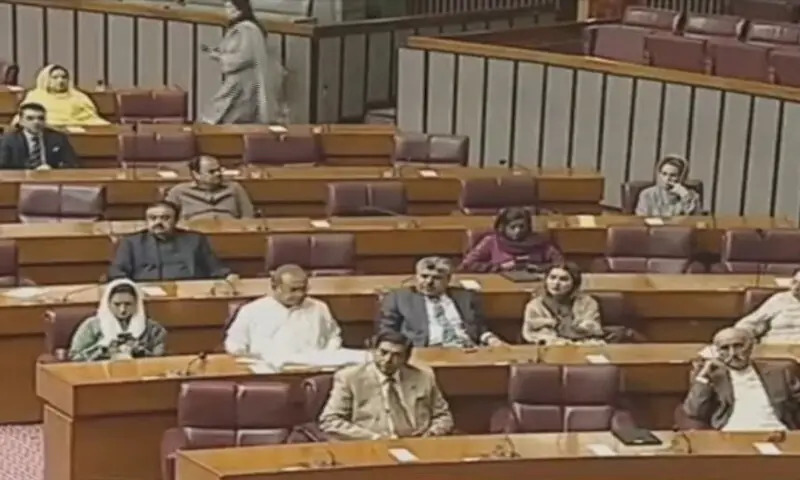
In a pivotal legislative session, the National Assembly on Wednesday formally ratified the federal government’s proclamation of emergency in Khyber Pakhtunkhwa (KP). The statutory motion, moved by Minister for Parliamentary Affairs Tariq Fazal Chaudhry and detailed by Federal Law Minister Azam Nazeer Tarar, was approved by a definitive majority vote after parliamentary authorities suspended the regular Question Hour to prioritize the matter.
This legislative endorsement cements the Centre's decision taken earlier this week to enforce Governor’s Rule under the constitutional framework of Article 232 and Article 234. The executive order follows sustained allegations by the federal cabinet pointing to an institutional breakdown and what federal spokespersons characterized as a deliberate administrative withdrawal by the provincial Pakistan Tehreek-e-Insaf (PTI) leadership from counter-terrorism coordination. Throughout the high-stakes proceedings, opposition lawmakers mounted aggressive verbal protests, rejecting the measure as an unconstitutional usurpation of provincial autonomy before staging walkouts and submitting formal dissents.
Commercial & Economic Implications
For commercial enterprises, wholesale merchants, and institutional supply chain operators, the imposition of direct federal oversight across Khyber Pakhtunkhwa injects severe operational volatility. KP serves as the vital geographic conduit connecting Pakistan's manufacturing hubs in Punjab and Sindh with regional export markets in Afghanistan and Central Asia. Enhanced security protocols, heightened checkpoint inspections, and potential administrative curfews risk slowing cargo throughput along the Indus Highway and the primary Torkham border crossing.
Wholesale distribution networks are already factoring in escalated transport risk premiums. Perishable FMCG inventory, cement deliveries, and essential food commodities moving into northern distribution centers face distribution bottlenecks, creating upward price pressure on urban retail shelves. Furthermore, municipal infrastructure contracts, public procurement tenders, and provincial development outlays under the Annual Development Programme (ADP) face an immediate administrative freeze pending the appointment and vetting of federal administrative teams. This halt disrupts liquidity flows to local contractors and allied secondary suppliers.
Related Intelligence: Bilawal Slams PTI Strategy as Political Turmoil Threatens Khyber Pakhtunkhwa Governance
Stakeholder Perspectives & Market Reactions
The legislative development has generated polarized reactions across commercial and legal fraternities. Trade bodies in Peshawar and Rawalpindi have expressed urgent concern over potential disruptions to domestic supply chains. The Sarhad Chamber of Commerce and Industry (SCCI) indicated that protracted political uncertainty in KP consistently depresses cross-border clearance volumes, dampening commercial revenue for logistics operators and wholesale trade houses.
Conversely, capital market analysts observe that direct federal governance may establish stronger short-term law enforcement oversight, which could stabilize investor sentiment if regional counter-terrorism metrics improve. Constitutional legal experts, however, caution that the resolution will swiftly face legal challenges before the Supreme Court of Pakistan. Legal petitions challenging the threshold of executive powers under Article 234 are expected to contest whether the federal government demonstrated sufficient constitutional necessity to bypass an elected provincial assembly.
Forward Outlook & Key Watchpoints
The immediate trajectory hinges on the administrative realignment orchestrated by the KP Governor’s office and federal interior authorities. Key operational metrics to track over the coming fortnight include the continuity of civil administrative machinery, civil secretariat postings, and commercial security across vital transit corridors.
Wholesale distributors, institutional investors, and corporate risk officers must closely monitor apex court proceedings regarding constitutional petitions filed by the provincial opposition. Additionally, business houses should track clearing velocity at major logistics dry ports and assess whether fiscal releases for public works projects face extended moratoriums, potentially reshaping sovereign revenue streams and private capital deployments across northwestern Pakistan throughout the quarter.
Join Our Official WhatsApp Channel
Receive live commodity alerts, policy changes, and commercial intelligence directly on WhatsApp.