
China Third-Quarter GDP Expands 4.5 Percent on Surging High-Tech Exports
China's gross domestic product expanded 4.5 percent in the third quarter, outperforming expectations on the back of aggressive high-tech export volumes despite persistent real estate headwinds.
Geopolitical & Core Developments
China's economic output expanded by 4.5 percent year-on-year in the third quarter, beating consensus estimates and marking a notable pickup from the previous quarter. The National Bureau of Statistics attributed this resilient performance primarily to accelerating industrial production and a sharp rebound in export volumes, specifically within artificial intelligence hardware, advanced electronics, and clean-energy infrastructure.
Beijing has systematically redirected sovereign capital and credit lines away from the legacy real estate sector toward cutting-edge industrial technology. This high-level industrial strategy has allowed state-backed and private manufacturing conglomerates to accelerate their outward shipments, offsetting muted domestic household consumption. However, the divergence between external export momentum and internal consumer sentiment remains pronounced. The long-running structural downturn across Chinese residential property markets continues to restrict municipal fiscal revenues and weigh heavily on private wealth accumulation, forcing policymakers to rely heavily on international trade surplus channels to achieve targeted annual benchmarks.
Global Trade & Economic Ripples
The unexpected strength in China's quarterly data has sent immediate ripples across global commodity benchmarks and trade lanes. In energy markets, Brent crude and liquefied natural gas futures experienced marginal upward support on expectations of elevated factory operating rates across coastal manufacturing hubs. Similarly, industrial metal pricing showed renewed firmness, with benchmark copper, aluminum, and nickel contracts trading higher on the London Metal Exchange.
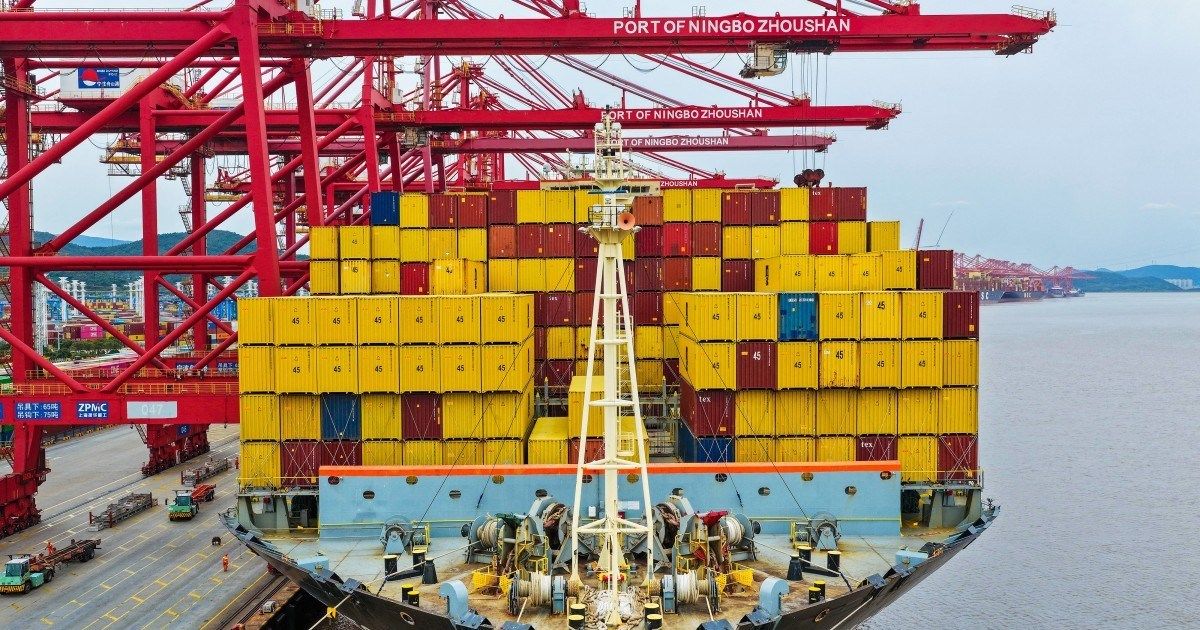
Concurrently, Chinese container volumes departing major hubs such as Shanghai and Ningbo-Zhoushan have surged, tightening capacity across Transpacific and Asia-Europe maritime routes. This industrial output surge has also provoked pushback from Western trading partners. The continuous flow of low-cost Chinese photovoltaic cells, high-spec battery systems, and electronic subcomponents is heightening competitive pressures on domestic producers across Europe and North America, accelerating regulatory friction regarding manufacturing subsidies and international supply chain dependencies.
Related Intelligence: Karachi Canal Encroachment Sparks Urban Flood Fears and Trade Risks
International Reactions & Diplomatic Stances
Global market participants and multilateral financial institutions reacted with measured optimism, tempered by persistent warnings regarding structural imbalances. Economists at the International Monetary Fund noted that while the headline 4.5 percent reading demonstrates China's formidable industrial capacity, sustainable long-term expansion will necessitate decisive fiscal intervention to stimulate domestic consumer demand and resolve local government debt burdens.
In Washington and Brussels, officials voiced heightened concern regarding China's export-led approach. European Commission representatives highlighted the intensifying risk of industrial overcapacity, reiterating that European markets cannot absorb an unconstrained influx of subsidized goods without reciprocal market access. Conversely, trade delegations across Southeast Asia, Latin America, and the Middle East welcomed the data, viewing Chinese industrial demand as a vital stabilizer for regional raw material suppliers and intermediate goods manufacturers.
Strategic Outlook & Future Scenarios
Looking ahead, China faces a delicate balancing act as it enters the final quarter of the year. While the 4.5 percent expansion places Beijing within realistic reach of its official annual growth objective of approximately 5 percent, external headwinds are mounting. Trade friction is expected to intensify ahead of upcoming international multilateral summits, where unilateral tariff adjustments, targeted technology export controls, and anti-dumping investigations will dominate trade agendas.
Should trade protectionism escalate further across Western jurisdictions, Beijing will face renewed urgency to roll out broader household stimulus, pension reforms, and targeted consumer subsidies. Without a sustained recovery in internal demand, China's reliance on external manufacturing absorption will remain highly vulnerable to trade barriers, shaping global industrial supply chains and macroeconomic policy for the coming year.
Join Our Official WhatsApp Channel
Receive live commodity alerts, policy changes, and commercial intelligence directly on WhatsApp.