
Busan Shark Stranding Captivates Millions Amid Rescue Efforts
A 3.5-metre shark trapped in a South Korean canal has attracted 600,000 visitors, prompting complex rescue operations by maritime authorities.
The Core Development
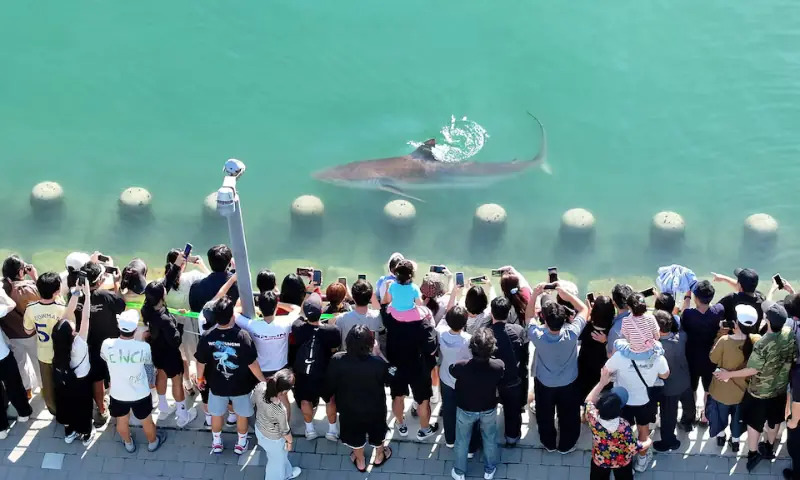
A 3.5-metre shark stranded within a narrow canal in the major South Korean port city of Busan has emerged as an unprecedented wildlife phenomenon, drawing an estimated 600,000 spectators to the urban waterfront over a two-week period. The apex predator was first sighted on September 18 within a restricted waterway situated in Busan's bustling North Port. As days elapsed without the animal navigating its own return to the open sea, local municipal authorities and maritime agencies initiated a formal rescue operation to guide the creature back to its natural habitat. On Tuesday, the South Korean Coast Guard, alongside allied environmental and municipal bodies, deployed specialized watercraft equipped with high-pressure water jets. The tactical objective was to spray controlled streams of water behind the shark, gently propelling it toward the adjacent ocean. However, video documentation published by Yonhap News Television revealed that the marine animal resisted the water currents, turning away from the designated escape route and remaining entrapped within the urban canal network. In response to the failed initial intervention, regional officials announced updated protocols, planning to deploy specialized containment nets on Friday to safely corral and guide the shark out of the waterway, as detailed by the Chosun Daily.
Commercial & Economic Implications
While the stranding is fundamentally an ecological and wildlife management event, unexpected mass public gatherings of this scale inherently generate localized economic ripples that hold instructive value for commercial and retail sectors. The sudden influx of 600,000 visitors to the North Port precinct created a localized economic boom for surrounding vendors, street food stalls, parking operators, and retail establishments operating in the vicinity of the canal. Informal commerce flourished as crowds gathered daily along the concrete banks to observe the rare urban wildlife spectacle. For supply chain analysts and urban commercial planners, such spontaneous events underscore the volatility of consumer foot traffic and the sudden shifts in localized retail demand. Although this specific occurrence remains isolated from macroeconomic variables such as inflation, wholesale distribution networks, or commodity pricing in South Asia, it highlights how unexpected public attractions can instantaneously disrupt conventional urban mobility and stimulate localized micro-economies.
Related Intelligence: Pakistan Men Secure Asian Games Squash Bronze After Defeating South Korea
Stakeholder Perspectives & Market Reactions
The unexpected marine intrusion triggered diverse reactions from public officials, marine biologists, and civil safety organizations. Municipal authorities faced mounting pressure to balance public safety with animal welfare, as thousands of curious onlookers crowded narrow walkways, bridges, and sea walls surrounding the North Port canal. Marine conservation groups and wildlife experts expressed growing concern regarding the physiological stress inflicted upon the 3.5-metre shark due to prolonged confinement in shallow, polluted urban waters and the acoustic disturbances generated by massive crowds. Public fascination remained intense, however, transforming the urban waterway into an impromptu tourist destination. Local law enforcement and port authorities were compelled to deploy additional personnel to manage crowd control, prevent accidents along the unguarded canal edges, and maintain logistical access for commercial port traffic operating within the broader Busan maritime zone.
Forward Outlook & Key Watchpoints
As municipal authorities prepare for the next phase of the operation, attention centers squarely on the planned Friday intervention utilizing specialized containment nets. The primary objective remains the humane extraction of the shark without inflicting physical injury or inducing fatal stress. Maritime experts emphasize that executing a net-guided exit within the confined concrete channel requires precise coordination among marine veterinarians, divers, and Coast Guard vessels. Should the net operation succeed, the area is expected to experience a rapid tapering of foot traffic as the primary attraction is removed. Conversely, any further complications in the rescue effort could prolong public mobilization, prompting tighter security perimeters and sustained municipal oversight. Long-term policy discussions among Busan port authorities are expected to focus on enhancing coastal monitoring systems to prevent marine wildlife from penetrating commercial shipping lanes and urban canals in the future.
Join Our Official WhatsApp Channel
Receive live commodity alerts, policy changes, and commercial intelligence directly on WhatsApp.