
Zardari and Shehbaz Confer on National Security and Political Stability
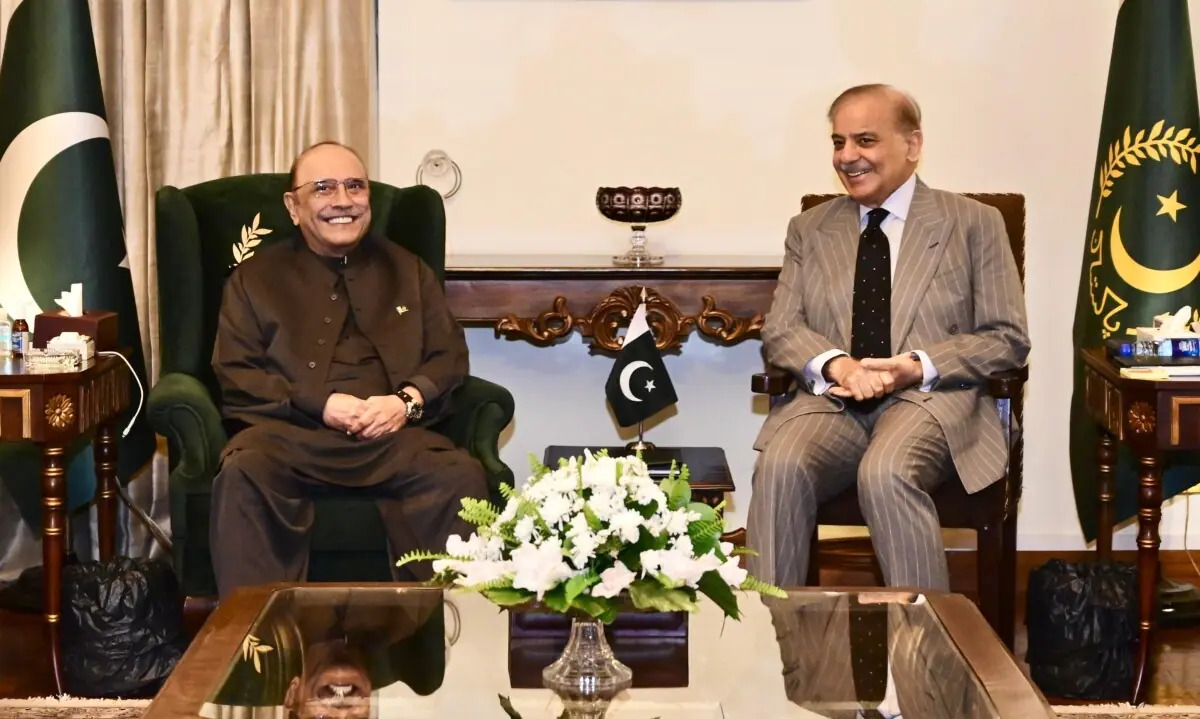
Prime Minister Shehbaz Sharif met President Asif Ali Zardari alongside key cabinet ministers to review national security, legislative agendas, and macroeconomic stability amidst evolving political dynamics.
The Core Development
Prime Minister Shehbaz Sharif held a high-level consultative session with President Asif Ali Zardari at the President House, focusing on the intersection of national security and legislative stability. The meeting brought together key members of the federal cabinet and coalition leadership to review ongoing administrative challenges, law and order dynamics, and governance reforms. According to the official handout issued by the President House, the high-stakes huddle included Deputy Prime Minister and Foreign Minister Ishaq Dar, Adviser to the Prime Minister on Political Affairs Rana Sanaullah, Interior Minister Mohsin Naqvi, Attorney General Mansoor Usman Awan, and Law Minister Azam Nazeer Tarar. The Pakistan Peoples Party (PPP) was further represented by senior figures Sherry Rehman and Syed Naveed Qamar, signaling a coordinated approach between the ruling Pakistan Muslim League-Nawaz (PML-N) and its primary coalition partner.
Commercial & Economic Implications
While the formal agenda centered on security and political alignment, market analysts and business leaders at Kalyar Traders recognize that political stability is the foundational prerequisite for macroeconomic recovery in Pakistan. Investor confidence, foreign direct investment inflows, and currency stabilization heavily depend on policy continuity between coalition partners. Protracted political friction directly impacts wholesale distribution networks, retail trade volumes, and consumer inflation by stoking market uncertainty. A unified front between the presidency, the premiership, and legislative leaders reduces sovereign risk premiums, reassuring multilateral lenders and international investors that ongoing fiscal consolidation and structural reforms under the International Monetary Fund framework will proceed without disruptive political impasses.
Related Intelligence: Federal Government Condemns KP Governance and NFC Fund Allocation
Stakeholder Perspectives & Market Reactions
Business councils, corporate associations, and legal experts have closely monitored these high-level political consultations. Representatives from major trade bodies emphasize that predictability in policy formulation is vital for industrial growth, export competitiveness, and supply chain integrity. Legal authorities note that the presence of the Attorney General and the Law Minister points toward intensive deliberations on pending legislative matters, constitutional alignment, and judicial reforms. Public response remains cautiously optimistic, with market participants looking for tangible improvements in regulatory transparency, ease of doing business, and administrative efficiency to mitigate the cost-of-living crisis affecting urban and rural consumers alike.
Forward Outlook & Key Watchpoints
In the coming weeks, market watchers will track how effectively the coalition leadership translates this political alignment into legislative action and economic policy enforcement. Key watchpoints include parliamentary proceedings regarding structural taxation reforms, energy sector circular debt management, and administrative measures to secure domestic supply chains. Sustained coordination between the federal government and key political stakeholders will determine whether Pakistan can maintain its fragile macroeconomic stabilization trajectory while addressing persistent regional security challenges.
Join Our Official WhatsApp Channel
Receive live commodity alerts, policy changes, and commercial intelligence directly on WhatsApp.