
US-China Summit Puts Trade and Global Markets in Focus
US President Donald Trump welcomed Chinese President Xi Jinping to Washington for a high-stakes state summit aimed at stabilizing bilateral ties and addressing major trade policies.
The Core Development
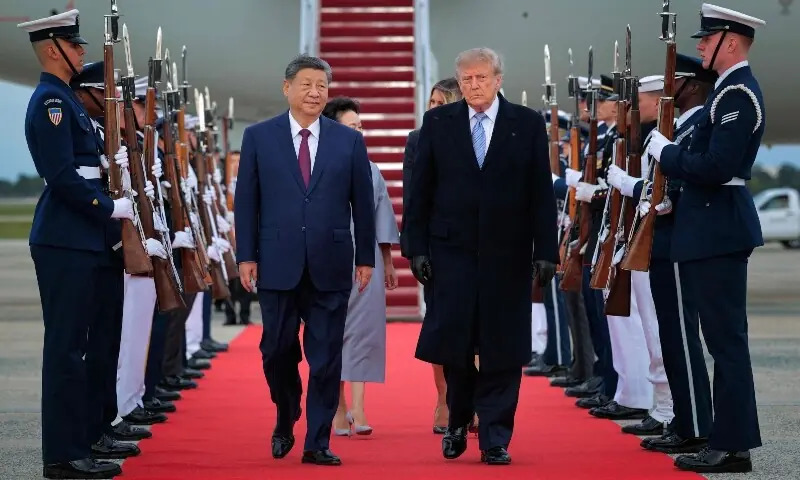
US President Donald Trump welcomed Chinese President Xi Jinping to the White House on Thursday for a high-profile state summit. The meeting represents the year's second encounter between the leaders of the world's two largest economies, and notably marks Xi's first official visit to Washington in over a decade. The diplomatic engagement commenced on Wednesday evening when President Trump greeted Xi upon his arrival at Joint Base Andrews. According to historical tracking by C-SPAN, this gesture marked the first time in eleven years that a sitting US president personally welcomed a visiting foreign leader at the military base, echoing President Barack Obama's reception of Pope Francis in 2015. While the summit is heavy on diplomatic symbolism and designed to showcase stable channels of communication, political analysts note that underlying strategic rivalries continue to shape the broader US-China relationship.
Commercial & Economic Implications
For emerging economies like Pakistan, the macroeconomic dynamics resulting from US-China trade policies carry profound ripple effects across wholesale distribution networks, retail pricing, and national inflation trajectories. As the two superpowers navigate tariffs, export controls, and supply chain realignments, Pakistani importers and exporters face shifting commodity prices and fluctuating freight costs. Wholesale markets in major commercial hubs such as Karachi and Lahore remain sensitive to international currency movements and raw material costs. Any stabilization or friction in Washington-Beijing commercial accords directly impacts global liquidity, foreign exchange reserves, and the cost of doing business for domestic enterprises dependent on imported machinery, textiles, and electronics.
Related Intelligence: Turkiye and Iraq Agree to Historic Bashiqa Military Base Handover
Stakeholder Perspectives & Market Reactions
Local trade bodies, industrial associations, and economic analysts in Pakistan are closely monitoring the developments emerging from the Washington summit. Business leaders emphasize that sustained friction between Washington and Beijing complicates international logistics and commodity procurement. Conversely, any meaningful trade breakthrough or reduction in bilateral tensions could alleviate global supply chain bottlenecks. Legal and financial experts suggest that Pakistani policymakers must maintain strategic agility to navigate potential shifts in international trade pacts, ensuring that local industries remain competitive amidst changing global economic parameters.
Forward Outlook & Key Watchpoints
In the coming months, market watchers will track specific policy announcements, tariff adjustments, and regulatory enforcement resulting from the summit dialogues. Key indicators to monitor include bilateral trade data, semiconductor supply agreements, and currency fluctuations involving the US dollar and the Chinese yuan. For Pakistani commercial stakeholders, understanding these global shifts is critical for long-term strategic planning, inventory management, and mitigating exposure to external macroeconomic shocks.
Join Our Official WhatsApp Channel
Receive live commodity alerts, policy changes, and commercial intelligence directly on WhatsApp.