
Tunisia Protests Intensify Over Detained Activists Amid Deepening Democratic Crisis
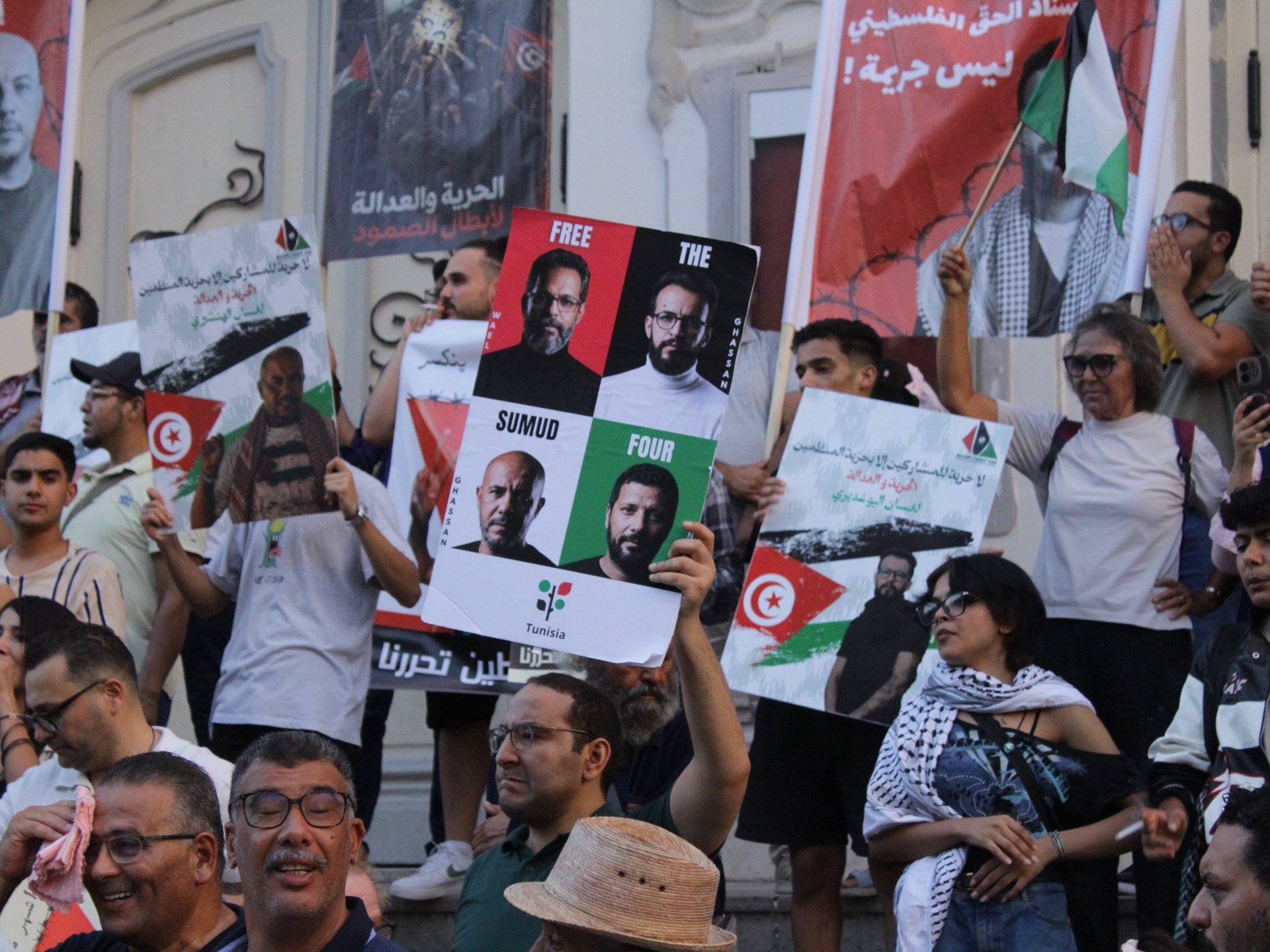
Demonstrators gathered in Tunis demanding the release of four detained Sumud coalition activists as hunger strikes heighten domestic political tensions, complicating Tunisia's economic stabilization efforts and European diplomatic relations.
Geopolitical & Core Developments
Civil society groups and political activists mobilized in the capital city of Tunis this week to demand the immediate release of four detained members of the Sumud coalition. The demonstrations escalated following reports that the medical condition of one detainee has severely deteriorated after remaining on a hunger strike for over four weeks. The detentions mark the latest flashpoint in an extensive security crackdown overseen by President Kais Saied, who has systematically dismantled institutional checks and balances since seizing executive powers in July 2021. Over the past three years, Saied has rewritten the constitution, dissolved the elected parliament, curbed judicial autonomy, and arrested dozens of prominent opposition leaders, trade unionists, journalists, and human rights defenders. The Sumud coalition, historically active in advocating for secular democratic governance, has increasingly clashed with state authorities over the suppression of civil liberties and the criminalization of political dissent. The deteriorating condition of the hunger-striking activist has galvanized fragmented opposition factions, intensifying street mobilization against what rights monitors describe as an accelerating descent into authoritarian rule.
Global Trade & Economic Ripples
The resurgence of political unrest comes at a perilous juncture for Tunisia's macroeconomic stability, carrying immediate ramifications for regional commerce and Mediterranean supply chains. The North African nation remains ensnared in a protracted balance-of-payments crisis, characterized by ballooning public debt, foreign exchange reserves pressure, and double-digit inflation. Prolonged domestic turmoil has completely frozen negotiations for a stalled 1.9 billion dollar International Monetary Fund rescue package, which President Saied has resisted due to mandated subsidy cuts and state enterprise restructuring. The resulting institutional paralysis threatens key export sectors, notably phosphate rock and derivative fertilizer production in the Gafsa mining basin, which global agricultural markets closely track amidst broader fertilizer supply constraints. Furthermore, Tunisia occupies a strategically sensitive position in regional energy transit, hosting the critical Trans-Mediterranean pipeline that transports Algerian natural gas across Tunisian territory to Italy. Sustained civil unrest or operational disruptions at commercial hubs, including the primary port of Rades, pose significant downside risks for Mediterranean maritime logistics, cross-border European industrial inputs, and global olive oil export valuations.
Related Intelligence: India Education Deficit Exposes Human Capital Risks Amid Supply Chain Push
International Reactions & Diplomatic Stances
The intensification of civil society crackdowns has magnified diplomatic friction between Tunis and Western partners. The United Nations Office of the High Commissioner for Human Rights, alongside international watchdogs such as Amnesty International, has repeatedly called on Tunisian authorities to halt politically motivated prosecutions and uphold fundamental judicial standards. In Washington, the United States Department of State and congressional leaders have expressed mounting concern over the erosion of democratic institutions, conditioning portions of bilateral military and economic assistance on human rights benchmarks. Conversely, the European Union finds its foreign policy constrained by competing priorities. While the European Parliament and human rights advocates have condemned arbitrary arrests, the European Commission remains heavily invested in the multi-million-euro migration and economic partnership signed with Tunis in 2023. European capitals, led by Rome, continue to balance democratic accountability against the imperative of securing Tunisian maritime cooperation to curb irregular migration across the Central Mediterranean corridor.
Strategic Outlook & Future Scenarios
Moving forward, Tunisia’s political trajectory hinges on the state's handling of detained dissidents and the response of organized labor. Should the health of the hunger-striking activist decline further or result in a fatality, street demonstrations could rapidly coalesce into widespread public unrest, potentially compelling the influential Tunisian General Labour Union to abandon its cautious stance and initiate nationwide industrial strikes. Alternatively, the Saied administration may double down on judicial suppression, leveraging anti-conspiracy legislation to silence dissent ahead of upcoming electoral milestones. Without structural economic relief or an IMF agreement, sovereign default risks will steadily climb, accelerating capital flight and weakening the Tunisian dinar. In such a scenario, Tunis may seek emergency bilateral financing from non-traditional partners or Gulf monarchies, further realigning North African diplomatic alliances while elevating geopolitical risk premiums across the broader Mediterranean basin.
Join Our Official WhatsApp Channel
Receive live commodity alerts, policy changes, and commercial intelligence directly on WhatsApp.