
Russian Drone Strike Hits Historic Kyiv Academy Amid Escalating Infrastructure Threats
A targeted Russian drone strike heavily damages a historic building belonging to Ukraine's National Academy of Sciences in Kyiv, intensifying concerns over regional stability and civilian infrastructure security.
Geopolitical & Core Developments
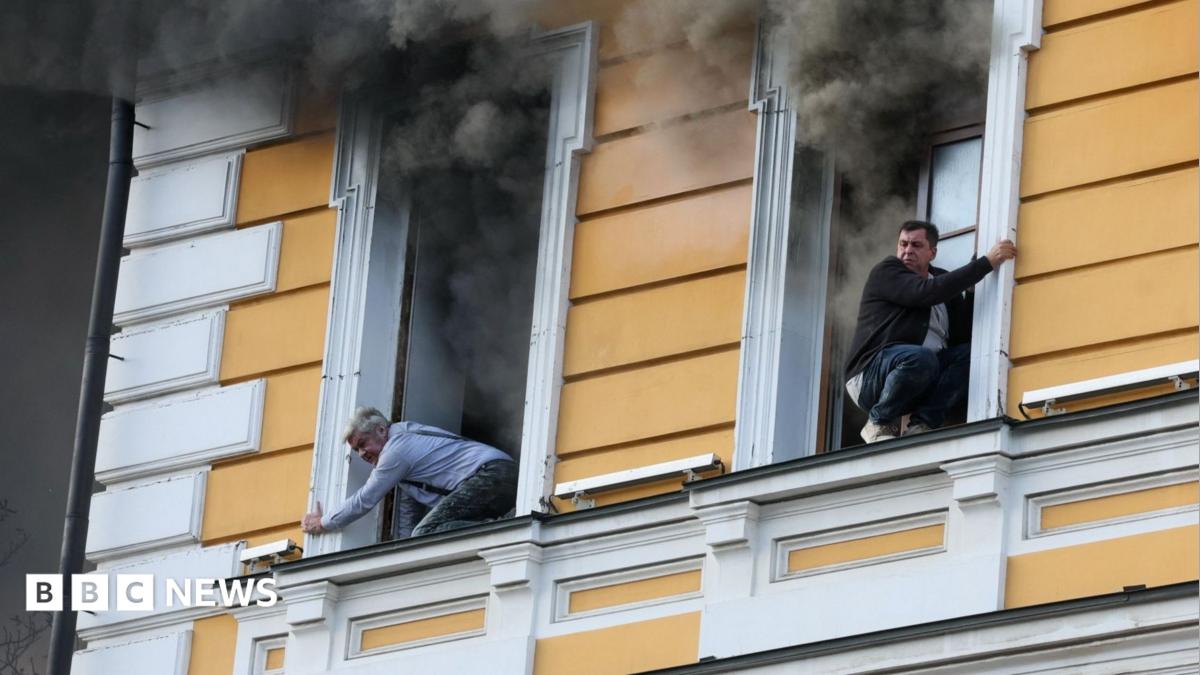
In the early hours of the morning, a barrage of Iranian-designed Shahed drones struck central Kyiv, resulting in a direct hit on a historic building belonging to Ukraine's National Academy of Sciences. According to on-the-ground reporting by BBC correspondent Paul Adams, the impact triggered massive structural damage and localized fires, forcing residents and personnel to flee the facility under the cover of air raid sirens. Emergency services responded swiftly to contain the blaze and secure the surrounding perimeter.
This latest strike highlights a persistent strategic shift in military operations, where urban centers and institutional landmarks are increasingly subjected to aerial attrition. The targeting of an academic institution—a repository of scientific heritage and intellectual capital—demonstrates the broad scope of infrastructure vulnerabilities across the Ukrainian capital. Military analysts note that such strikes are designed to demoralize the civilian population, strain municipal emergency services, and project psychological pressure outward to international partners observing the conflict's protracted trajectory.
Global Trade & Economic Ripples
While the immediate impact of the strike is measured in structural loss and civilian disruption, the broader economic ramifications extend deeply into global commodity and energy markets. Persistent aerial assaults on Ukrainian urban and logistical hubs continue to cast a shadow over foreign direct investment, agricultural export corridors, and industrial productivity. Although the Black Sea grain initiative and alternative overland routes have established a degree of resilience, heightened regional volatility directly influences maritime insurance rates and shipping logistics across the broader Eastern European theater.
Furthermore, the ongoing destruction of municipal and commercial assets exacerbates inflationary pressures within Ukraine, necessitating sustained international financial stabilization packages. Energy markets remain hyper-sensitive to escalation risks; any perceived threat to critical infrastructure or energy grids immediately feeds into European natural gas and power futures. Global traders continue to price in geopolitical risk premiums, balancing supply chain redundancies against the constant threat of sudden supply shocks originating from the conflict zone.
Related Intelligence: Nations League Clash Highlights European Diplomatic and Commercial Ties
International Reactions & Diplomatic Stances
International condemnation of the strike was swift, with Western diplomats and multilateral bodies reiterating their support for Ukrainian sovereignty and institutional preservation. Representatives from the United Nations underscored the absolute protection due to cultural and scientific institutions under international humanitarian law, condemning attacks that endanger civilian lives and architectural heritage.
盟友 and international trade partners emphasized that such incidents reinforce the urgency of delivering advanced air defense systems to safeguard urban centers. Economic ministers across the G7 reaffirmed their commitment to maintaining restrictive sanctions on state actors enabling the conflict, signaling that diplomatic isolation and financial pressure will remain the primary tools for countering regional destabilization. Market analysts point out that these steadfast diplomatic stances continue to shape long-term trade alignments and defense manufacturing commitments globally.
Strategic Outlook & Future Scenarios
As the conflict enters another grueling phase, the strategic outlook points toward sustained aerial campaigns and entrenched ground positions. The resilience of Kyiv's civil defense infrastructure will remain critical to maintaining administrative and economic continuity. Upcoming international summits are expected to focus heavily on long-term reconstruction financing, enhanced security guarantees, and tighter enforcement of dual-use technology export controls to curb drone manufacturing capabilities.
For global commerce, the prolonged nature of the crisis dictates a permanent adjustment to baseline geopolitical risk. Importers, commodity traders, and multinational corporations operating in Eastern Europe must navigate an environment where supply chain predictability is continually challenged by kinetic escalation. The ability to adapt to sudden infrastructural disruptions will define economic survival as the geopolitical landscape remains fractured and unpredictable.
Join Our Official WhatsApp Channel
Receive live commodity alerts, policy changes, and commercial intelligence directly on WhatsApp.