
Punjab Police Morale Falters Amid Rumoured Khyber Pakhtunkhwa Deployment
Punjab Police personnel face escalating discontent over potential redeployment to Khyber Pakhtunkhwa, compounded by severe logistical failures and officer fatalities during political unrest deployments.
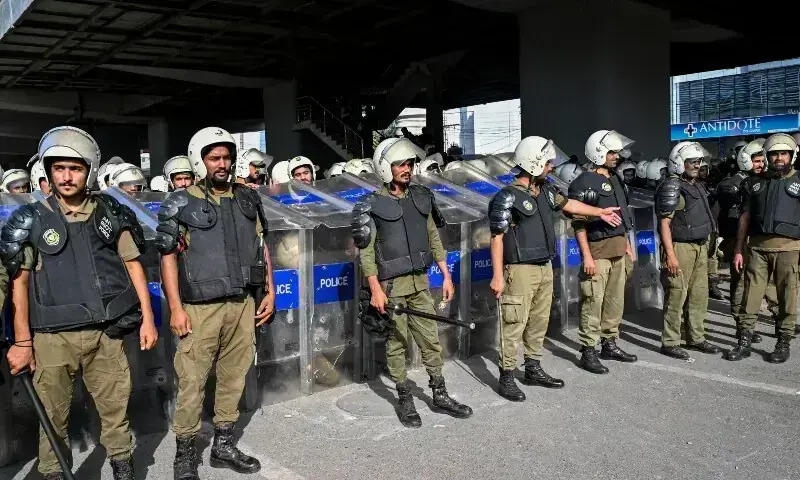
The Core Development
Discontent within the ranks of the Punjab Police has intensified significantly following widespread reports regarding the potential redeployment of a massive contingent to Khyber Pakhtunkhwa. Out of a total 40,000 personnel currently mobilized in the Rawalpindi division and stationed around Attock to counter Pakistan Tehreek-e-Insaf (PTI) political demonstrations, approximately 25,000 officers face imminent transfer. This potential movement is reportedly contingent upon the declaration of an emergency and the formal imposition of governor’s rule in the neighbouring province.
The ground reality for these deployed officers has grown increasingly grim over the past several weeks. Exhausted by relentless shifts, profound sleep deprivation, and substandard living conditions, the rank and file view the prospect of crossing provincial borders into Khyber Pakhtunkhwa not merely as an operational assignment, but as an intolerable burden. Compounding these operational strains are severe administrative lapses. Over the last fortnight, persistent allegations have surfaced accusing the Rawalpindi division police administration of distributing rotten and stale food provisions to the troops on duty. Tragically, these harsh conditions have coincided with the confirmed deaths of five policemen who succumbed while performing active duty in Attock and Wah Cantt.
Commercial & Economic Implications
While security operations and internal police deployments are fundamentally administrative and political matters, the sustained mobilization of tens of thousands of security personnel exerts a notable ripple effect on regional commerce and economic activity. Large-scale deployment of police forces necessitates heavy diversion of public expenditures toward emergency logistics, transport, temporary billeting, and field provisioning. At the local level in districts like Attock and Rawalpindi, sudden heavy concentrations of security forces strain local municipal services and create localized supply bottlenecks.
Furthermore, heightened political tensions, road blockades, and stringent security clampdowns directly disrupt inter-provincial trade corridors, wholesale distribution networks, and daily retail commerce. Transport operators face severe delays along major national highways connecting Punjab and Khyber Pakhtunkhwa, leading to elevated freight costs, inventory holding delays, and potential inflationary pressures on perishable food items and essential consumer goods. Prolonged political instability and its associated security overheads ultimately undermine commercial confidence across Northern Pakistan.
Related Intelligence: Police Scuttle Swabi Convention Amid Khyber Pakhtunkhwa Emergency
Stakeholder Perspectives & Market Reactions
Civil society groups, trade associations, and legal observers have expressed deep concern over the mounting grievances of law enforcement personnel. Representative bodies have voiced alarm regarding the welfare, fundamental rights, and occupational safety of front-line officers who are frequently thrust into high-stress political flashpoints without adequate sustenance or institutional protection. Legal experts emphasize that operational efficacy requires strict adherence to statutory welfare standards for civil servants, arguing that administrative neglect directly compromises public security objectives.
Meanwhile, official channels have faced mounting public scrutiny regarding the logistical failures highlighted during the Attock deployment. While senior departmental commanders maintain that forces remain fully prepared to execute lawful directives under any constitutional framework, the internal friction caused by reported food contamination and heavy fatigue has ignited broader debates within bureaucratic circles concerning institutional readiness and resource allocation during protracted civil disturbances.
Forward Outlook & Key Watchpoints
As political friction persists between federal and provincial stakeholders, the immediate trajectory of the 25,000 Punjab Police personnel hinges on formal political developments in Khyber Pakhtunkhwa. Should emergency measures or governor's rule be officially enacted, the logistical execution of inter-provincial troop movements will serve as a critical test of command-and-control capabilities within Pakistan's security apparatus.
Key watchpoints for analysts and observers include official audits of police welfare provisions, the remediation of logistical supply chains in active deployment zones, and potential policy adjustments by provincial authorities to address troop fatigue. Ensuring the physical well-being and morale of civil law enforcement remains paramount to maintaining public order and mitigating operational risks in an increasingly volatile political landscape.
Join Our Official WhatsApp Channel
Receive live commodity alerts, policy changes, and commercial intelligence directly on WhatsApp.