
PTI-Government Negotiations Collapse Over Access to Incarcerated Founder Imran Khan
High-stakes negotiations between the federal government and the opposition collapsed after authorities refused to include provisions guaranteeing access to incarcerated PTI founder Imran Khan in a formal agreement.
The Core Development
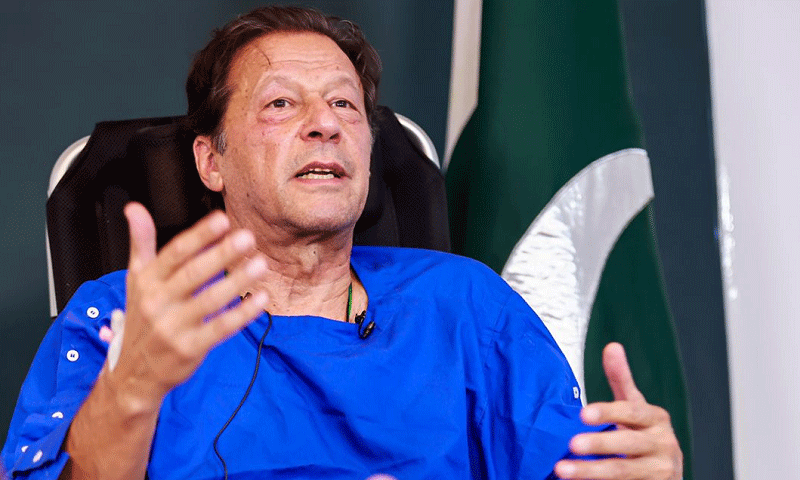
Political tensions in Pakistan escalated sharply following the complete collapse of high-stakes negotiations between the ruling coalition and an opposition delegation comprising the Pakistan Tehreek-e-Insaf (PTI) and the Tehreek-i-Tahafuz-i-Ayin-i-Pakistan (TTAP). Following hours of intense discussions on Saturday night, both sides emerged without a consensus, plunging the country back into political gridlock. According to senior PTI leadership, the negotiations hit an insurmountable wall when government representatives flatly refused to incorporate formal terms guaranteeing unhindered legal and political access to incarcerated party founder Imran Khan into the proposed framework agreement.
The dialogue, which was designed to ease months of crippling institutional confrontation, broke down amidst fierce mutual recriminations. While federal ministers and allied Pakistan Peoples Party (PPP) leaders publicly blamed the opposition—specifically pointing fingers at the Khyber Pakhtunkhwa chief minister for allegedly sabotaging the process—the PTI vehemently rejected the narrative. The opposition party maintained that the central administration acted in bad faith by balking at the primary point of contention: prisoner rights and direct political communication with their jailed leader. The breakdown terminates what many analysts considered a critical window for legislative compromise and national reconciliation.
Commercial & Economic Implications
For the domestic commercial sector, wholesale distribution networks, and retail markets across Pakistan, the collapse of political dialogue carries severe macroeconomic repercussions. Financial markets, which had shown tentative signs of stabilizing amid hopes of reduced political friction, reacted with immediate nervousness. Persistent political instability directly undermines investor sentiment, delays vital structural reforms required under international financial programs, and creates a volatile environment for rupee valuation and foreign direct investment.
Furthermore, the ongoing standoff trickles down directly to the ordinary consumer. Uncertainty surrounding government stability invariably impacts supply chain logistics, business capital allocation, and inventory management. Retailers and wholesale traders in major commercial hubs report that prolonged agitation and legislative paralysis dampen consumer purchasing power, stall commercial expansion, and exacerbate inflationary pressures. When political actors remain deadlocked over fundamental governance issues, domestic commerce bears the brunt as economic policy implementation takes a back seat to partisan confrontation.
Related Intelligence: Pakistan Political Deadlock Deepens as PTI Talks Collapse Over Imran Khan Access
Stakeholder Perspectives & Market Reactions
Prolonged political turbulence has drawn sharp rebukes from prominent trade bodies, industrial associations, and legal experts across the country. Leading chambers of commerce and industry have issued joint appeals urging political stakeholders to prioritize national economic revival over partisan posturing. Representatives from key trade sectors emphasize that continuous street protests, legislative deadlocks, and institutional friction disrupt manufacturing schedules, hamper export growth, and increase the cost of doing business.
Legal analysts point out that the inability of the government and the opposition to establish basic ground rules for political dialogue highlights deep structural deficiencies in Pakistan's democratic framework. Constitutional experts argue that resolving disputes through backroom ultimatums rather than institutionalized parliamentary debate creates a precarious legal environment. Public response has been largely fatigued, with citizens expressing widespread frustration over the political class's inability to address pressing economic hardships, soaring utility tariffs, and structural unemployment.
Forward Outlook & Key Watchpoints
As the dust settles on Saturday night's failed negotiations, the immediate political horizon looks volatile and uncertain. The primary watchpoints for financial analysts, business leaders, and foreign investors will be the PTI's next phase of political mobilization and the federal government's legislative and security response. With reconciliation efforts effectively frozen, market watchers anticipate renewed street agitation, heightened security deployments in major urban centers, and a hardening of stances on both sides of the political aisle.
In the medium term, the absence of a working political consensus threatens to stall crucial economic adjustments and fiscal targets. Unless moderate elements within both camps manage to reopen backchannel communications, Pakistan risks entering another prolonged cycle of confrontation that could derail fragile macroeconomic recovery efforts. Businesses and investors must brace for heightened volatility and adjust strategic risk management frameworks accordingly as the political landscape remains hostage to institutional deadlock.
Join Our Official WhatsApp Channel
Receive live commodity alerts, policy changes, and commercial intelligence directly on WhatsApp.