
Pakistan Engages Central Asia at SCO Meeting to Bolster Trade Corridor
Deputy Prime Minister Ishaq Dar arrived in Dushanbe for the SCO summit, focusing on regional trade, financial mechanisms, and expanding direct economic corridors with Central Asian economies.
The Core Development
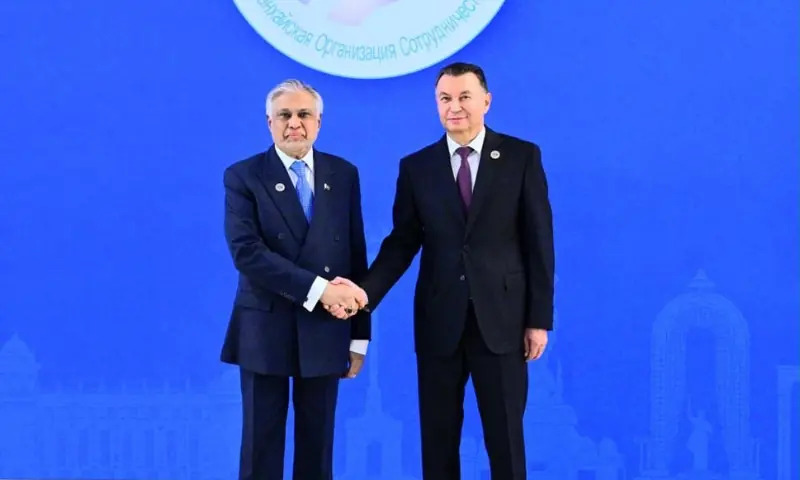
Deputy Prime Minister and Foreign Minister Senator Mohammad Ishaq Dar arrived in Tajikistan's capital, Dushanbe, on Tuesday to lead Pakistan's delegation at the Shanghai Cooperation Organisation (SCO) Council of Heads of Government (CHG) meeting. Upon landing at Dushanbe International Airport, the Deputy Prime Minister was formally received by Tajik Prime Minister Qohir Rasulzoda alongside senior diplomatic officials, marking the initiation of high-level ministerial deliberations aimed at regional integration.
The Council of Heads of Government functions as the SCO's second-highest statutory decision-making body, specifically tasked with managing economic, financial, trade, and transport agendas across Eurasia. As Pakistan continues to seek external economic rebalancing, Dar's diplomatic engagement in Dushanbe concentrates on advancing transit trade agreements, energy connectivity projects, and digital trade networks. High on the council agenda are institutional guidelines regarding regional infrastructure development, trade facilitation mechanisms, and the approval of the organisation's programmatic budget for the forthcoming fiscal year.
Commercial & Economic Implications
For Pakistan's domestic economy and merchant class, diplomatic momentum within the SCO carries direct commercial significance. Landlocked Central Asian economies, spearheaded by Tajikistan and Uzbekistan, represent critical frontier markets for Pakistani consumer goods, pharmaceuticals, textiles, and agricultural produce. Expanding land-based logistics corridors through the Quadrilateral Traffic in Transit Agreement (QTTA) and the China-Pakistan Economic Corridor (CPEC) provides local exporters with access to underserved consumer bases.
Furthermore, direct connectivity mitigates the freight costs associated with maritime transport, potentially lowering import tariffs on raw materials and industrial inputs entering Pakistan. Wholesale distribution networks, particularly in northern logistical hubs such as Rawalpindi, Peshawar, and Lahore, stand to benefit from increased transit volumes. Reliable trade corridors also foster commodity price stabilization, offering alternative sources for petrochemicals, mineral resources, and primary produce, which shields local consumers from global shipping vulnerabilities and currency volatility.
Stakeholder Perspectives & Market Reactions
Commercial stakeholders and trade bodies across Pakistan have welcomed Islamabad's continuous diplomatic push within the SCO framework. Business chambers, including the Federation of Pakistan Chambers of Commerce and Industry (FPCCI), emphasize that Central Asia remains an untapped $100 billion commercial ecosystem. Importers and logistics operators have expressed optimism regarding multilateral efforts to standardize customs procedures, eliminate non-tariff barriers, and harmonize border clearances.
However, market analysts highlight operational caveats, notably lingering infrastructure bottlenecks and cross-border currency payment complexities. Industry representatives urge the Ministry of Commerce to negotiate local-currency settlement mechanisms within the SCO banking consortium to circumvent US dollar dependency. Financial institutions in Karachi and Islamabad note that banking connectivity between Central Asian institutions and Pakistani scheduled banks remains a critical missing link required to facilitate seamless documentary credit and commercial financing.
Forward Outlook & Key Watchpoints
As the Dushanbe summit proceeds, the primary focus will center on multilateral protocols endorsed by member states regarding economic corridors and digital customs cooperation. Observers will monitor whether bilateral meetings between Pakistani officials and Central Asian counterparts yield binding bilateral trade targets, particularly concerning the transit of agro-commodities and specialized manufacturing supplies.
Key watchpoints over the coming quarters include progress on the CASA-1000 electricity transmission project and regulatory ratifications on regional trucking permits. If Islamabad successfully translates multilateral communiqués into tangible customs clearance reforms, domestic businesses could observe enhanced export volumes and stabilized import supply chains by early 2026.
Join Our Official WhatsApp Channel
Receive live commodity alerts, policy changes, and commercial intelligence directly on WhatsApp.