
Nationwide Unrest Grips France Sparking Mass Arrests and European Economic Concerns
France faces severe domestic volatility as nationwide demonstrations escalate into widespread looting and structural arson, testing government authority and casting uncertainty over European commercial stability.
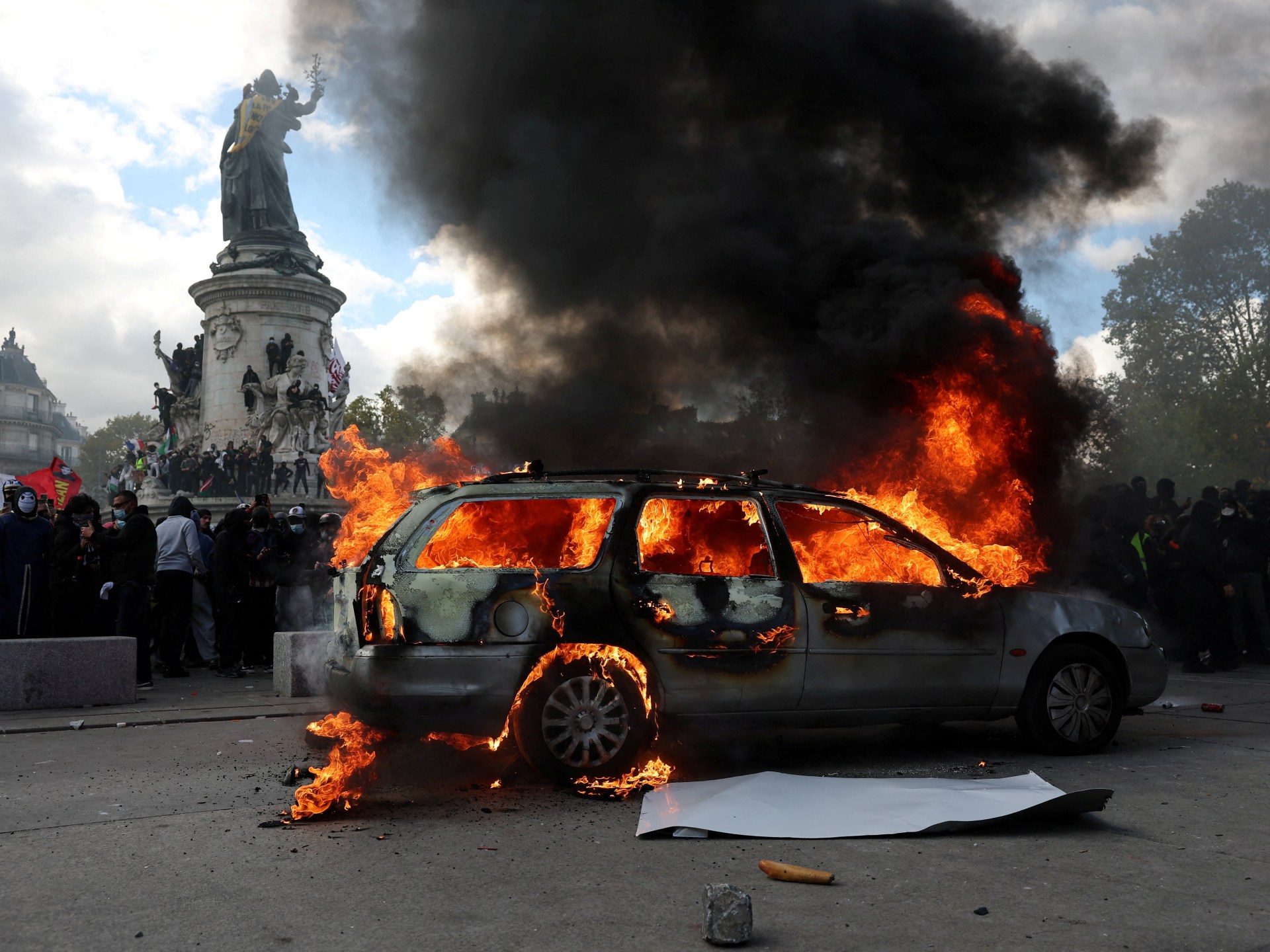
Geopolitical & Core Developments
France has entered a phase of profound domestic instability following consecutive nights of violent civil unrest that spread rapidly across Paris, Marseille, Lyon, and multiple secondary urban centers. Government ministries confirmed that security forces carried out more than 1,200 arrests over a 48-hour window, with at least 150 law enforcement officers sustaining serious injuries during intense confrontations. The unrest, triggered by public outrage over a fatal police encounter, quickly transcended targeted demonstrations, devolving into coordinated property destruction, commercial looting, and arson attacks aimed at administrative infrastructure.
President Emmanuel Macron convened emergency ministerial meetings to coordinate a nationwide deployment of 45,000 police personnel, elite gendarmerie tactical units, and light armored response vehicles. Municipal authorities imposed localized curfews and suspended evening public transport networks to restore operational control. The escalation represents one of the most critical governance crises for the French executive in recent years, testing the stability of a core European sovereign state at a time of broader continental socio-economic strains.
[Global Trade](/news/us-political-realignment-shifts-global-trade-diplomatic-calculus) & Economic Ripples
The ongoing civil disruption has triggered measurable economic friction across domestic and intra-European commerce. The immediate destruction of physical retail hubs, public transport nodes, and metropolitan logistics warehouses has disrupted primary distribution routes for consumer goods, agricultural products, and light manufacturing inputs. Major retail associations across France have warned that commercial losses are climbing into hundreds of millions of euros, further dampening consumer confidence during an already delicate post-inflationary recovery period.
On the sovereign front, the cost of French borrowing showed subtle tremors as sovereign bond yields experienced minor widening against German benchmarks, reflecting heightened investor sensitivity to European political risk. Key transit arteries connecting French production zones with neighboring European Union trade partners experienced transit bottlenecks due to roadblocks and localized transit curfews. Multinational insurers are recalibrating urban risk exposure models across Western Europe, which analysts anticipate could translate into elevated commercial property premiums and higher operational overheads for cross-border supply chain operations.
Related Intelligence: US Political Realignment Shifts Global Trade and Diplomatic Calculus
International Reactions & Diplomatic Stances
Diplomatic entities and international institutions have monitored developments with growing concern. The United Nations Office of the High Commissioner for Human Rights urged French authorities to manage civil unrest with strict adherence to human rights benchmarks, while simultaneously calling on demonstrators to refrain from destructive actions against public property.
Key diplomatic allies, including the United Kingdom, Germany, and the United States, issued updated travel advisories warning citizens to exercise extreme caution in metropolitan France, avoid mass assembly areas, and anticipate significant transport cancellations. Cross-border business councils and European trade confederations expressed concern over the safety of commercial assets, urging swift de-escalation to prevent disruption to regional distribution corridors and international tourism flows during the peak summer commercial quarter.
Strategic Outlook & Future Scenarios
The short-term trajectory of the French crisis hinges on whether law enforcement surge deployments can effectively suppress organized flashpoints without triggering secondary waves of public mobilization. Should unrest continue unabated, the executive administration faces increasing pressure to declare a formal state of emergency, a statutory move that would impose stringent movement controls and expand federal police authority nationwide.
In the medium term, persistent unrest threatens to derail administrative reform agendas, drain state budgets through infrastructure reconstruction outlays, and weaken Paris's geopolitical leverage within the European Union and NATO frameworks. Market observers anticipate that structural socio-economic grievances will sustain elevated political polarization, keeping French equities and regional transport networks exposed to episodic operational volatility over the coming quarters.
Join Our Official WhatsApp Channel
Receive live commodity alerts, policy changes, and commercial intelligence directly on WhatsApp.