
Ireland Defeats Israel in Somber Nations League Clash Amid Protests
Ireland secured a 3-0 victory against Israel in a tense Nations League match marked by black armbands, skipped handshakes, and strict security.
The Core Development
In a sports fixture heavily overshadowed by ongoing geopolitical conflict, the Republic of Ireland secured a decisive 3-0 victory against Israel in a UEFA Nations League encounter on Sunday. The match, relocated to a neutral and near-empty venue at the Debrecen stadium in Hungary due to security considerations, unfolded within an eerie and sombre atmosphere. From the outset, the proceedings departed sharply from standard international protocol. The Irish squad chose to wear black armbands as a visible protest against the devastating humanitarian crisis and war in Gaza. While players bowed their heads respectfully during the playing of the Israeli national anthem, the traditional pre-match rituals of handshakes and pennant exchanges were entirely omitted by mutual or tacit understanding of the charged political climate.
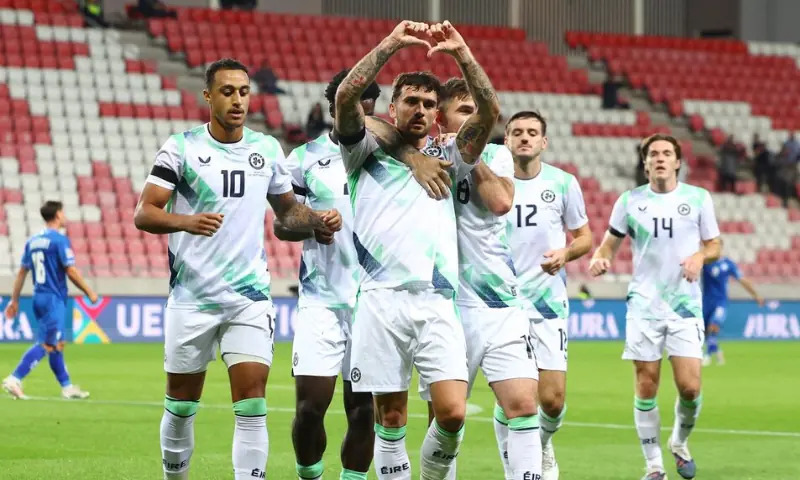
The action on the pitch quickly reflected the emotional intensity of the evening. Troy Parrott opened the scoring for Ireland in the 14th minute, celebrating his goal by forming a heart sign with his hands directed toward the sparse stands. Shortly thereafter, Jack Moylan sealed the dominant performance by netting the third goal in the 25th minute, immediately kissing both the Irish team badge on his jersey and his black armband in a poignant gesture of solidarity. The match concluded without further incident, but the stark absence of spectators and the deliberate symbolic actions of the athletes underscored how international sports continue to serve as a prominent platform for global conscience.
Commercial & Economic Implications
While the fixture itself was a matter of athletic competition, high-profile international sporting events intersecting with geopolitical boycotts and diplomatic tensions carry substantial commercial ramifications for global sports broadcasting, sponsorships, and associated retail markets. In economies like Pakistan, where international sporting goods manufacturing, wholesale distribution, and retail trade are deeply integrated into global supply chains, heightened sensitivities can influence consumer sentiment and corporate sponsorship evaluations. Brand associations with governing bodies like UEFA face rigorous risk assessments when political demonstrations become central to match broadcasts, affecting advertising revenue streams and merchandise distribution networks across international markets.
Furthermore, the logistical costs associated with relocating high-risk international fixtures to neutral venues—such as the Debrecen stadium in Hungary—impose financial burdens on sports federations, which ultimately trickle down to broadcast rights valuations and commercial partnerships. Retailers dealing in sports apparel and licensed merchandise must navigate increasingly complex consumer preferences, where politically charged symbols like armbands and gestures can rapidly shift market demand and influence public purchasing behavior across global retail channels.
Related Intelligence: Hurricane Polo Threatens Mexico Pacific Coast and Global Supply Chains
Stakeholder Perspectives & Market Reactions
Global reaction to the demonstration by the Irish national team has drawn diverse responses from sports governing bodies, civil society organizations, and international trade and political associations. Human rights groups and pro-Palestinian advocacy networks have widely praised the Irish players for utilizing their platform to highlight the plight of civilians in Gaza, viewing the silent protest and black armbands as a powerful exercise of free expression within professional sports. Conversely, sports administrators face ongoing challenges regarding the fine line between political neutrality and athlete expression, with regulatory bodies continuously reviewing disciplinary frameworks for matches held under volatile geopolitical conditions.
In domestic markets, business and trade associations monitor these international cultural shifts closely, recognizing that consumer alignment with ethical and political stances increasingly dictates brand loyalty. Legal opinions across European and international sports jurisdictions highlight the delicate balance UEFA and FIFA must maintain to uphold contractual obligations with commercial sponsors while accommodating the growing desire of athletes to address pressing global humanitarian crises.
Forward Outlook & Key Watchpoints
As European football governance bodies review the logistical and security management of neutral-venue fixtures, future international matches involving teams from conflict-affected regions will likely face intensified scrutiny. Key watchpoints for industry observers, sports economists, and policy analysts include potential updates to UEFA and FIFA regulatory codes concerning political displays, upcoming sponsorship contract renewals, and the broader economic impact on broadcasting rights values.
For commercial enterprises, retailers, and supply chain operators in emerging markets, monitoring the intersection of geopolitics and major sports entertainment remains crucial for risk management. As public sentiment continues to shape consumer markets, corporate strategies must remain adaptable to sudden shifts in global sporting schedules, venue relocations, and the evolving socio-political stances of prominent international athletes.
Join Our Official WhatsApp Channel
Receive live commodity alerts, policy changes, and commercial intelligence directly on WhatsApp.