
Govt Holds Emergency Mansoorah Talks as Petroleum Levy Agitation Intensifies
A high-level government delegation entered emergency talks with Jamaat-i-Islami at Mansoorah to avert a march on Islamabad demanding the rollback of steep petroleum levies and duties.
The Core Development
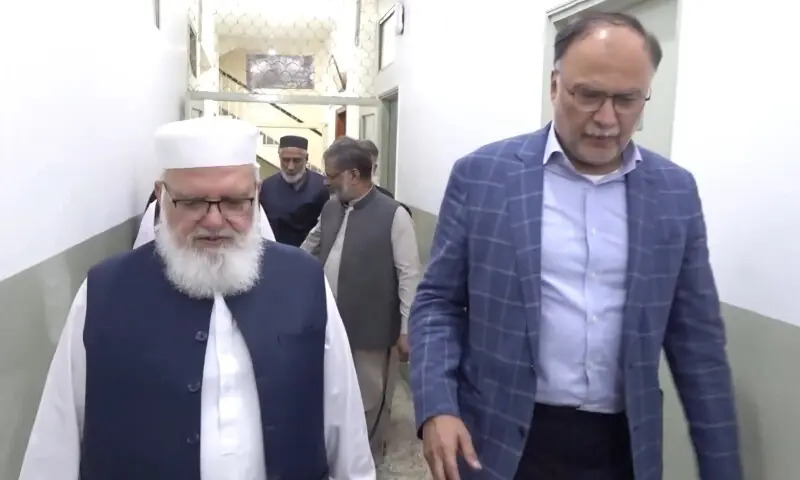
In an eleventh-hour bid to stave off a politically destabilizing capital lockdown, an official federal and provincial government delegation arrived at Mansoorah, the central headquarters of Jamaat-i-Islami (JI) in Lahore, late Saturday night. The delegation—comprising Federal Minister for Planning, Development, and Special Initiatives Ahsan Iqbal, Adviser to the Prime Minister on Political Affairs Rana Sanaullah, and senior provincial leadership—convened for emergency negotiations with JI Emir Hafiz Naeem ur Rehman and the party's central leadership.
The talks were precipitated by JI's announcement of a direct protest march on Islamabad, marking the culmination of a nationwide agitation campaign sustained since August 16. The focal point of the standoff is the sheer incidence of indirect taxation on refined petroleum products. Under the current fiscal architecture, the federal government extracts an estimated Rs114 per litre in taxes, petroleum development levies, and related duties on motor gasoline (petrol), alongside approximately Rs100 per litre on high-speed diesel (HSD). With sit-ins already disrupting commercial arterials across Karachi, Lahore, and Peshawar over recent weeks, the march threatened to converge mass demonstrators on Islamabad's institutional core.
Commercial & Economic Implications
For Pakistan's domestic commercial ecosystem—spanning wholesale trading houses, distributed retail networks, and logistics operations—the petroleum taxation regime represents an unrelenting cost-push shock. High-speed diesel functions as the primary operational artery for inter-city freight, agrarian machinery, and backup industrial generation. Exorbitant fuel tariffs immediately manifest in elevated ton-kilometer freight charges across long-haul transit corridors connecting Karachi's ports to the manufacturing hubs of Punjab and Khyber Pakhtunkhwa.
Wholesale distributors, particularly in essential food grains, edible oils, and fast-moving consumer goods, have struggled to absorb these logistics premiums without passing them directly to retailers and consumers. The compounding tax structure exacerbates headline and core inflation, compressing consumer disposable incomes and inducing retail demand contraction across major consumption centers. Conversely, the federal government faces an acute fiscal dilemma: the Petroleum Development Levy (PDL) serves as an indispensable pillar of the revenue framework mandated under the International Monetary Fund's (IMF) $7 billion Extended Fund Facility. Any abrupt unilateral reduction in fuel levies risks precipitating fiscal deficit slippage, directly jeopardizing multilateral compliance and sovereign credit stability.
Stakeholder Perspectives & Market Reactions
Business sentiment remains acutely divided between fundamental sympathy for economic relief and profound anxiety over potential supply chain blockades. Apex merchant bodies, including chapters of the All Pakistan Anjuman-e-Tajiran and regional chambers of commerce, have voiced alignment with JI's grievances regarding unsustainable overheads, noting that cumulative electricity surcharges and fuel levies have compressed trading margins to historic lows.
Simultaneously, logistics operators, freight forwarders, and industrial manufacturers express severe trepidation regarding highway interdictions and urban transit disruptions. Historical precedents demonstrate that roadblocks along the Grand Trunk Road and national motorways inflict severe working capital delays, spoiling perishable consignments and idling commercial fleets. For their part, state emissaries during the Mansoorah discussions maintained that uncalibrated petroleum tariff cuts would instantly breach sovereign fiscal covenants, proposing instead structured administrative reviews to evaluate non-fuel relief measures.
Forward Outlook & Key Watchpoints
The operational environment across Pakistan's wholesale and transport sectors hinges on the outcome of these late-night deliberations. Should negotiators secure a compromise—potentially encompassing a phased review mechanism or a deferred protest timeline—domestic freight corridors will remain open, averting an immediate supply bottleneck in northern hubs.
Conversely, a breakdown in dialogue will inevitably prompt heavy administrative security interventions across the twin cities, including road containerization, vehicular diversions, and enforcement of Section 144. Commercial enterprises must monitor the upcoming bi-weekly petroleum pricing revisions, wholesale transport rate volatility, and whether the federal administration considers alternative revenue offsets to defuse public discontent while maintaining its rigid macroeconomic stabilization trajectory.
Join Our Official WhatsApp Channel
Receive live commodity alerts, policy changes, and commercial intelligence directly on WhatsApp.