
German and US Scientists Win Nobel Medicine Prize for Optogenetics
American and German researchers win the 2026 Nobel Prize in Physiology or Medicine for pioneering discoveries in optogenetics.
The Core Development
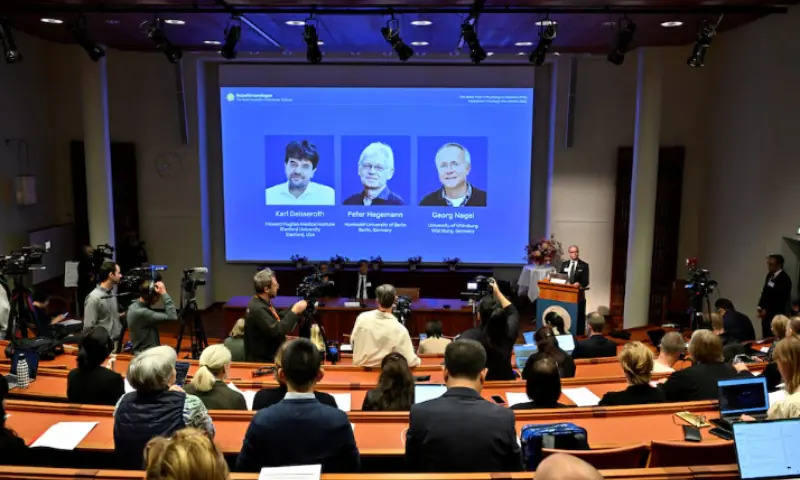
American researcher Karl Deisseroth, alongside German scientists Peter Hegemann and Georg Nagel, has been awarded the 2026 Nobel Prize in Physiology or Medicine. Announced on Monday by the Nobel Assembly at Sweden’s Karolinska Institute, the prestigious prize recognizes their revolutionary discoveries concerning light-gated ion channels and the burgeoning field of optogenetics. The technique enables precise control of cellular activities within living tissue using light, transforming neuroscience by allowing researchers to activate or deactivate specific neurons with millisecond precision.
The breakthrough stems from foundational work identifying microbial proteins that respond to light by opening ion channels in cell membranes. Deisseroth, 54, Hegemann, 71, and Nagel, 73, bridged microbiology and neurobiology, creating tools that make it possible to study complex neural circuits in unprecedented detail.
Commercial & Economic Implications
While rooted in fundamental biosciences, the global commercialization of optogenetic tools holds profound long-term implications for the international biomedical industry, venture capital markets, and high-tech medical device manufacturing. For developing economies such as Pakistan, advanced neurological research infrastructure remains in its nascent stages, yet the commercial spillover effects are manifold. As global pharmaceutical giants and biotechnology firms leverage optogenetics to accelerate drug discovery for neurodegenerative disorders like Parkinson's and Alzheimer's, Pakistani healthcare markets anticipate future downstream impacts through imported therapeutics, specialized diagnostic equipment, and advanced clinical trial methodologies.
Furthermore, the capital allocation toward neuro-technology ventures highlights a shifting global macroeconomic landscape where intellectual property in life sciences commands immense valuation. Pakistani academic and commercial stakeholders monitoring global trade in medical apparatus note that foundational scientific breakthroughs eventually dictate the pricing structures of next-generation pharmaceuticals and therapeutic devices entering domestic markets.
Related Intelligence: French School Shutdowns Spark Wider Economic and Trade Anxiety
Stakeholder Perspectives & Market Reactions
Global scientific bodies, biotechnology consortia, and investor networks have responded with overwhelming acclaim to the announcement. International research institutions emphasized that the laureates' work has bridged decades of gap in understanding psychiatric and neurological conditions. Meanwhile, industry analysts project increased venture capital flows into neurotech startups specializing in optogenetic-based therapies and optical interface hardware.
In domestic scientific and trade circles within Pakistan, the recognition underscores the growing importance of global biotechnology trends. Local medical technology distributors and academic researchers have highlighted the necessity of fostering collaborative research frameworks to ensure emerging economies are not left behind in the global transition toward precision medicine and light-activated therapeutics.
Forward Outlook & Key Watchpoints
As the scientific community prepares for the formal Nobel Prize award ceremony, key stakeholders are closely monitoring the clinical translation of optogenetic research. Primary watchpoints include the progress of human clinical trials utilizing optogenetic gene therapy to restore vision in patients with degenerative retinal diseases and the development of wireless, implantable optical devices for neurological disorders.
For market observers and policymakers, the trajectory of optogenetics serves as a bellwether for the future of biomedical innovation, regulatory frameworks governing gene-editing technologies, and international technology transfer agreements.
Join Our Official WhatsApp Channel
Receive live commodity alerts, policy changes, and commercial intelligence directly on WhatsApp.