
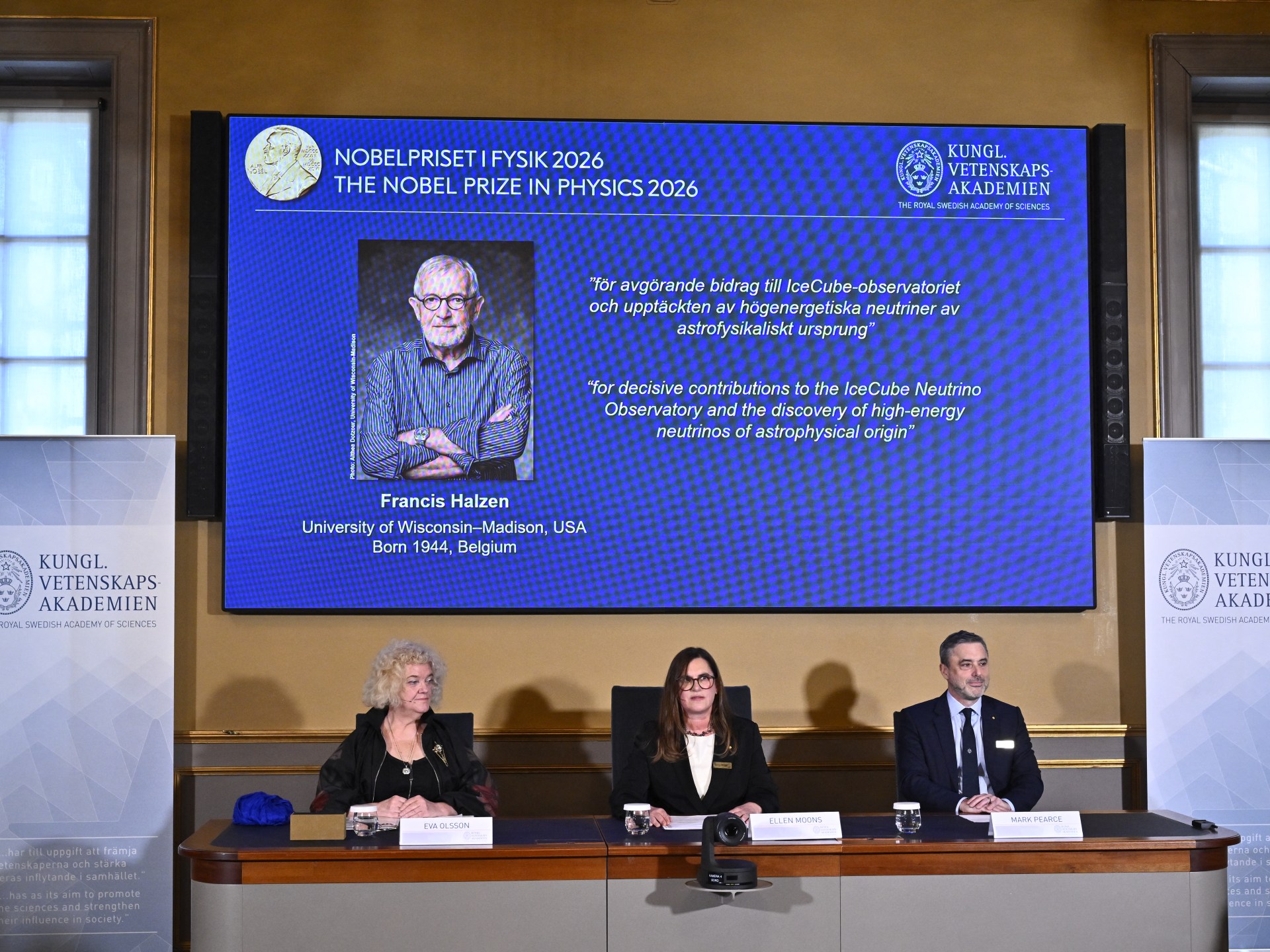
Francis Halzen Awarded Nobel Prize in Physics for Neutrino Breakthrough
Belgian physicist Francis Halzen wins the Nobel Prize in Physics for spearheading the IceCube Neutrino Observatory, revolutionizing humanity's detection of cosmic ghost particles.
Geopolitical & Core Developments
In a landmark recognition of fundamental scientific achievement, Belgian physicist Francis Halzen has been awarded the Nobel Prize in Physics for his visionary work on cosmic neutrinos—elusive subatomic entities frequently dubbed 'ghost particles.' Halzen's crowning scientific contribution is the conceptualization and construction of the IceCube Neutrino Observatory, an unprecedented scientific installation embedded a mile deep into the glacial ice at the geographic South Pole.
For decades, astrophysical research was constrained by electromagnetic radiation—light, X-rays, and radio waves—which can be blocked, scattered, or distorted by cosmic dust and magnetic fields. Neutrinos, by contrast, possess almost no mass and rarely interact with ordinary matter, allowing them to travel uninterrupted across billions of light-years from the most violent regions of the universe, including black holes and exploding stars. By turning a cubic kilometer of pristine Antarctic ice into a massive particle detector equipped with thousands of optical sensors, Halzen and his global research collaboration unlocked an entirely new window onto the cosmos, shifting humanity's observational capabilities from traditional photon astronomy to multi-messenger astrophysics.
Global Trade & Economic Ripples
While fundamental physics research operates primarily outside immediate commercial imperatives, large-scale international scientific mega-projects invariably generate critical technological spillovers. The engineering challenges overcome in realizing the IceCube observatory—ranging from ultra-low-temperature cryogenic systems and advanced deep-field drilling technologies to high-bandwidth satellite communications in extreme polar environments—have direct applications across multiple commercial sectors.
Furthermore, the processing of massive datasets generated by continuous neutrino monitoring demands cutting-edge computational infrastructure. The algorithms and machine-learning frameworks developed to filter background noise from rare cosmic signals contribute directly to the broader artificial intelligence and big data analytics markets. These advancements indirectly support high-performance computing hardware manufacturers, specialized semiconductor developers, and enterprise cloud infrastructure providers operating within the global technology supply chain. Additionally, specialized optical sensor manufacturing and photonics industries benefit from the stringent specifications required for deep-ice instrumentation, fostering innovation in medical imaging and environmental monitoring equipment.
Related Intelligence: Belgian Physicist Francis Halzen Awarded Nobel Prize in Physics
International Reactions & Diplomatic Stances
Global scientific bodies, academic institutions, and international research councils have united in praising the Nobel Committee's decision. The National Science Foundation (NSF) of the United States, which has provided primary financial backing for the IceCube facility, hailed the award as a testament to the power of sustained public investment in fundamental research and multinational scientific diplomacy.
Diplomatic representatives from Belgium, the United States, and partner nations across Europe and Asia emphasized that the success of the IceCube collaboration underscores the critical importance of cross-border scientific cooperation. In an era marked by rising geopolitical fragmentation and technological nationalism, massive international research facilities stand out as enduring symbols of collaborative human enterprise, where researchers from dozens of countries pool resources to answer fundamental questions about the universe.
Strategic Outlook & Future Scenarios
Looking ahead, Halzen's Nobel Prize is expected to accelerate momentum for next-generation neutrino detection initiatives currently in the planning and early development phases. Proposals for vastly expanded arrays, such as IceCube-Gen2, aim to dramatically increase detection volume, enabling astrophysicists to map the high-energy universe with unprecedented precision.
As governments and multilateral funding bodies evaluate future science budgets, the proven high yield of neutrino astronomy will likely secure robust long-term funding streams. This sustained investment will continue to drive innovation in extreme-environment engineering, deep-space telemetry, and advanced sensor technologies, ensuring that fundamental physics research remains a vital engine for technological progress and international collaboration in the decades to come.
Join Our Official WhatsApp Channel
Receive live commodity alerts, policy changes, and commercial intelligence directly on WhatsApp.