
Belgian Physicist Francis Halzen Awarded Nobel Prize in Physics
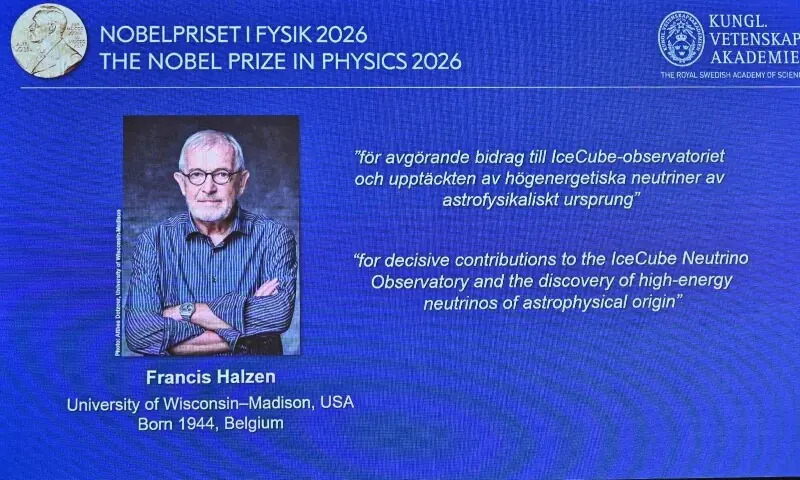
Belgian physicist Francis Halzen has won the Nobel Prize in Physics for his pioneering contributions to the IceCube Neutrino Observatory and the discovery of high-energy astrophysical neutrinos.
The Core Development
Belgian physicist Francis Halzen has been awarded the prestigious Nobel Prize in Physics for his monumental work on subatomic particles at the South Pole, the award jury announced on Tuesday. Ellen Moons, secretary general of the Royal Swedish Academy of Sciences, unveiled the laureate during a dedicated news conference, describing the breakthrough as a triumph in understanding what she termed 'ghost messengers from space.'
Halzen was specifically honored for his decisive contributions to the IceCube Neutrino Observatory and the successful detection and discovery of high-energy neutrinos originating from deep astrophysical sources outside our solar system. The IceCube facility, buried deep within the Antarctic ice sheet, transforms a cubic kilometer of pristine ice into an unprecedented detector capable of capturing fleeting interactions of elusive subatomic particles.
Commercial & Economic Implications
While fundamental physics research operates primarily at the frontier of human knowledge rather than immediate commercial trade, advancements in big data processing, cryogenic engineering, and advanced sensor technologies developed for projects like IceCube often cascade into broader industrial sectors. For emerging economies and industrial enterprises in nations like Pakistan, technological spillovers from global scientific infrastructure stimulate modernization in telecommunications, data analytics, and high-performance computing.
Furthermore, heightened global investment in cutting-edge scientific research infrastructure fosters international collaboration standards that influence high-tech supply chains and specialized component manufacturing. Although direct impacts on retail trade, domestic wholesale distribution, and immediate consumer price inflation remain minimal, global technological progress ultimately shapes the long-term competitiveness of knowledge-based economies.
Related Intelligence: Physics Nobel Awarded for Pioneering Space Observatory and Neutrino Breakthroughs
Stakeholder Perspectives & Market Reactions
Global scientific bodies, academic institutions, and high-technology research organizations have lauded the Nobel Committee's decision to recognize neutrino astronomy. Industry analysts and technology commentators emphasize that recognizing foundational research validates long-term international funding commitments toward mega-science projects.
In Pakistan, academic circles and scientific research forums have viewed the announcement as a powerful testament to the value of sustained, curiosity-driven exploration. Experts note that breakthroughs of this magnitude inspire younger generations toward careers in science, technology, engineering, and mathematics, reinforcing the human capital foundation necessary for sustainable national economic development.
Forward Outlook & Key Watchpoints
Following this Nobel recognition, the global astrophysical community anticipates accelerated funding and technological upgrades for next-generation neutrino detectors, such as IceCube-Gen2. Researchers aim to map the universe with unprecedented precision using neutrinos, potentially unlocking answers regarding dark matter, cosmic ray origins, and extreme astrophysical phenomena.
For policymakers and global technology observers, key watchpoints include how international consortia finance upcoming expansions and how rapidly advanced computational techniques utilized in processing these massive datasets migrate into commercial enterprise applications worldwide.
Join Our Official WhatsApp Channel
Receive live commodity alerts, policy changes, and commercial intelligence directly on WhatsApp.