
Dar Presses EU for GSP+ Renewal at UNGA
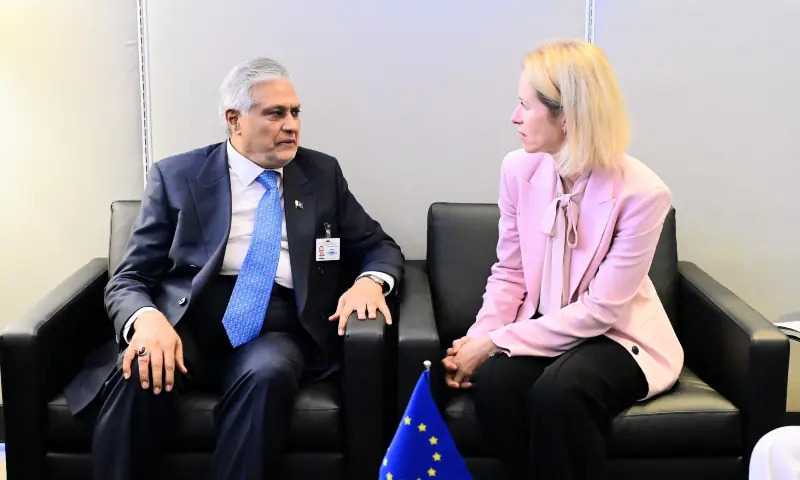
Deputy Prime Minister Ishaq Dar underscored the critical importance of the GSP+ trade scheme during high-level talks with EU foreign policy chief Kaja Kallas at the United Nations.
The Core Development
Deputy Prime Minister and Foreign Minister Ishaq Dar underscored the critical significance of the Generalized Scheme of Preferences Plus (GSP+) during a high-stakes diplomatic encounter with European Union High Representative for Foreign Affairs and Security Policy, Kaja Kallas. The bilateral meeting transpired on the sidelines of the 81st session of the United Nations General Assembly (UNGA) in New York, scheduled from September 21 to 25. According to an official statement released by the Ministry of Foreign Affairs, the dialogue centered on fortifying institutional and economic bridges between Islamabad and Brussels, with a primary focus on the continuation of preferential trade terms that have historically anchored Pakistan's export-driven sectors.
Commercial & Economic Implications
The GSP+ status serves as a financial lifeline for Pakistan's external account stability, granting preferential zero-duty or low-duty access to the lucrative European single market for thousands of product lines. For Pakistan's domestic manufacturing, wholesale distribution, and retail supply chains—particularly within the textile, apparel, leather goods, and agricultural processing sectors—the continuation of this scheme is paramount. Any disruption or revocation of GSP privileges would impose severe tariff barriers, eroding the competitive edge of Pakistani exporters against regional peers like Bangladesh and Vietnam. This would ultimately depress foreign exchange earnings, strain macroeconomic stabilization efforts, and exert upward pressure on domestic trade deficits and inflation.
Related Intelligence: Pakistan and Iran Forge Deeper Ties for Regional Stability and Trade
Stakeholder Perspectives & Market Reactions
Export-oriented industrial associations, chambers of commerce, and agricultural trade bodies across Pakistan have closely monitored the UNGA interactions, viewing the renewal of GSP+ as an existential requirement for industrial employment and capacity utilization. Business leaders emphasize that maintaining preferential market access requires stringent compliance with 27 international core conventions spanning human rights, labor standards, environmental protection, and good governance. Legal experts and policy analysts note that while Brussels continues to scrutinize legislative reforms and implementation timelines within Pakistan, ongoing diplomatic engagement by senior leadership like Dar is vital to reassure European regulators of Islamabad's long-term reform trajectory.
Forward Outlook & Key Watchpoints
As diplomatic channels remain active following the New York consultations, market watchers and trade analysts are tracking the legislative review cycles within the European Union regarding the future architecture of the GSP framework. Key watchpoints include upcoming monitoring missions from European delegations to evaluate Pakistan's regulatory compliance, legislative updates on human and labor rights, and the finalization of regulatory extensions. Policymakers in Islamabad must sustain rigorous inter-ministerial coordination to meet evolving compliance benchmarks, ensuring that bilateral trade ties with the European Union are safeguarded against geopolitical and regulatory shifts.
Join Our Official WhatsApp Channel
Receive live commodity alerts, policy changes, and commercial intelligence directly on WhatsApp.