
Pakistan, Saudi Arabia, and Turkey Convene for Strategic Defence Pact Talks
Military chiefs from Pakistan, Saudi Arabia, and Turkey held high-level talks on Friday to explore strategic military assistance under the Makkah Defence Alliance.
The Core Development
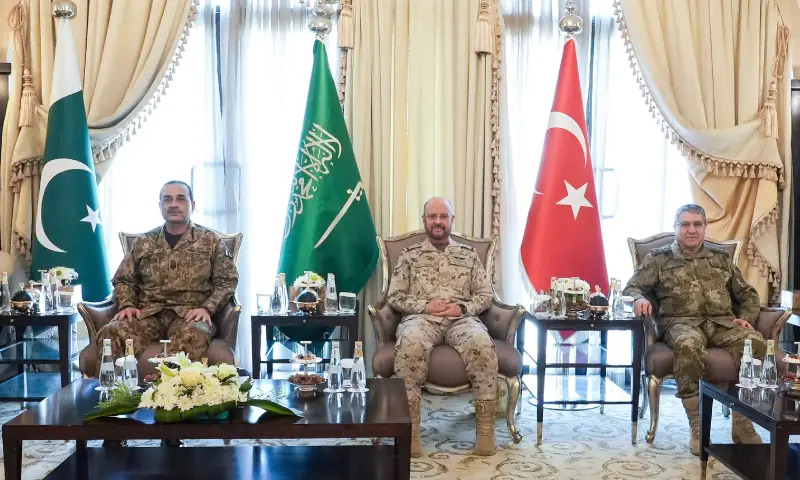
In a significant regional security development, military chiefs of staff from Pakistan, Saudi Arabia, and Turkey convened on Friday for high-level strategic talks. The primary objective of the summit was to explore comprehensive ways to assist Riyadh under the framework of the Makkah Defence Alliance. While the exact location of the summit was withheld by participating authorities, the Turkish Ministry of Defence released official photographs showing the three military officials in uniform.
Turkish media and defence disclosures earlier confirmed that Turkey's Chief of General Staff, General Selcuk Bayraktaroglu, traveled specifically to Saudi Arabia to participate in the deliberations. This trilateral engagement underscores an escalating institutionalization of defence cooperation among three of the most potent military forces in the broader Middle East and South Asian corridors. The talks focused on operationalizing collective security mechanisms, intelligence sharing, and strategic interoperability under the Makkah Defence Alliance, signaling a shift toward a more robust, multi-lateral security architecture.
Commercial & Economic Implications
While ostensibly a military and geopolitical pact, the deepening strategic alignment among Pakistan, Saudi Arabia, and Turkey carries profound commercial and economic ramifications for Pakistan's domestic market, foreign reserves, and external trade balances. Enhanced defence cooperation historically translates into expanded bilateral trade frameworks, joint defence production ventures, and direct foreign investment flows from Gulf economies into Pakistan's industrial and energy sectors.
For Pakistan's wholesale distribution and manufacturing ecosystems, particularly the heavy engineering and industrial sectors, closer ties with Riyadh and Ankara open lucrative avenues for defence exports and technology transfers. Furthermore, robust geopolitical stability fostered by such alliances directly influences investor confidence, stabilizing the Pakistani Rupee against foreign currencies and mitigating imported inflation risks tied to energy imports from the Gulf. A secure trade corridor ensures uninterrupted petroleum supply chains, shielding domestic retail fuel prices from extreme global volatility.
Related Intelligence: Pakistan Adjusts Fuel Prices with Petrol Up and Diesel Down
Stakeholder Perspectives & Market Reactions
Business councils, trade bodies, and financial analysts in Pakistan have welcomed the strategic alignment, viewing it as a catalyst for broader economic integration. Representatives from leading chambers of commerce noted that strengthened diplomatic and military ties often precede preferential trade agreements and enhanced financial lifelines, which are vital for Pakistan's macroeconomic stabilization.
Financial markets responded with cautious optimism, as investors monitor potential spillover effects into bilateral economic corridors, such as the Saudi-funded infrastructure projects and Turkish industrial investments in Pakistan. Legal and policy experts emphasize that while the pact is primarily defensive and security-oriented, its secondary economic dividends could significantly bolster Pakistan's external account position through bilateral financial support and joint commercial ventures.
Forward Outlook & Key Watchpoints
As the Makkah Defence Alliance transitions from conceptual framework to operational reality, key stakeholders must monitor several critical timelines and policy milestones. Analysts will closely watch for formal announcements regarding joint military exercises, institutional command structures, and specific technological cooperation agreements emanating from this trilateral engagement.
For Pakistan, the primary watchpoints include potential inflows of foreign direct investment, the formalization of joint defence manufacturing contracts, and the overall trajectory of trade agreements with Saudi Arabia and Turkey. Policymakers must ensure that strategic military commitments translate into tangible economic benefits for local industries, reinforcing Pakistan's position as a pivotal player in regional security and economic stability.
Join Our Official WhatsApp Channel
Receive live commodity alerts, policy changes, and commercial intelligence directly on WhatsApp.