
Pakistan and Russia Deepen Security Ties as Interior Minister Visits GHQ
Russian Interior Minister Vladimir Kolokoltsev met Pakistani military leadership in Rawalpindi, marking a historic milestone aimed at bolstering bilateral security coordination, counter-transnational crime efforts, and regional economic stability.
The Core Development
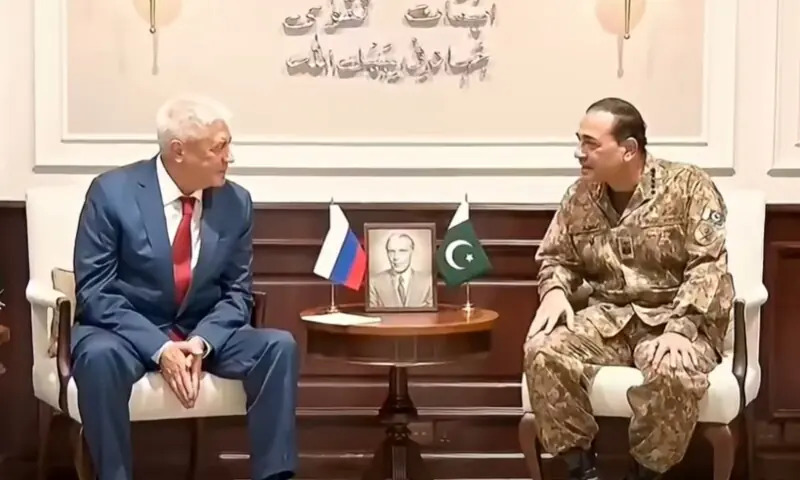
In an unprecedented diplomatic and strategic exchange, Russian Interior Minister Vladimir Kolokoltsev met Chief of Army Staff General Asim Munir at General Headquarters (GHQ) in Rawalpindi. The engagement represents the first official visit of a Russian interior minister to Pakistan, signaling a structural recalibration of bilateral relations between Moscow and Islamabad. Minister Kolokoltsev arrived on a four-day official tour following an invitation from Pakistani Interior Minister Mohsin Naqvi.
According to an official communique from the Inter-Services Public Relations (ISPR), the deliberations focused on matters of mutual security interest, the regional geostrategic environment, and enhanced coordination against cross-border threats. Both sides underlined the strategic necessity of upgrading bilateral cooperation, including collaborative mechanisms between internal security apparatuses, counter-terrorism initiatives, and institutionalized intelligence sharing. The dialogue at GHQ builds on earlier working-level meetings with civilian security counterparts, reflecting Moscow’s sustained pivot toward South Asian security frameworks amidst shifts in Eurasian geopolitics.
Commercial & Economic Implications
While the GHQ summit concentrated primarily on security mechanisms, its underlying economic ramifications are critical for Pakistan's macro stability and commodity supply chains. Institutional security agreements provide the foundational prerequisite for advancing bilateral trade routes, particularly the expansion of direct cargo transit via the International North-South Transport Corridor (INSTC) and maritime links linking St. Petersburg and Vladivostok with Karachi and Gwadar.
For Pakistan's wholesale and retail distribution sectors, improved logistical predictability between Central Asia, Russia, and South Asia carries tangible benefits. Bilateral accords that stabilize transit corridors mitigate supply disruptions for critical imports, notably Russian crude petroleum, liquefied petroleum gas (LPG), and industrial fertilizers such as urea and diammonium phosphate. Secure trade routes significantly lower maritime freight risk premiums, tempering landed import costs and insulating domestic wholesale markets from extreme price volatility. Over the medium term, reliable cross-border law enforcement reduces illicit trafficking, shielding regulated distributors from untaxed parallel imports that distort local retail pricing.
Related Intelligence: West Bank Escalation Deepens Middle East Instability and Trade Risks
Stakeholder Perspectives & Market Reactions
Industry and trade bodies in Pakistan have viewed the high-level Russian engagement as a pragmatic step toward market diversification. Representatives from national chambers of commerce have long advocated for a formal framework to resolve correspondent banking constraints and insurance bottlenecks currently impeding direct trade settlement with Russian counterparties. Strategic convergence at the military and internal security levels is widely seen by legal analysts and international trade practitioners as the precursor to resolving these operational obstacles.
Official delegations emphasized that bilateral cooperation remains defensive, institutional, and geared toward combating organized transnational crime, human trafficking, and illicit narcotics. Diplomatic observers note that Islamabad’s strategic recalibration demonstrates a balanced foreign policy that maintains active partnerships across global power centers. Financial analysts, meanwhile, point out that secure commercial corridors with Moscow could provide vital fiscal breathing room, enabling competitive procurement of energy and agricultural inputs crucial for stabilizing consumer price inflation.
Forward Outlook & Key Watchpoints
The immediate aftermath of Minister Kolokoltsev's visit will require monitoring the formalization of technical protocols between the respective interior ministries. Key watchpoints include the potential establishment of a joint working group on counter-narcotics, standard operating procedures for real-time maritime domain intelligence, and capacity-building exchanges for law enforcement personnel.
In the commercial sphere, business stakeholders will assess whether high-level security goodwill translates into the activation of alternative currency settlement frameworks and bilateral investment treaties. As Moscow and Islamabad navigate the implementation phase over the next two fiscal quarters, market participants will closely track the flow of energy consignments, reciprocal customs clearance rationalization, and the sustained security of land-based transport routes through Central Asian transit nodes.
Join Our Official WhatsApp Channel
Receive live commodity alerts, policy changes, and commercial intelligence directly on WhatsApp.