
Pakistan Demands End to Israeli Occupation at Global Peace Summit
Deputy Prime Minister Ishaq Dar urged an immediate end to Israeli occupation at a high-level international summit convened by France, the UK, and Canada, emphasizing Pakistan's unwavering commitment to the two-state solution.
The Core Development
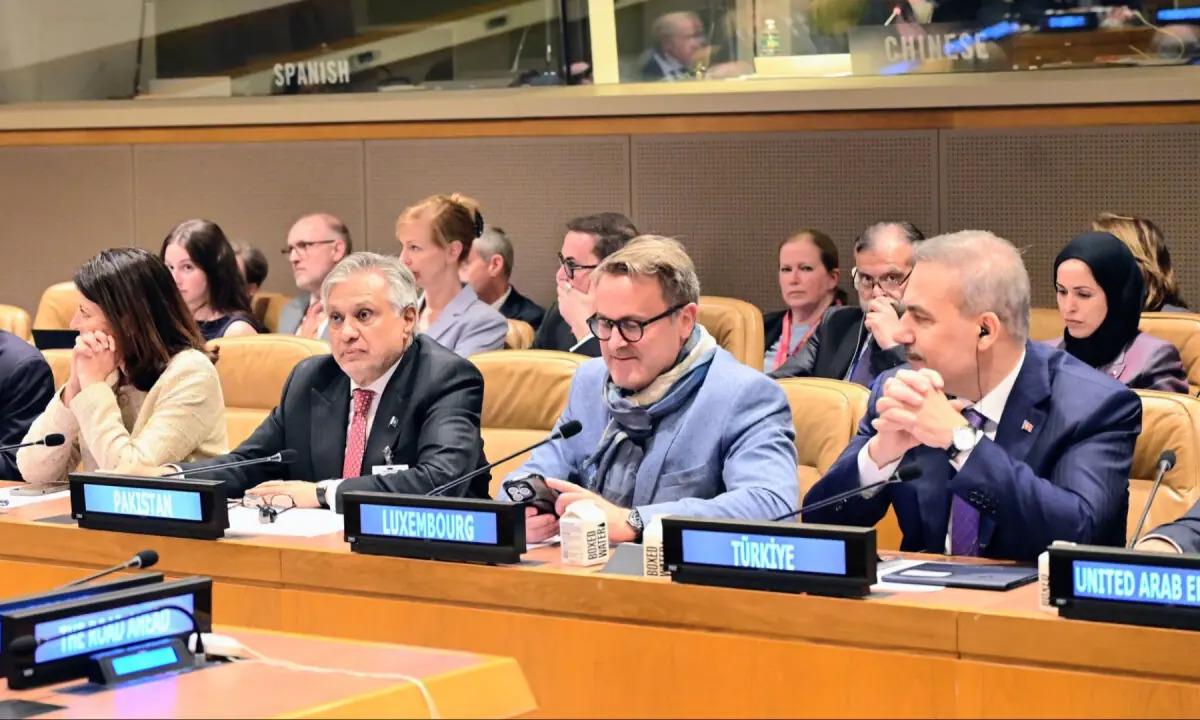
Deputy Prime Minister and Foreign Minister Ishaq Dar delivered Pakistan's official national statement at the High-Level International Meeting on the Two-State Solution, held under the thematic framework titled The Road Ahead: One Year After the New York Declaration and the Comprehensive 20-point Peace Plan. The high-stakes diplomatic conference was convened jointly by French President Emmanuel Macron, Canadian Prime Minister Mark Carney, and British Prime Minister Andy Burnham to evaluate multilateral progress on Middle East peace initiatives. Opening remarks at the summit were delivered by Saudi Foreign Minister Prince Faisal bin Farhan and United Nations Secretary-General António Guterres, underscoring the gravity and urgency of the international mandate. During his address, Foreign Minister Dar underscored Pakistan's historical stance on the Palestine question, mapping out Islamabad's active participation in various diplomatic forums aimed at securing a sovereign Palestinian state based on pre-1967 borders, with Al-Quds Al-Sharif as its capital. The Foreign Office confirmed that Pakistan remains actively engaged with international partners to ensure humanitarian corridors remain open and that international law is upheld without selective application.
Commercial & Economic Implications
While geopolitical developments in the Middle East often appear distant from domestic markets, prolonged regional instability carries profound macroeconomic ramifications for Pakistan's trade balance and energy security. Ongoing conflicts in the Levant and the broader Middle East routinely exert upward pressure on global crude oil benchmarks, directly inflating Pakistan's import bill and exacerbating domestic inflationary pressures. For Kalyar Traders and the wider mercantile community across Pakistan, volatile energy prices translate directly into higher freight charges, increased costs of raw material imports, and compressed profit margins for manufacturing and wholesale distribution sectors. Furthermore, disruptions in maritime supply chains through major regional chokepoints can delay shipments of essential commodities, agricultural inputs, and manufactured goods. A stable resolution in the Middle East is viewed by financial analysts as a prerequisite for stabilizing international commodity prices, which in turn helps insulate Pakistan's foreign exchange reserves and stabilizes domestic retail price indices.
Related Intelligence: UN General Assembly Convenes Amid Global Diplomatic Friction
Stakeholder Perspectives & Market Reactions
Business councils, trade associations, and policy think tanks in Pakistan have closely monitored the government's diplomatic engagements, weighing foreign policy stances against domestic economic imperatives. Major chambers of commerce and industry bodies have expressed cautious optimism regarding multilateral peace efforts, noting that sustained international diplomacy is essential for mitigating global economic shocks. Legal experts and foreign policy analysts in Islamabad have lauded the Foreign Office for maintaining a principled stance on self-determination while actively participating in Western-backed multilateral initiatives. Public response across national media platforms has strongly supported the government's vocal advocacy for Palestinian rights, reflecting deep-rooted societal solidarity. Concurrently, financial market participants emphasize that Pakistan's active participation in high-level global forums reinforces its standing within the international financial community, signaling diplomatic maturity and constructive engagement in global governance.
Forward Outlook & Key Watchpoints
As the international community reviews the milestones outlined in the comprehensive 20-point peace plan one year after the New York Declaration, policymakers in Islamabad are preparing for subsequent diplomatic phases. Key watchpoints for the coming months include the follow-up ministerial sessions scheduled by the convening nations, potential resolutions at the United Nations General Assembly, and the implementation timeline for humanitarian aid distribution and reconstruction frameworks in Gaza. For Pakistani enterprises and market observers, tracking the trajectory of international sanctions, regional ceasefires, and bilateral trade agreements with Middle Eastern economies will remain critical. The Ministry of Foreign Affairs is expected to issue a comprehensive domestic policy brief detailing how Pakistan will leverage its diplomatic capital in upcoming multilateral summits to advocate for sustainable peace and regional economic stability.
Join Our Official WhatsApp Channel
Receive live commodity alerts, policy changes, and commercial intelligence directly on WhatsApp.