
Government-JI Talks Stalled as Islamabad Cites Security Threats
The fifth round of negotiations between the government and Jamaat-i-Islami concluded inconclusively on Saturday after authorities requested a postponement citing security alerts, leaving planned protests against power tariffs and taxes on track.
The Core Development
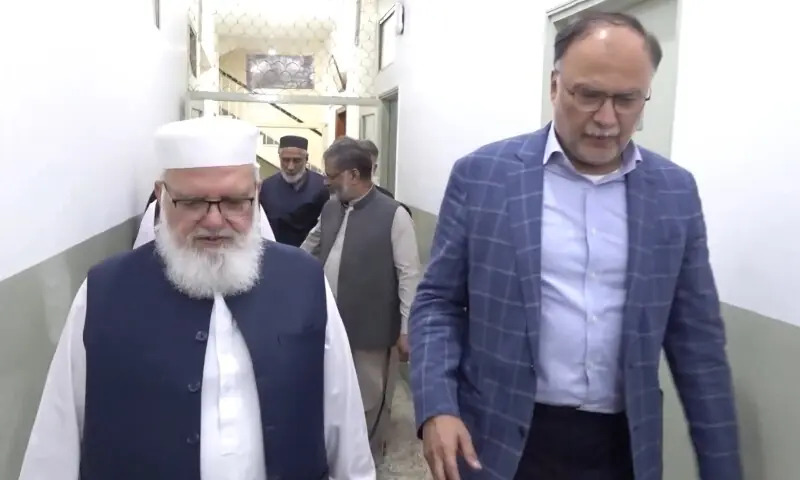
A high-stakes fifth round of negotiations between the federal government and the leadership of Jamaat-i-Islami (JI) ended in a stalemate on Saturday in Lahore, as state representatives failed to persuade the party to call off its planned long march on the federal capital. Convening under mounting political tension, the government delegation—comprising Federal Minister for Planning, Development and Special Initiatives Ahsan Iqbal, Prime Minister's Advisor on Political Affairs Rana Sanaullah, and Punjab Provincial Minister Khawaja Salman Rafique—formally requested a postponement of the protest movement, explicitly citing heightened security threats and intelligence warnings.
The JI negotiating committee, led by Deputy Emir Liaquat Baloch alongside Acting Secretary General Nazir Ahmad Janjua, Special Assistant Umair Idrees, JI Lahore Emir Ziauddin Ansari, and Information Secretary Shakeel Ahmad Tarrabi, refused to defer the agitation without enforceable, binding relief measures. The party's campaign stems from intensifying public discontent over punitive electricity tariffs, capacity charges to Independent Power Producers (IPPs), and elevated direct taxation across retail and salaried segments. Despite protracted closed-door discussions, neither side conceded operational ground, prompting JI to maintain its protest mobilization while government interlocutors scrambled to prevent logistics gridlocks along the Grand Trunk Road.
Commercial & Economic Implications
The persistent impasse casts a direct shadow over Pakistan's primary commercial corridors and retail distribution networks. Prolonged political standoffs and potential highway blockades routinely disrupt internal trade flows between Punjab's industrial heartland and northern consumer markets. Wholesale traders, freight forwarders, and logistics operators are already pricing in supply chain vulnerabilities, with transport firms anticipating detours, delayed consignments, and elevated transit costs.
At the core of the confrontation lies severe microeconomic stress facing domestic enterprises and retail trade. JI's agitational platform focuses heavily on surging utility expenses, where commercial power tariffs—amplified by fuel charges adjustments and fixed debt amortization components—have severely compressed merchant margins and depleted urban consumer purchasing power. If the deadlock translates into localized market closures or extended highway blockades, wholesale distribution of perishables and essential fast-moving consumer goods will face acute friction, driving up spot prices and compounding headline inflation in urban centres.
Related Intelligence: Smoke Plume Near Riyadh Airport Signals Deepening Gulf Regional Security Risks
Stakeholder Perspectives & Market Reactions
Trade bodies and merchant associations across Lahore, Karachi, and Rawalpindi have registered deep concern over the breakdown in talks. While commercial associations broadly endorse JI's economic demands—particularly the rationalization of power tariffs, revision of IPP contracts, and relief from withholding tax burdens—they remain wary of indefinite transport disruptions that could paralyze daily turnover at wholesale hubs like Shah Alam Market and Akbari Mandi.
Government officials maintain that state institutions cannot overlook actionable intelligence regarding security risks at mass public gatherings, framing their appeal for a postponement as a matter of civic protection rather than political stalling. Conversely, JI representatives contend that the administration is leveraging security alerts as a political mechanism to deflect attention from fiscal austerity measures implemented under the International Monetary Fund framework. Independent economic analysts note that while the federal government lacks the fiscal headroom to offer unbudgeted power subsidies, failing to provide a credible policy concession risks exacerbating political risk premiums across domestic markets.
Forward Outlook & Key Watchpoints
With negotiations stalled, immediate attention shifts to administrative and security measures along the principal transport corridors connecting Punjab with Islamabad. Key watchpoints over the next 48 hours include the potential imposition of Section 144 across critical junctions, pre-emptive freight rerouting, and targeted administrative measures to contain march convoys.
Should JI proceed with its mobilization toward the federal capital, domestic supply chains risk widespread logistical snarls, prompting wholesale distributors to hold inventory and restrict credit terms. A durable de-escalation will depend on whether the federal administration can present a structured, verifiable timetable on energy sector reforms and tariff revisions, balancing macro stability commitments with the mounting demand for domestic economic relief.
Join Our Official WhatsApp Channel
Receive live commodity alerts, policy changes, and commercial intelligence directly on WhatsApp.