
Optogenetics Pioneers Secure 2026 Nobel Prize for Brain Research
Three scientists have been awarded the 2026 Nobel Prize in Physiology or Medicine for pioneering optogenetics and light-gated ion channels, transforming our understanding of neurological functions.
The Core Development
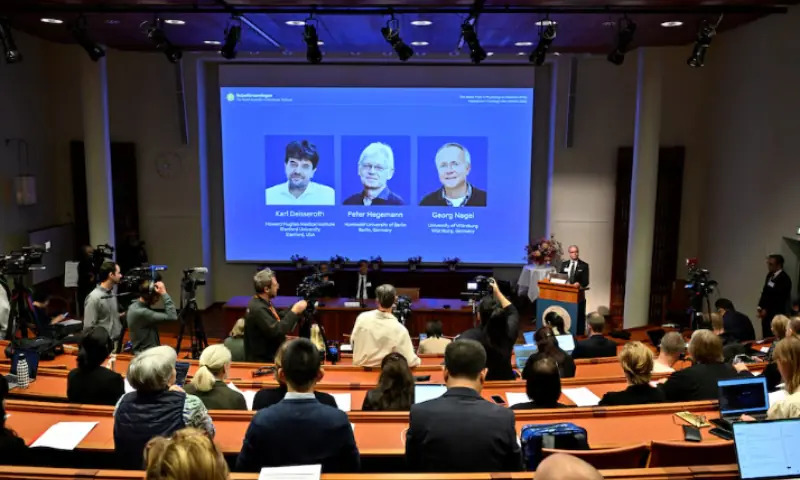
In a landmark announcement on Monday, the Nobel Assembly at Sweden's Karolinska Institute awarded the 2026 Nobel Prize in Physiology or Medicine to American researcher Karl Deisseroth alongside German scientists Peter Hegemann and Georg Nagel. The prestigious accolade recognizes their revolutionary discoveries concerning light-gated ion channels and the burgeoning field of optogenetics, a technology that merges optics and genetics to control the behavior of cells in living tissue with unprecedented precision.
Karl Deisseroth, 54, professor at Stanford University, worked alongside Peter Hegemann, 71, and Georg Nagel, 73, both prominent biophysicists from Germany, to unlock how specific microbial proteins can respond to light. Their collective findings have fundamentally shifted the paradigm of neuroscience, offering researchers the capability to activate or deactivate targeted neuronal circuits using millisecond-pulsed light beams. This precision contrasts sharply with traditional pharmacological and electrical stimulation methods, which often lack cellular specificity and impact broader brain networks indiscriminately.
Commercial & Economic Implications
While the Nobel-winning breakthrough originated in fundamental academic and biophysical research, its long-term commercial ramifications extend deeply into the global biotechnology and pharmaceutical sectors. For developing markets like Pakistan, the expansion of advanced neuro-technological research tools underscores a growing technological divide, while simultaneously creating new avenues for future medical import economies and specialized healthcare infrastructure.
As global pharmaceutical giants invest heavily in neuro-modulation therapies for treatment-resistant depression, Parkinson's disease, and neurodegenerative disorders, the cost structures of advanced medical treatments will likely experience structural shifts. Domestic healthcare markets in South Asia may eventually observe a trickle-down effect as diagnostic devices and specialized neurological equipment evolve. However, in the near term, the primary economic impact remains concentrated within venture capital flows into Western biotech hubs, medical device manufacturing, and intellectual property portfolios held by leading research institutions.
Related Intelligence: Pioneering Optogenetics Research Secures Nobel Prize Amid Commercialization Wave
Stakeholder Perspectives & Market Reactions
International scientific bodies, academic institutions, and medical technology associations have overwhelmingly praised the Karolinska Institute's decision, hailing it as a long-overdue validation of optogenetics' transformative impact on modern medicine. Global pharmaceutical analysts note that the recognition will likely spur a fresh wave of venture funding directed toward start-ups specializing in optogenetic gene therapies and precision neuro-stimulators.
Within regional scientific communities in South Asia, researchers have emphasized the necessity of bridging the gap in advanced optical and genetic laboratory infrastructure. Industry commentators point out that while Pakistan's commercial and retail trade sectors remain insulated from direct market shocks related to this basic science award, the broader tech and biotech sectors must monitor these foundational shifts to prepare for future waves of medical innovation.
Forward Outlook & Key Watchpoints
Looking ahead, the clinical translation of optogenetics stands as the next major frontier for the medical community. While animal models have yielded profound insights into neural circuitry, human clinical trials utilizing optogenetic gene therapy remain in their nascent stages. Key watchpoints for the coming decade include regulatory approvals for human trials, advancements in fiber-optic implant miniaturization, and the commercial viability of vector delivery systems.
Policymakers, healthcare investors, and academic institutions worldwide will closely track how effectively these foundational discoveries transition from laboratory benchmarks into scalable, commercially viable therapeutics. As the global medical establishment embraces light-based neural regulation, the boundaries of neurology continue to expand, setting a new benchmark for biomedical innovation.
Join Our Official WhatsApp Channel
Receive live commodity alerts, policy changes, and commercial intelligence directly on WhatsApp.