
Nobel Medicine Prize Awarded for Optogenetics Breakthrough
Three scientists from the United States and Germany have won the 2026 Nobel Prize in Medicine for pioneering optogenetics, a revolutionary technique using light to control brain cells.
The Core Development
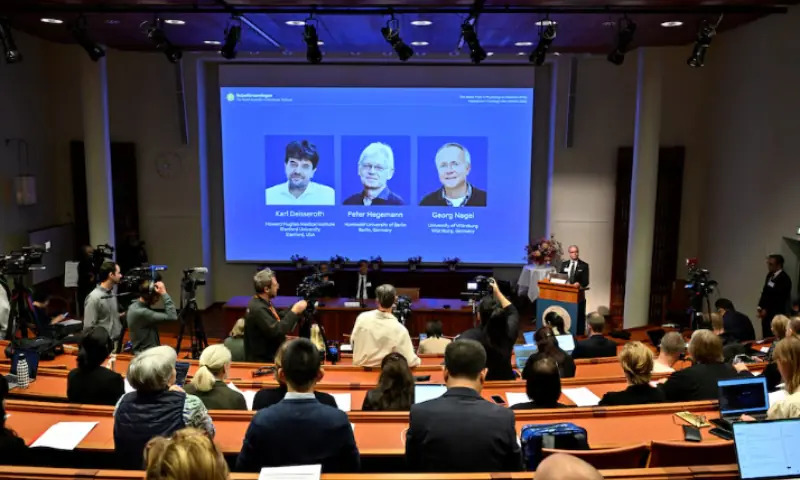
The 2026 Nobel Prize in Physiology or Medicine has been awarded to American researcher Karl Deisseroth alongside German scientists Peter Hegemann and Georg Nagel. Announced on Monday by the Nobel Assembly at Sweden's Karolinska Institute, the prestigious prize recognizes their groundbreaking discoveries concerning light-gated ion channels and the development of optogenetics.
Karl Deisseroth, 54, joined by Peter Hegemann, 71, and Georg Nagel, 73, were honored for a technological leap that allows scientists to control the behavior of cells in living tissue with unprecedented precision using light. The technique relies on microbial proteins called channelrhodopsins, which open and close in response to specific light wavelengths, thereby controlling the flow of ions across cell membranes. By introducing these light-sensitive proteins into specific neurons, researchers can activate or silence targeted neural circuits on a millisecond timescale.
Commercial & Economic Implications
While the Nobel-winning breakthrough stems from fundamental neuroscience research, the commercial and economic ripple effects extend deeply into the global biotechnology, pharmaceutical, and medical device sectors. For emerging economies like Pakistan, the maturation of optogenetics signals a long-term paradigm shift in pharmaceutical research and development, particularly for central nervous system disorders such as Parkinson disease, depression, and epilepsy.
Although direct impacts on retail trade or domestic wholesale markets are indirect, the advancement accelerates the discovery pipeline for next-generation neuro-therapeutics. Global pharmaceutical giants are increasingly investing in proprietary neuro-technologies, altering valuation metrics across health-tech markets. For Pakistan's burgeoning technology and medical research sectors, understanding these frontier disciplines is vital for long-term academic alignment, foreign technology transfer, and future high-value medical imports.
Related Intelligence: Pioneering Optogenetics Research Secures Nobel Prize Amid Commercialization Wave
Stakeholder Perspectives & Market Reactions
Global scientific bodies, academic institutions, and biotechnology investors have overwhelmingly praised the Karolinska Institute decision, viewing it as validation of interdisciplinary research bridging optics, genetics, and neurobiology. International trader associations and pharmaceutical stakeholders note that fundamental research of this caliber ultimately lays the groundwork for multi-billion-dollar therapeutic markets.
In regional academic and medical circles, experts emphasize the need for enhanced investment in advanced biotechnology infrastructure. While Pakistani clinical markets primarily focus on imported pharmaceuticals and established medical devices, visionary leaders argue that tracking global breakthroughs in neuromodulation is essential for preparing national healthcare systems for future diagnostic and therapeutic paradigms.
Forward Outlook & Key Watchpoints
As the scientific community digests the 2026 Nobel announcement, key watchpoints include the clinical translation of optogenetic tools in human trials. Researchers are currently exploring optogenetic-based therapies for restoring vision in degenerative retinal diseases and treating severe neurological disorders resistant to traditional pharmacology.
For policymakers and market observers, the ongoing commercialization of optogenetic research equipment and vector delivery systems will dictate how rapidly these sophisticated technologies diffuse beyond elite Western laboratories into broader international clinical practice. Monitoring venture capital flows into neuro-tech startups will provide clear indicators of when these scientific milestones begin reshaping commercial healthcare markets globally.
Join Our Official WhatsApp Channel
Receive live commodity alerts, policy changes, and commercial intelligence directly on WhatsApp.