
Pakistan and Maldives Deepen Defence and Strategic Maritime Ties in Islamabad
Maldivian President Dr Mohamed Muizzu and Pakistan military leadership agreed to enhance bilateral defence and maritime collaboration, opening strategic opportunities for regional security, bilateral trade expansion, and diversified freight corridors.
The Core Development
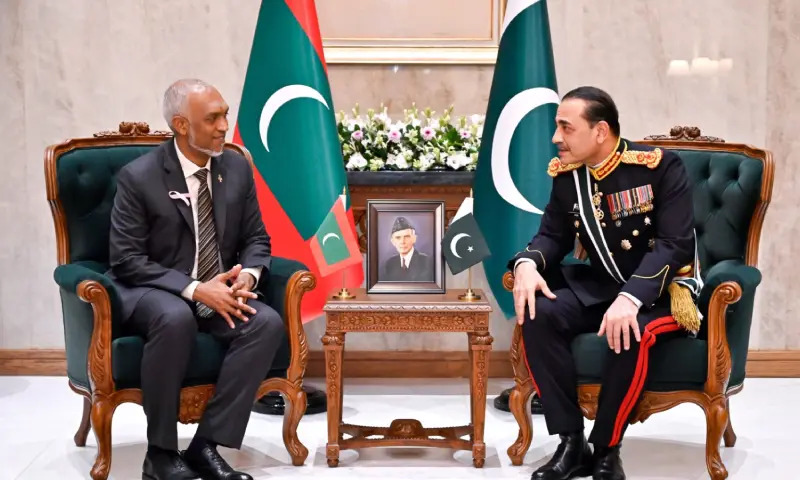
In a landmark diplomatic engagement marking the 60th anniversary of bilateral relations established in 1966, Maldivian President Dr Mohamed Muizzu held extensive high-level talks with Pakistan's senior military leadership in Islamabad. Chief of Defence Forces and Chief of Army Staff General Asim Munir called on the visiting head of state during his three-day official visit, which was undertaken at the invitation of Prime Minister Shehbaz Sharif. This historic trip represents the first official visit by a Maldivian president to Pakistan in over eleven years, signaling a renewed momentum in regional geopolitical partnerships.
Discussions centered on expanding bilateral defence cooperation, joint training exercises, maritime security operations, and intelligence coordination. Given the Maldives' pivotal geographical positioning along vital Indian Ocean sea lanes of communication (SLOCs), both sides underscored the urgency of safeguarding open maritime corridors against piracy, contraband smuggling, and geopolitical disruptions. The leaders reviewed the evolving regional security architecture, emphasizing that structured institutional security cooperation serves as the backbone for broader economic and bilateral development initiatives between South Asian littoral states.
Commercial & Economic Implications
While predominantly framed around defence, the deepening ties between Islamabad and Malé bear direct economic ramifications for Pakistan's commercial ecosystem. The Indian Ocean transit routes are indispensable for Pakistan’s bulk energy imports, sea freight, and non-traditional export destinations. Strategic alignment with the Maldives enhances Pakistan's maritime footprint, offering long-term stability to commercial sea trade routes and reducing maritime insurance risk premia over critical commercial corridors.
For Pakistan’s domestic trading community, particularly exporters in value-added textiles, agro-commodities, pharmaceuticals, and construction materials, the bilateral reset presents lucrative trade diversification opportunities. The Maldives relies heavily on imports for staple consumer goods, perishable food items, and construction materials—sectors where Pakistani wholesale traders and manufacturers maintain a structural competitive advantage. Direct maritime connectivity and enhanced institutional trust could streamline shipping logistics, curtail intermediary merchant markups, and establish cost-effective shipping lanes, benefiting local freight forwarding networks and boosting foreign exchange liquidity through non-traditional exports.
Related Intelligence: Pakistan and Maldives Deepen Bilateral Defence and Economic Ties in Islamabad
Stakeholder Perspectives & Market Reactions
Pakistan's business and trade leadership have welcomed the diplomatic pivot. Commercial bodies, including the Federation of Pakistan Chambers of Commerce and Industry (FPCCI) and various wholesale commodity associations, highlighted that South Asian island economies represent untapped markets for domestic staples such as rice, citrus, pharmaceuticals, and light engineering goods. Industry representatives noted that previous trade flows suffered from inconsistent direct shipping infrastructure and fragmented institutional frameworks.
Maritime analysts and security observers noted that the discussions between President Muizzu and the Pakistani military establishment reflect a synchronized approach toward balanced regional foreign policy. Legal and international trade practitioners also point out that high-level defence accords frequently pave the way for preferential trade agreements (PTAs) and bilateral investment treaties. By solidifying defence and institutional linkages, both governments are establishing the necessary sovereign guarantees required for private sector investments, cargo transport contracts, and direct air-sea multimodal links.
Forward Outlook & Key Watchpoints
Moving forward, commercial and policy observers will monitor several key milestones. Prime among these is the institutionalization of scheduled defence exchanges and technical capacity programs, alongside bilateral joint ministerial commission (JMC) meetings intended to formulate actionable commercial treaties. Establishing direct cargo routes or reciprocal port-handling facilities will be crucial in converting diplomatic goodwill into tangible trade volume.
Additionally, watchpoints include the potential negotiation of bilateral tariff concessions on agricultural products and construction materials, which would allow Pakistani exporters to compete directly with existing regional suppliers in the Maldivian market. Should the security framework successfully transition into formalized economic pacts, it will establish a sustainable blueprint for trade diplomacy, enhancing both national security resilience and domestic wholesale market expansion across the Indian Ocean rim.
Join Our Official WhatsApp Channel
Receive live commodity alerts, policy changes, and commercial intelligence directly on WhatsApp.