
Pakistan and Brazil Move to Deepen Bilateral Defence and Economic Ties
Pakistan and Brazil have agreed to enhance bilateral defence cooperation and institutional engagements following high-level military talks at Rawalpindi's General Headquarters.
The Core Development
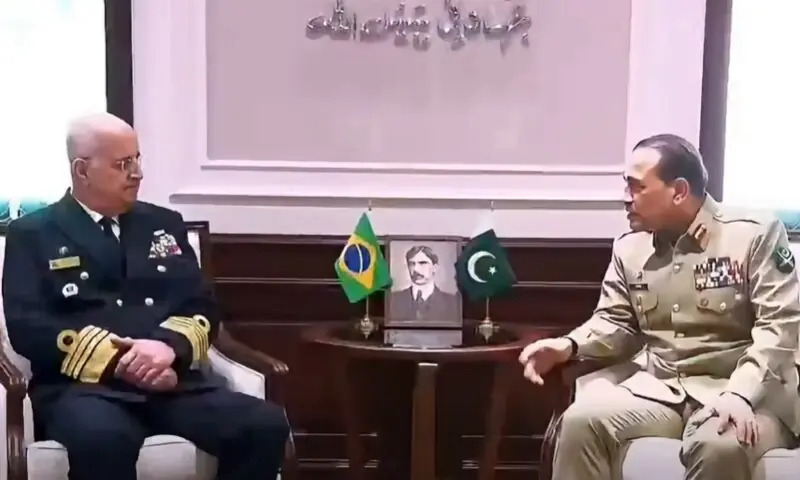
Pakistan and Brazil have formally agreed to reinforce institutional military-to-military engagement following high-level discussions held at the General Headquarters (GHQ) in Rawalpindi. The Brazilian delegation was led by Admiral Renato Rodrigues De Aguiar Freire, Chief of the Joint Chiefs of Staff of the Armed Forces of Brazil, who met with Pakistan's Chief of Army Staff (COAS), General Asim Munir.
According to an official communique released by the Inter-Services Public Relations (ISPR), the deliberations encompassed regional security architectures, global geo-strategic shifts, and specific avenues to enhance bilateral defence collaboration. Both sides expressed satisfaction with the longstanding diplomatic ties between Islamabad and Brasília and identified concrete frameworks for operational cooperation. The meeting focused on mutual training programs, intelligence sharing mechanisms, and exploratory avenues for defence-industrial partnerships, setting the groundwork for enhanced engagement between the two militaries.
Commercial & Economic Implications
While the primary objective of the dialogue remains strategic alignment and defence procurement, the deepening of bilateral relations between Pakistan and Latin America's largest economy carries vital commercial implications. Brazil represents a major international trading hub, particularly in agribusiness, mineral resources, and heavy manufacturing. Broadened institutional ties frequently pave the way for bilateral trade concessions and diversified logistics routes.
For Pakistan's commercial landscape, closer state-level ties could yield improvements in wholesale agricultural commodities, notably the import of Brazilian soybean, raw cotton, and poultry processing technology. Furthermore, Brazil’s sophisticated aerospace and defence industries, spearheaded by global players like Embraer, offer potential joint-venture avenues for Pakistan’s domestic aviation and engineering sectors. Over the medium term, improved maritime and trade cooperation could ease supply chain bottlenecks for critical imports, stabilizing wholesale distribution prices for industrial inputs and downstream consumer goods.
Related Intelligence: Pakistan Warns Afghan Regime Over Cross-Border Militancy and Trade Disruption
Stakeholder Perspectives & Market Reactions
Commercial and economic analysts view high-level bilateral military diplomacy as a strategic vehicle for expanding international market access outside traditional Western and Gulf corridors. Trade bodies, including the Federation of Pakistan Chambers of Commerce and Industry (FPCCI), have repeatedly underscored the need to penetrate Latin American markets to diversify Pakistan's export profile beyond textiles.
Security and defence analysts point out that expanding cooperation with Brazil aligns with Pakistan’s doctrine of broad-based diplomatic engagement across the Global South. Legal and industrial experts also anticipate that sovereign-level engagement will provide the necessary regulatory framework for private sector joint ventures, particularly in commercial engineering, agro-logistics, and technology transfer.
Forward Outlook & Key Watchpoints
Following the GHQ deliberations, bilateral working groups are anticipated to formalize structured MoUs covering joint military exercises, institutional exchanges, and technical delegations. Market observers will be monitoring whether this high-level military interaction acts as a catalyst for reciprocal trade delegations through the Ministry of Commerce.
Key watchpoints over the coming quarters include the scheduled bilateral political consultations, progress on proposed joint defense-production ventures, and potential tariff rationalizations to support non-traditional bilateral trade flows between Islamabad and Brasília.
Join Our Official WhatsApp Channel
Receive live commodity alerts, policy changes, and commercial intelligence directly on WhatsApp.