
Khyber Pakhtunkhwa Faces Economic Stagnation Under Newly Imposed Governor Rule
Following the imposition of governor's rule and emergency powers in Khyber Pakhtunkhwa, widespread transport closures and market disruptions have crippled regional logistics and retail supply chains.
The Core Development
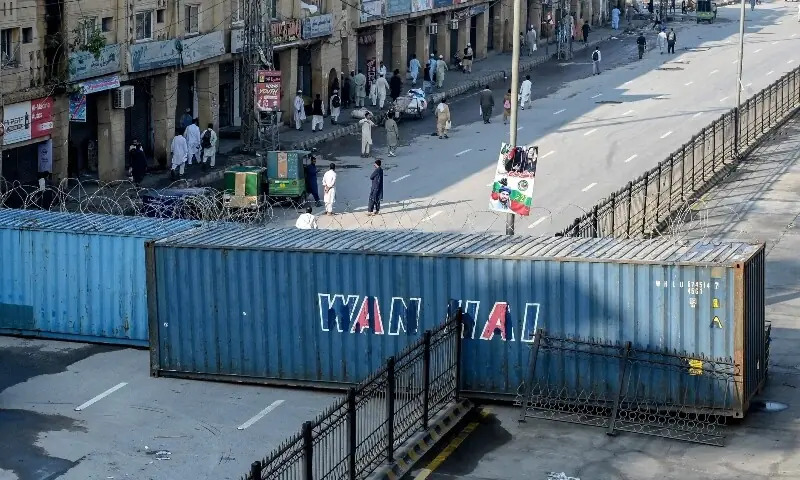
The declaration of emergency and the subsequent enforcement of governor's rule across Khyber Pakhtunkhwa (KP) has plunged the province into operational and commercial paralysis. On the inaugural day of direct federal oversight, major urban centers including Peshawar, Shangla, and Charsadda witnessed stringent security enforcement, punctuated by arterial road blockages, extensive traffic diversions, and broad educational institution closures. Sub-Divisional Police Officer (SDPO) Usman Munir confirmed that police operations resulted in the immediate detention of multiple Pakistan Tehreek-e-Insaf (PTI) activists across key municipal hubs to preempt organized civil resistance.
Provincial authorities invoked Section 144, prohibiting public gatherings and heavily restricting vehicular movements along critical conduits connecting peripheral industrial zones to urban trade centers. The operational transition under the federally appointed governor has triggered sharp friction between civil administration arms and local governance bodies, creating a regulatory and security vacuum that has effectively halted standard civic and administrative activity across the province.
Commercial & Economic Implications
For regional commerce, the sudden enforcement of emergency measures represents an acute disruption to domestic supply chains and transit operations. Khyber Pakhtunkhwa functions as the primary distribution gateway linking Punjab's manufacturing corridors with northern regional consumer markets and the international Torkham border crossing. The closure of major transportation routes has stranded freight carriers carrying perishable agricultural produce, consumer packaged goods, and construction inputs, raising immediate fears of localized supply shortages and inventory spoilage.
Wholesale distribution networks in Peshawar's prominent markets—including Karkhano and the Old City trading centers—reported an estimated 60 to 70 percent drop in daily transaction volumes on the first day alone. The commercial paralysis exerts compound upward pressure on retail prices. Supply bottlenecks typically translate into a direct surge in transportation freight premiums and warehousing overheads. If arterial access routes remain restricted, consumer price index (CPI) prints for basic foodstuffs across urban KP are expected to experience short-term volatility, disproportionately impacting working-class households already managing elevated national inflation rates.
Stakeholder Perspectives & Market Reactions
Trader associations, chambers of commerce, and transport syndicates have expressed grave apprehension regarding prolonged administrative friction. Business leaders in Peshawar emphasized that localized supply routes operate on slim credit and delivery margins, meaning an interruption lasting more than 72 hours triggers systemic liquidity shortfalls across retail tiers. The Sarhad Chamber of Commerce and Industry noted that uncertainties surrounding governance authority disrupt tax collection mechanisms, customs clearance processing, and routine municipal licensing.
Legal and policy analysts remain divided over the durability of the federal intervention. While federal representatives assert that emergency powers were mandatory to re-establish civic stability and deter public unrest, opposition legal counsels argue that the constitutional mechanism destabilizes federalism and paralyzes regional enterprise. Concurrently, logistics operators report elevated security risks, with fleet managers halting outbound shipments to KP until permanent corridors are formally designated and secured by law enforcement agencies.
Forward Outlook & Key Watchpoints
The immediate trajectory of Khyber Pakhtunkhwa depends on the federal administration's capacity to maintain basic civic order without suffocating retail commerce and trade logistics. Market participants will closely monitor whether the provincial administration establishes secure commercial transit corridors along the Grand Trunk Road and Indus Highway to sustain wholesale continuity. Key watchpoints include the duration of educational and commercial sector restrictions, the court challenges mounted against the emergency proclamation, and the response of cross-border trade operators managing Afghan transit cargo. Prolonged political confrontation will inevitably entrench commercial uncertainty, deterring private sector capital flows and severely depressing inter-provincial trade revenues over the current quarter.
Join Our Official WhatsApp Channel
Receive live commodity alerts, policy changes, and commercial intelligence directly on WhatsApp.